
Open this photo in gallery:
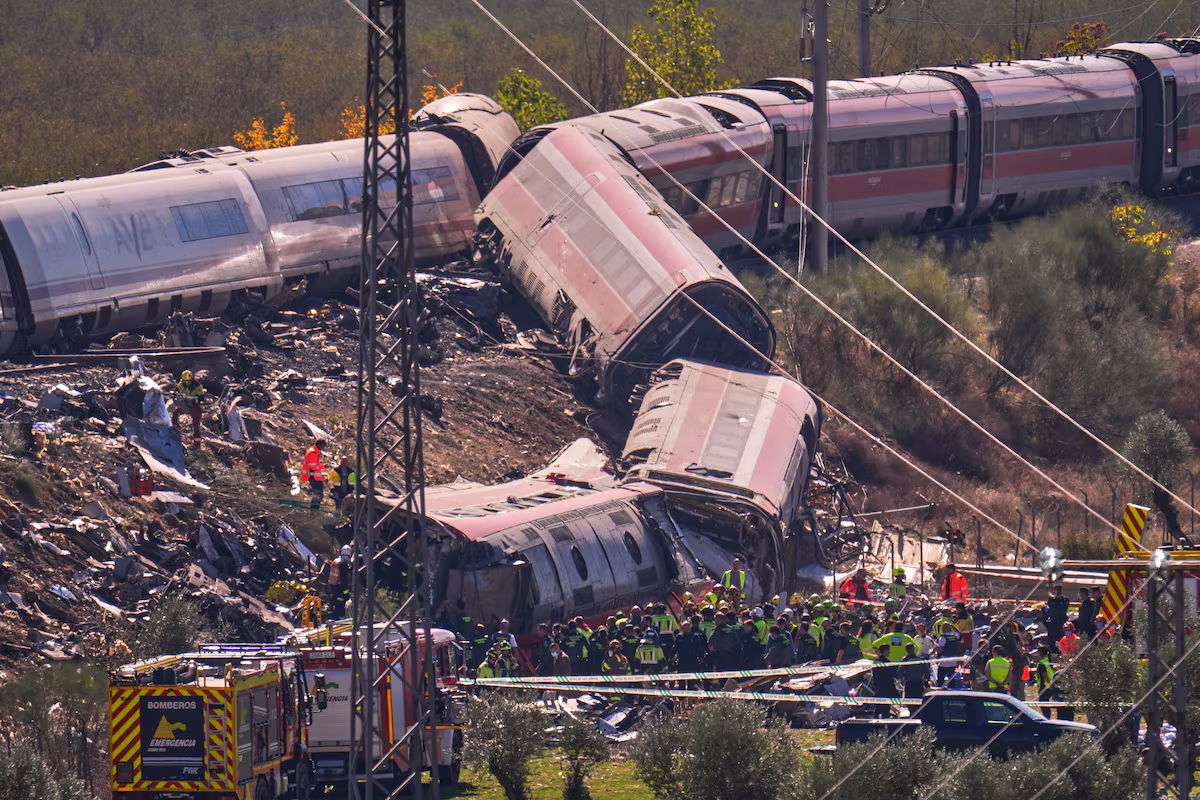
Emergency services work at the scene of a collision between two trains in Urda, Spain, on Wednesday.Manu Fernandez/The Associated Press
Six Canadians are among the injured and a seventh remained unaccounted for following a high-speed rail crash in central Spain Wednesday morning.
The deadly accident occurred just before 9 a.m. local time, when one train slammed into another that had stopped on the tracks. Spanish officials reported at least 68 people killed, and another 58 were receiving treatment at local hospitals.
Global Affairs Canada spokesperson Thida Ith said Wednesday the department had confirmation six Canadians injured in the crash, and one more was still unaccounted for by Wednesday evening. Ith said Canadian officials are providing consular assistance and are in contact with local authorities to gather more information.
“Our thoughts are with their families and loved ones as well as all of those affected,” said Ith.
At least 68 dead after two high-speed trains collide in Spain
Earlier in the day, Prime Minister Mark Carney expressed Canada’s solidarity with victims and family members and indicated Ottawa would help as needed. Transport Minister Steven MacKinnon said on social media he had reached out to his Spanish counterpart.
“I also thank the emergency responders and medical teams working around the clock to help those impacted by this tragedy,” McKinnon said.
Spain’s rail system operator ADIF said the crash occurred Wednesday morning in the province of Toledo. It involved two high-speed trains carrying hundreds of passengers and heading in the same direction from the capital Madrid to Seville in southwestern Spain.
A train operated by the state-owned RENFE company struck the rear of another train operated by private company IRYO that was stopped. The collision derailed two carriages on the tail of the IRYO train and the front of the RENFE train.
Authorities said 397 passengers were in the RENFE train and 147 passengers in the IRYO train.
Rail service was suspended between Madrid, Ciudad Real and Andalusia.
Spain’s Transport Minister Oscar Puente said the crash was caused by what he called an “inexplicable” order from a central command centre for Spain’s trains after a security system had failed. He said the train engineers were not to blame.
Puente said at 8:30 a.m., local time, the security system on a stretch of 63 kilometres stopped working due to a computer malfunction, causing all trains on that stretch to stop. But the central command told the RENFE train to start running again without any speed restrictions, and it ended up colliding with the stopped IRYO train at 8:53 a.m.
Puente said the train never should have been told to start moving again, since there was still a “stop signal” active on that line, and that it should at least have been told to go at a reduced speed.
Authorities were still trying to determine Wednesday how fast the train was going, but it could have been at 200 kph for that stretch of the track, Puente said.
The crash, which occurred in a flat stretch surrounded by olive fields in between the towns of Urda and Los Yebenes, left carriages shredded into bits of metal and other material, scattering debris down a gravel slope.
Until this year, there had been no fatal crash on Spain’s dedicated high-speed lines since the network opened in 1992. Now there have been two in just 10 months.
In January, 46 people died in southern Spain when an IRYO train jumped the track and hit an oncoming RENFE train.
“Today all of Spain is grieving,” Spanish Prime Minister Pedro Sánchez said from the crash site, where he announced that his government would declare three days of national mourning.
Sánchez called for increased safety measures to restore confidence in a high-speed rail system that was once a source of national pride.
“It is unacceptable for a country like Spain to suffer two high-speed rail accidents in the same year,” said Sánchez, who faces a national election on Nov. 29.
With files from The Associated Press