
Listen to this article
Estimated 5 minutes
The audio version of this article is generated by AI-based technology. Mispronunciations can occur. We are working with our partners to continually review and improve the results.
Indigenous leaders in Ontario are calling on the provincial and federal governments to address what they call an infrastructure crisis at remote airports across the north.
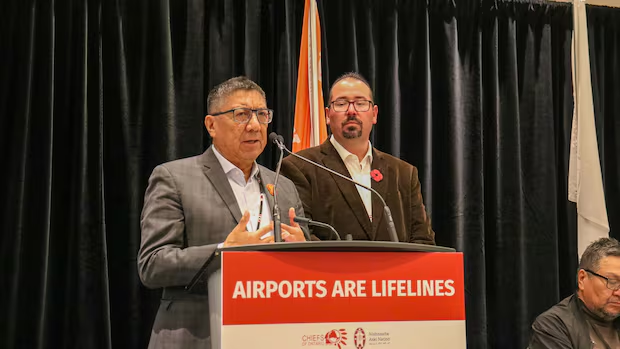
Nishnawbe Aski Nation (NAN) and Chiefs of Ontario (COO) held a joint news conference in Toronto on Wednesday afternoon after launching a documentary and advocacy campaign about the issue.
“We need better lighting, we need better navigational aids, we need our airstrips to be lengthened so that they can accommodate bigger aircraft,” said NAN Grand Chief Alvin Fiddler.
“We need to have our runways paved so that when a big plane arrives to evacuate a community, that they don’t tear up the runway, and we need staffing to operate these airports 24/7.”
Ontario’s Ministry of Transportation owns and operates the 29 northern airports, 27 of which are in remote First Nations.
According to a high-level needs assessment conducted by NAN last year, addressing infrastructure deficiencies across the airports would cost up to $1.5 billion.
NAN and COO want the two levels of government to:
- Commit to providing immediate and long-term infrastructure funding.
- Develop a phased infrastructure improvement plan.
- Conduct an immediate safety audit.
- Establish an ongoing multilateral table, including First Nations, First Nations organizations, provincial and federal governments, and regional air carriers.
- Invest in First Nations employment and local capacity related to aviation.

An aerial shot taken from a plane en route to Eabametoong First Nation, a remote Ojibway community in northwestern Ontario. (Sarah Law/CBC)
NAN and COO also are seeking amendments to the National Airports Policy to include an essential service airport standard “that adequately funds the investments required to improve safety and access for remote First Nations,” says NAN’s news release Wednesday.
“Our message again to Ontario: we cannot keep meeting with you, we cannot keep writing letters to you. You need to act. Same with Canada,” Fiddler said. “The legislation that you pass on transportation does not meet the conditions on the ground in our communities.”
CBC News reached out to Ontario’s Ministry of Transportation (MTO), Indigenous Services Canada and Transport Canada for comment on the calls for action.
Dakota Brasier, director of media relations with the MTO, says the province spends $27.2 million a year “for airport operations, maintenance and rehabilitation” at its remote airports.
“Ontario has also established a forum with Nishnawbe Aski Nation to share information and discuss transportation issues affecting NAN member First Nations, including MTO-owned remote airports,” Brasier said. “We look forward to continuing discussions on the transportation priorities and concerns raised through that forum.”
Spokespeople for the federal departments said they are working on responses to address First Nation leaders’ concerns.
Gravel runways need ‘constant repair’
Remote airports are critical for medevac flights, to provide transportation, and for people getting to medical appointments in urban centres, as well as emergency evacuations, and the delivery of food and other supplies, said Ontario Regional Chief Abram Benedict.
NAN and COO argue decades of chronic underfunding have left remote airports unable to meet basic safety and service standards, and that’s putting people’s lives at risk.

First Nation chiefs were at Wednesday’s news conference in Toronto to raise awareness about concerns over airport infrastructure in remote communities. (Nishnawbe Aski Nation)
Bruce Achneepineskum, chief of Marten Falls First Nation, described a recent incident in his community where a large plane hit the side of the First Nation’s Ministry of Transportation building.
His community is in the process of upgrading the gravel runway at its airport, but Achneepineskum said this isn’t sustainable.
“In our current situation, our airport is 3,500 feet when most of the airports across the land” are 5,000 feet and paved, he said, adding its gravel runway “needs constant repair every year.”

Wapekeka First Nation’s airport is seen in this September 2023 photo. (Sarah Law/CBC)
Flights may be delayed or cancelled in remote First Nations due to factors such as inclement weather, shortages of pilots or planes.
Russell Wesley, chief of Cat Lake First Nation, said his community members missed 88 appointments in a one-week period, several of which were to see specialists, due to cancelled flights.
For the Ornge air ambulance that provides emergency medevacs in these communities, another challenge is that aircraft aren’t always able to safely land on short, gravel runways.
Between January 2020 and September 2026, Ornge received 33,000 emergency calls from Ontario’s remote airports, an average of about 13 calls a day.
However, aircraft were not able to safely land in more than 2,300 of these cases, delaying urgent medical care, said Fiddler.
“It impacts people’s lives, their health,” he said.
As advocacy efforts continue, leaders such as Fort Albany First Nation Chief Robert Nakogee say it’s critical for First Nations to take the lead.
“Infrastructure must be made with First Nations, not for First Nations, so that’s something we need to be involved in immediately,” Nakogee said.
“That’s the only way it’s gonna work.”