
Listen to this article
Estimated 3 minutes
The audio version of this article is generated by AI-based technology. Mispronunciations can occur. We are working with our partners to continually review and improve the results.
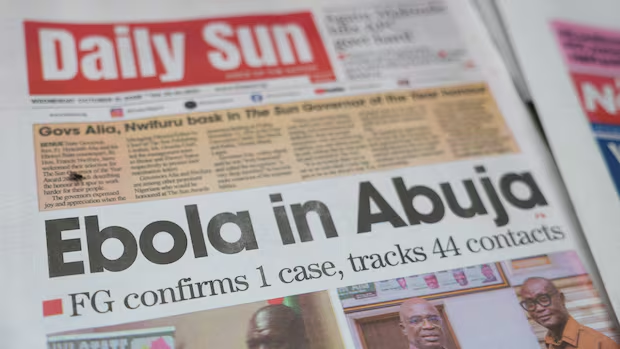
Nigeria reported its first Ebola case in more than a decade on Tuesday, becoming the fourth African country and the most populous yet to be affected by an outbreak that health officials have described as the fastest-spreading on record.
The Ebola species behind the outbreak kills about half of those infected and has no approved treatment or vaccine. Since the first cases were confirmed in Democratic Republic of Congo in May, the disease has killed 4,646 people. Health officials fear misinformation and funding shortfalls could fuel further spread within the region and across borders.
“Ebola is now affecting three regions of Africa. The situation demands urgent action and political leadership at the highest level,” Africa Centres for Disease Control and Prevention Director General Jean Kaseya said on X on Wednesday.
The Nigeria case concerns a Ugandan woman who who arrived in Nigeria’s capital Abuja via Addis Ababa on October 5, Odianosen Ehiakhamen of the Nigeria Centre for Disease Control told Arise TV on Tuesday.
“She is in isolation, and she is receiving quality medical care. Contact tracing has been conducted, and it’s under way as we speak, with 44 contacts already identified,” Health Minister Muhammad Ali Pate told public broadcaster NTA.
Among the contacts are the patient’s husband, a Swiss national living with her in Abuja.

A file photo shows an aerial view of the Nigerian capital of Abuja. Nigeria’s government said on Tuesday there was a case of Ebola in the capital after laboratory tests confirmed the viral infection. (Olympia de Maismont/AFP/Getty Images)
Nigeria confident it contain spread
Pate said in a statement that the patient had been admitted to a private hospital in Abuja, where she had received care for several days before the diagnosis was confirmed.
“Nigeria successfully contained Ebola in 2014, and we have the experience and public health systems to respond to this case,” the minister said in the statement.

Children bear brunt of DRC’s Ebola outbreak
Death rates for children much higher than for adults, WHO estimates, while others orphaned.
Uganda’s Health Ministry said the woman had travelled to Congo, where more than 9,500 Ebola cases have been recorded across eight provinces.
It was not immediately clear where she had been in Congo.
“Travel through Uganda does not establish that infection occurred here,” Uganda’s health ministry said, adding that the country has no active Ebola cases.
Uganda reported 20 cases in May and June, mostly imported from Congo, but was declared free of the virus by the World Health Organization in August.
An Ebola outbreak was declared in Democratic Republic of Congo in mid-May and has since grown into the world’s second-largest outbreak ever, caused by the rare Bundibugyo strain.
Africa’s top public health agency has started mobilizing support for Nigeria, said its head, Jean Kaseya.
“This Bundibugyo Ebola outbreak has already become the most geographically extensive in history, affecting … countries spread across three regions of Africa,” Kaseya said in a post on X.
Kenya, meanwhile, has reported nine Ebola cases this month, all linked to a person who had travelled from Congo.