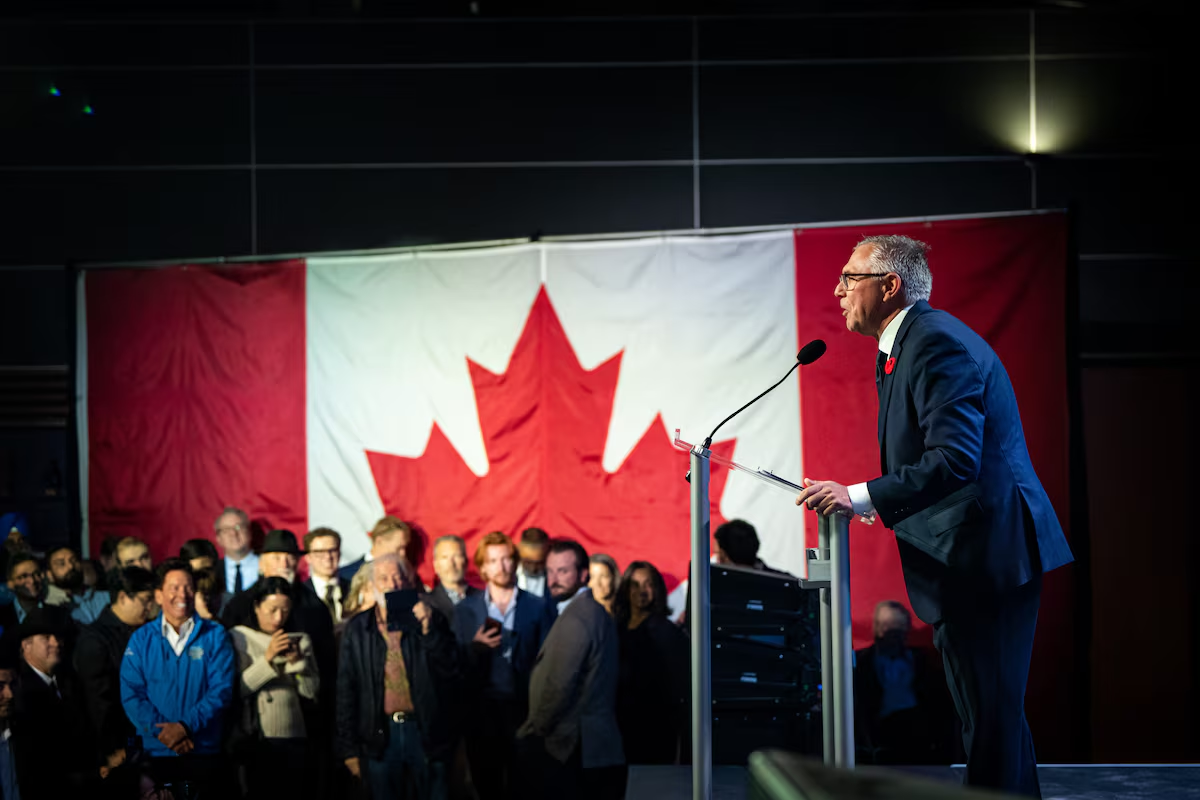

Open this photo in gallery:
B.C. Conservative interim Leader Lorne Doerkson on election night. The party is projected to form a majority government for the first time in nearly a century.ETHAN CAIRNS/The Canadian Press
British Columbia voters elected a Conservative majority government on Saturday, after a snap election called by the NDP backfired.
Here are five takeaways from the provincial election.
David Eby steps down as leader
Open this photo in gallery:
B.C. NDP Leader David Eby resigned on election night.DARRYL DYCK/The Canadian Press
David Eby resigned as leader of the NDP after his party was badly defeated in an election that didn’t have to happen. Mr. Eby acknowledged he bore responsibility for the outcome of the election, which he called two years earlier than required. He lamented that many of his colleagues lost their seats, including seven cabinet ministers.
The standings with 95 per cent of polls reporting stood at 64 Conservatives seats, 27 for the NDP and 2 Greens. The results reduced the NDP by 20 seats. “A number of my colleagues, some of the hardest-working MLAs I know for their communities were not elected tonight. It breaks my heart, and I accept full responsibility for that outcome,” a crestfallen Mr. Eby said in his concession speech.
The Conservatives pull themselves together after months of chaos
Open this photo in gallery:
Mr. Doerkson celebrates on stage in Vancouver.ETHAN CAIRNS/The Canadian Press
Lorne Doerkson managed to pull together a party win mere weeks after he was abruptly named interim Conservative leader, after Kerry-Lynne Findlay quit after just over three months of turmoil.
The BC Conservatives went into the race as an underdog. Even during the campaign, there was turbulence linked to comments from some candidates.
Lorne Doerkson didn’t plan on leading the BC Conservatives, but he’s trying to meet the moment
Much of the NDP campaign focused on attacking what Mr. Eby framed as the most controversial and “dangerous” candidates. But for some, those attacks didn’t seem to find their mark. Mr. Doerkson refused to drop Heather Maahs as a candidate, even after her anti-LGBTQ comments from a 2022 podcast resurfaced. Ms. Maahs won her seat Saturday night.
Mr. Eby’s forests minister Ravi Parmar called out David Williams, the incumbent MLA for Salmon Arm-Shuswap, over for a Facebook post that showed much of B.C., the Yukon, Alberta and Saskatchewan as “The Republic of Western Canada,” and a “protectorate” of the U.S.
Mr. Williams was re-elected Saturday night.
Limits of the Trump effect
At the outset of the campaign, Mr. Eby tried to frame the election in existential terms, saying he needed a strong mandate from B.C. voters in order to protect the province from U.S. President Donald Trump and the ongoing trade war.
Ontario Premier Doug Ford used a similar justification when he called a snap election in 2025, saying he needed a mandate to respond to Trump’s economic threats.
Mr. Ford led his Progressive Conservatives to a third, straight majority, but Mr. Eby arrived at election day with the B.C. Conservatives running ahead in public-opinion polling, and ultimately lost.
Voter turnout was low
Fewer than half of eligible B.C. voters turned up at the polls. Saturday’s voter turnout of 46 per cent is the lowest since 1996, and eight per cent lower than the 54-per-cent turnout from 2020, an election that was held while the province – and the world – was still in the grip of the COVID-19 pandemic.
The last time B.C. voters went to the polls, when Mr. Eby secured a slim majority, turnout was 58.4 per cent. When former premier John Horgan lead the NDP to victory in 2017, turnout was 61 per cent.
Relationship with First Nations may change
Throughout the campaign, Mr. Doerkson made repealing the Declaration on the Rights of Indigenous People Act a central plank of his platform, a promise roundly criticized Indigenous leaders. The BC Assembly of First Nations was strongly opposed to the move, as was a powerful chief in Mr. Doerkson’s own riding.
While Mr. Doerkson didn’t mention DRIPA by name in his victory speech, he did offer several references to Indigenous people and their communities, saying the groups need to work together with the province to “supercharge” B.C.’s economy by cutting red tape.
“This future is one we will build together as partners with the certainty all of us need.”
He also invoked a frequent fear in some Conservative circles, that expanding reconciliation efforts might put private property rights in question.
“I also believe in the protection of private property rights,” Mr. Doerkson said, earning a loud cheer from his supporters, “and parks that are open to all British Columbians.”
The Greens increased share of popular vote
Open this photo in gallery:
B.C. Green Party Leader Emily Lowan won her seat in Saanich North and the Islands.Chad Hipolito/The Canadian Press
The BC Greens increased their share of the popular vote, which may have hurt the NDP, particularly in close ridings.
In 2024, the Greens took 8.2 per cent of the popular vote. On Saturday night the party, led by 26-year-old Emily Lowan, took 11 per cent.
“We did it,” Ms. Lowan said, in an election-night speech that framed what she sees as a coming fight against the new government’s likely agenda.
“I am scared for what’s to come. The Conservative agenda is one of cuts to the programs that we rely on the most,” Ms. Lowan said. “It’s one of culture wars and needless attacks on human rights.”
At 26 years old, Ms. Lowan is among the youngest leader of a political party with an elected member in Canadian history. Despite her youth, she traded jabs with the more seasoned leaders of the NDP and Conservatives, men more than 20 years her senior. She won her seat of Saanich North and the Islands handily, with almost 50 per cent of the vote. Jeremy Valeriote also won his seat of West Vancouver-Sea to Sky for the Greens.
While the Greens only managed to keep their two existing seats, their share of the vote in some key ridings appeared to allow a Conservative candidate to take the win.
For example, the Saanich-South riding went to the Conservative’s Cathie Ounsted with 10,413, or 39 per cent. Former journalist Richard Zussman, for the NDP, was close behind with 9,244, or 34.7 per cent. The Green’s Lisa Lapointe took 6,916 for 26 per cent – well shy of the winner’s circle, but a large enough share to have split the vote on the left.