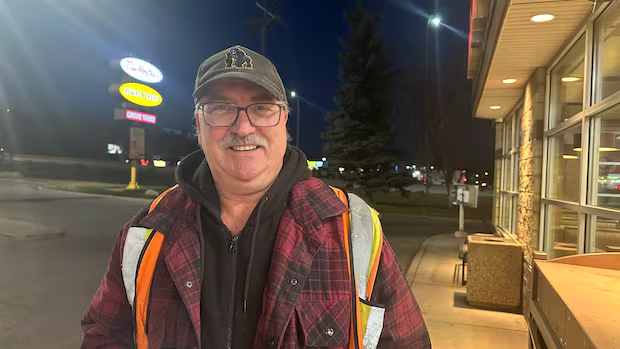
Voters across Alberta woke up to referendum results Tuesday morning, and at one coffee shop near Calgary’s industrial southeast few people seemed surprised at the results.
Leovan Inoferio stopped by in his construction helmet and safety vest. He said he wasn’t surprised at all, and the former Filipino immigrant said it lines up with how he voted.
“I came here because of Canada, not as an Albertan. I love Alberta, but we should stay in Canada as one.”
Rimbir Singh hadn’t heard the results yet, but was satisfied when told that about 75 per cent had voted to stay in Canada.
“I believe it’s good for Canada. When we’re united, it’s better for everything.”
“Truthfully, the results were what I expected,” added Ralph Patterson, stopping for coffee on his way to work.
Throughout the campaign, supporters of Alberta independence argued that the province has been poorly treated by Ottawa, and that structural issues with the distribution of power are hurting its economy. Other supporters spoke in favour of change out of frustration with the current economy, or with restrictions on personal freedoms, and often argued a vote to start the process of leaving would simply give Alberta more bargaining power.
But those in favour of Alberta remaining in Canada spoke about the strength that comes from unity and argued there are other ways to address longstanding issues.
Three quarters of Albertans vote to remain
The results Tuesday morning were similar to polls released during the campaign. With the majority of polls reporting, about 75 per cent voted in favour of remaining in Canada, and 25 per cent voted for having a binding referendum on leaving.

Supporters cheer as results begin to display at the pro-Canada watch party in Edmonton, Monday, Oct. 19, 2026. (James Maclennan/The Canadian Press)
Patterson said he has reasons to be upset with Canada. He now drives a delivery truck for a flooring company, after seeing a career in the oil industry end during the recent downturn, something he blames on the past prime minister.
But he voted to stay. He said the arguments for independence were not convincing.
“Number one, I don’t want four international borders around me. I like being able to get into my vehicle and going to visit my sister and brother and not have to show my Alberta passport,” he said.
“I looked into it. Canada has no obligation to give us, let us use Canadian money. If we separate, are we going to build a mint here in Alberta along with the refinery? And they keep saying, oh, we’d have plenty of money for our pension. I don’t know how well all that was calculated.”
But he doesn’t think the issue of separation is going away. There will be another vote, he predicts.
“I’m pretty sure it’s going to happen again now, just like Quebec. These guys will let it ride for a year or two, then they’ll stir the pot.”
A few voters say they are surprised by the results
CBC News set up outside the Tim Hortons off Blackfoot Trail near 46th Avenue S.E., just as the morning rush was starting.
Richard Racine, who popped into the coffee shop wearing work coveralls, said he was disappointed and wanted to look into the numbers more closely. The numbers for separation seemed low when he checked online, he said, after so many people signed the petition asking for the vote.

People gather early Monday evening at the watch party for the Alberta Prosperity Project on Alberta referendum night. Leader Mitch Sylvestre can be seen second to the right. (Julia Wong/CBC)
Cody Ratcliffe, a delivery driver in the service industry, was also a little surprised. But he thought the remain side would have been even higher. Even 24 per cent of people saying they would like to leave Canada “feels weird,” he said.
“It feels like a psy-op, is what it feels like. It feels like a method to stir people up,” he said, using a military term for an operation that uses psychological techniques to weaken an enemy.
“Maybe there is a small portion of people, but I think most people are genuinely happy to be Canadian. And yes, they might have frustrations about the state of the country, but not to the point where they’re like, I don’t need to be Canadian anymore. That’s absurd.”
Jennifer Drews said she wasn’t surprised by the results, but is concerned by how much support the immigration questions got. All five looked likely to get majority support as of Tuesday morning.

Anthony Bright, left, and William Larsen stopped by the Tim Hortons for coffee Tuesday morning. They said they were not surprised by the results, and expect support for a renewed push for independence when those in power want to distract the population from other issues in the province. (Elise Stolte/CBC)
“I’m a little bit concerned that it allows the government too much leeway in what kind of policies that they implement,” she said. “I think that there are some practical change elements that could be in place, but I worry that it created a little bit more divisiveness and scapegoating around immigration.”
Most say the independence debate is not over
Jason Carter said he was not surprised when he caught the results on the radio. And now he’s hoping Alberta can move on.
“I think that it’s good to support the people that disagree and try to understand their reasoning behind it. I think we have a democracy so that people can speak out,” he said. “But hopefully in the end, everybody realizes and supports that same thing. Whether they’re on the technically losing side or winning side, it’s still a democracy and we should support each other.”
At the Tim Hortons at least, few people thought the push for independence in Alberta was over. There are too many people committed to this idea, said some, and it can be convenient for those in power who might want to distract voters from other issues, said others.
“I think it will come up any time that someone’s got to hide something they’ve done or don’t want people to talk about,” said Anthony Bright, coming for coffee with a friend.
“I think it’s something [the current government] threw up to make people distracted.”