
Listen to this article
Estimated 4 minutes
The audio version of this article is generated by AI-based technology. Mispronunciations can occur. We are working with our partners to continually review and improve the results.
Roughly two months after a first-degree murder trial in Windsor, Ont., ended, one juror took the “highly unusual” step of sending the convicted man a letter requesting to meet.
In June, a Superior Court of Justice jury found Glen Mayer guilty of first-degree murder, which comes with an automatic life sentence and no chance of parole for 25 years.
On Monday, family members of Tony Bechara — who was shot dead in his own home on Jan. 20, 2024, after Mayer learned Bechara was having an affair with his wife — were waiting to read their victim impact statements in court prior to sentencing.
Instead, the defence put forward a motion requesting what’s known as a judicial inquiry based on the letter.
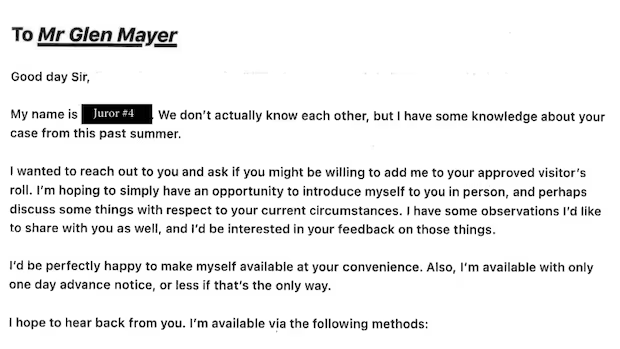
The typed letter, obtained by CBC News, was addressed to Mayer and requests a meeting to “perhaps discuss some things with respect to your current circumstances.”
“I have some observations I’d like to share with you as well, and I’d be interested in your feedback on those things,” it reads.
The individual, whose name and contact information is redacted from the court document, didn’t include identification as a juror in the letter.
Defence wonders if verdict was ‘tainted’
The trial heard that in the overnight hours of Jan. 20, 2024, Mayer found out about the affair between his wife and Bechara, left his LaSalle home with his registered handgun and drove to Belle River to confront Bechara.
Mayer testified that he and Bechara were yelling, and Bechara grabbed a knife and came toward him. That’s when Mayer pulled out his gun and shot Bechara multiple times.
Hours later, Mayer turned himself in to the LaSalle police station with his dad.

Defence lawyer Julianna Greenspan says she plans to file for an appeal of the guilty verdict on behalf of Mayer. (Jason Viau/CBC)
Mayer’s defence lawyer, Julianna Greenspan, said the letter creates a “highly unusual, very concerning dynamic.”
Since both Mayer and the juror connected to the letter heard the same evidence at trial, Greenspan said, the letter raises “a concern that he’s referencing information” beyond what occurred in the courtroom.
“It does suggest on its face that there is extraneous information that this juror is wanting and hoping to share privately with Mr. Mayer,” said Greenspan.
If outside information was used by this juror, or the jury, during the trial, Greenspan argued, it could have “tainted the verdict.”
Jurors can’t discuss info not shared in open court
The Criminal Code of Canada also states a juror can be found “guilty of an offence punishable on summary conviction” if the individual discloses information relating to the proceeding that wasn’t shared in open court.
“Jurors are, in the course of deliberations, to be in a private space, and that cannot be pierced,” said Greenspan.
After hearing the lawyers’ arguments for nearly two hours, Justice J. Ross Macfarlane took a 20-minute break and returned to dismiss the motion to conduct a judicial review.
He said the information presented by the defence “does not provide a credible basis that this jury may have been exposed to extraneous evidence.”

This image from surveillance video shows Mayer turning himself in to the LaSalle Police Service on Jan. 20, 2024. He was convicted of the first-degree murder of Tony Bechara. (Superior Court of Justice)
Macfarlane also asked Greenspan why she waited so long to bring the letter to the attention of the court if she had been so concerned.
The trial ended June 26 and the letter was stamped as received by the South West Detention Centre on Aug. 26.
Lawyer consulted others about unusual letter
Greenspan explained in court that given the unusual nature of this letter, she consulted with a number of individuals on the appropriate next steps.
She also indicated she reached out to the individual to confirm he in fact was a juror and attempt to suss out his intentions.
The juror responded via email to say that they have “no information or details on the aforementioned case Mr. Mayer was involved with whatsoever, other than the information I was entrusted with during my involvement as a member of that particular jury.”
The juror also said they still want a private meeting with Mayer and he’s not “requesting an audience” with lawyers present.
Greenspan said the second correspondence is more guarded and calculated compared to the first letter, and is written in a “litigator” sort of tone.
“It heightens the need for inquiry,” she said.
Within the next 30 days, Greenspan said, she intends to file for an appeal of Mayer’s guilty verdict.