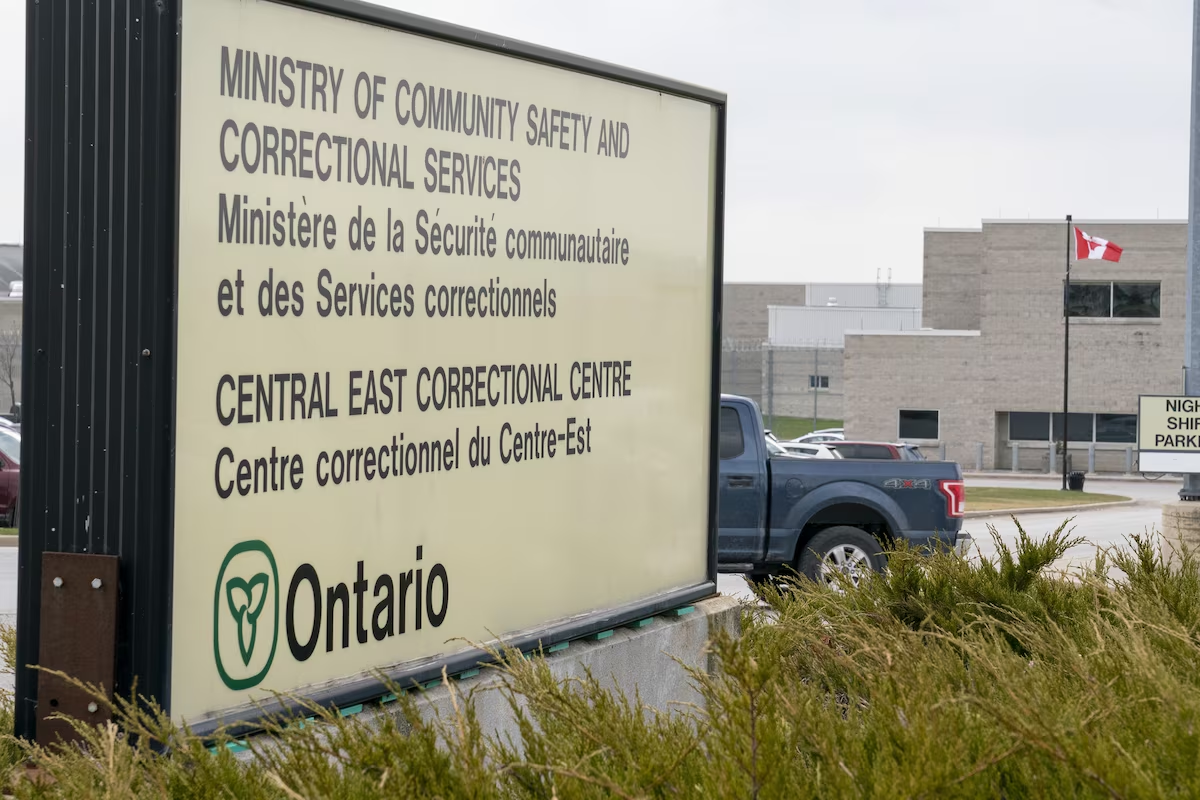

Open this photo in gallery:
The Central East Correctional Centre in Lindsay, Ont., in April, 2020.Frank Gunn/The Canadian Press
Advocates for prisoners are urging the Ontario government to preserve mandatory coroner’s inquests into inmate deaths, saying the hearings foster transparency at a time of increasing jail fatalities.
The government is proposing to scrap the requirement for an inquest into the case of any inmate who dies from non-natural causes. Instead, the coroner’s office would conduct an annual review of deaths in correctional facilities.
But such a change would limit institutional accountability while denying families answers, said Alexander McClelland, a criminology professor at Carleton University who tracks in-custody fatalities across Canada.
“The result will be that there will be a series of deaths that happen across the province that end up being a footnote in a report where there’s no way to engage or understand how or what the circumstances of the deaths were,” he said.
No more inmates will be improperly released from Ontario jails, Ford says
Coroner’s inquests are hearings that make findings of fact but do not lay blame. The goal is to help prevent future deaths through non-binding recommendations. In Ontario, the Office of the Chief Coroner, which is part of the Ministry of the Solicitor-General, must hold inquests in certain circumstances, including unexpected jail deaths, fatalities in police custody and deaths of physically restrained psychiatric patients.
The provincial government says annual reviews of correctional fatalities would better identify broader systemic issues and provide more timely recommendations, while avoiding retraumatizing families.
The government proposed the rule change online last December and asked stakeholder groups to provide written feedback within a month. However, after facing criticism for not consulting people whose loved ones had died in jail, the coroner’s office said additional meetings were being planned this summer with families and Indigenous representatives.
The coroner’s office has a backlog of cases; inquests typically happen five to seven years after a death occurs. In 2024, the office held 47 inquests, 45 of which were mandatory. Coroners also have the option to call inquests at their discretion, including relating to public-safety issues.
The total number of inmates who have died in provincial custody has been increasing over the past 15 years, rising to 41 in 2025 from 16 in 2010, according to the coroner’s office. The numbers include natural deaths, drug overdoses and suicides. Most people in provincial custody are awaiting trial.
Ontario plans massive expansion of jails over next few decades, documents show
Eliminating the requirement for inquests is wrong given the unique environment and high death rate in jails, said Howard Sapers, a former federal correctional investigator who is now executive director of the Canadian Civil Liberties Association.
“We’re not talking about a small matter here,” he said. “We are talking about somebody’s death when they are in a total institution that the government is operating, which means that their very life depends on the government doing its job properly.”
Critics argue the government’s proposal is part of a broader attempt to erode scrutiny of correctional institutions that could lead to more deaths.
“It’s just going to limit further transparency in an already kind of crisis situation in the province,” said Prof. McClelland, who leads the Tracking (In) Justice project, which includes researchers from several universities and interest groups. He said the government should instead increase funding to clear the inquest backlog and implement existing recommendations.
In 2023, a coroner’s expert panel on Ontario jail deaths released a report saying capacity limitations, including overcrowding and frequent lockdowns due to staff shortages, were causing unsafe conditions and must be addressed to prevent further fatalities. The report also urged the government to increase oversight, improve inmate health care and provide more staff training.
Premier Doug Ford’s government is planning to spend $3-billion to build new jails and expand existing facilities over the next decade, said Saddam Khussain, spokesman for Solicitor-General Michael Kerzner. He said the province is also hiring hundreds of new correctional workers.
Federal prison service ‘ill-equipped’ to deliver long-term mental health care, watchdog says
Yusuf Faqiri, whose brother Soleiman was killed at the Central East Correctional Centre in Lindsay, Ont., in 2016, fears that eliminating mandatory inquests could shield wrongdoing, especially in cases where inmates die at the hands of guards.
“The public has a right to know what’s going on,” he said. “Our jails are a mess and when somebody dies in these systems, especially with mental-health … challenges, this is the only mechanism that exists, and to take this mechanism away is going to have a consequential impact for years to come.”
A coroner’s jury ruled in 2023 that Soleiman’s death was a homicide. The 30-year-old was in a severe psychotic crisis when guards beat, pepper-sprayed and shackled him by his wrists and ankles in a segregation cell. A spit hood was placed over his head, and he was left lying stomach-down on the floor. He stopped breathing and was declared dead minutes later.
No jail staff were charged despite Soleiman sustaining at least 50 injuries. Though the jury concluded his death was a homicide, it was not a criminal finding and carried no legal liability.
Still, Mr. Faqiri, whose family spent years attempting to get justice, said the inquest was “monumental” because it revealed how his brother died. “Our path to justice was getting to the truth. That’s the difference that the inquest made. … If we didn’t have an inquest, the public would not know what happened to Soleiman Faqiri.”
The Ontario government is proposing amending the Coroners Act to require annual reviews for non-natural correctional deaths to improve the system, said Mr. Khussain, spokesman for the Solicitor-General. He said the coroner’s office could still hold discretionary inquests when warranted.
“This approach supports a more timely, system-wide review of in-custody deaths,” he said in an e-mail. Annual reviews would “help ensure recommendations are delivered more efficiently.”
The province received 42 submissions after posting the proposal online, many of which supported “the continuation of inquests into in-custody deaths” while recognizing “the benefits of alternative approaches,” said Julia Noonan, manager of program delivery and strategy at the coroner’s office.
In 2024, the province adopted annual reviews for accidental construction deaths, which previously triggered mandatory coroner’s inquests.