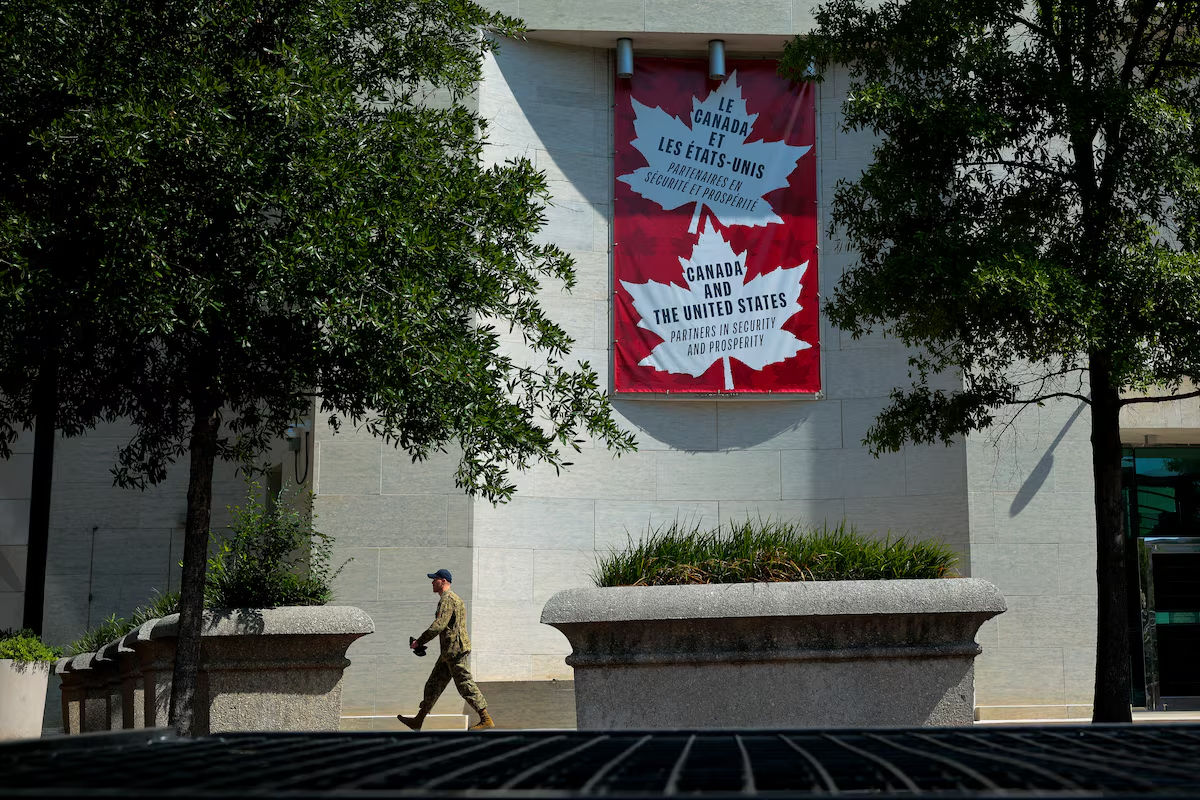

Good morning. The divide between Canada and the United States got a bit wider over the weekend. More on that below, along with three by-elections happening today and exclusive documents on the high-speed rail line.
Open this photo in gallery:
A visitor photographs the newly unveiled sign that says ‘Lake Ontario now and always’ at Fifty Point Conservation Area in Grimsby, Ont., on Saturday.Keito Newman/The Canadian Press
TOP STORIES
The map highlights a new divide
Users in Canada will still see it displayed as Lake Ontario, but Google Maps has officially updated to display “Lake America” for users located in the U.S. Here’s what else you need to know:
Off the map: The same day U.S. President Donald Trump signed an executive order renaming Lake Ontario to Lake America, MapQuest posted a simple, blunt message: “We’re not changing it.” And with that, the mapping company you didn’t even know was still in business became a mascot of the resistance.
On the ground: Just over half of Canadians said they are following the tariff threats “closely,” according to surveys conducted by Angus Reid in July and August. Meanwhile, only 45 per cent of Americans said they have heard of Mark Carney, according to data analytics firm YouGov. Irene Galea took a walk on the Washington mall to see what Americans think of the trade war.
In the sky: With Canadians quietly lending a hand, a U.S. spy satellite-turned-telescope takes flight. Astronomers around the world are gearing up for the trove of data that will deliver discoveries across a range of subfields.
Keep reading
- Shannon Proudfoot: Stupidity is an infinitely renewable resource with this U.S. administration
- John Rapley: Can Canada afford the price of being ‘masters of our own destiny’?
- Eric Reguly: Defying Trump came with no loud cheers from world leaders. They will reward Carney in other ways
Open this photo in gallery:
A handout rendering depicts the proposed first high-speed rail line between Quebec City and Toronto, which will start with a shorter segment linking Montreal and Ottawa.Supplied
Documents show costs soar in high-speed rail project
An internal document obtained by The Globe shows the full cost of a high-speed rail line from Toronto to Quebec City is estimated at about $150-billion once four decades of operating and maintenance expenses are included. Alto – the Crown corporation responsible for the massive infrastructure project – regularly says the line will cost between $60-billion and $90-billion.
The context: As the prospect of Canada building a high-speed rail service has come closer to reality, the project has faced growing opposition to its cost and potential route, including from Pierre Poilievre. The Conservative Leader has pledged to cancel it if he becomes prime minister; meanwhile, local and provincial lawmakers in Eastern Ontario are concerned about the effects of the rail line on their rural communities.
Open this photo in gallery:
Bridget Healy was attacked by a student while teaching a Grade 4 class at a school in Innisfil, Ont., in 2023.Darren Calabrese/The Globe and Mail
A surge in student violence at Canadian schools
Data from across the country gathered by The Globe show that acts of violence against elementary and high school teachers are on the rise. Many teachers are at a breaking point, and they are urging education ministries and school boards to solve the problem – but not everyone can agree on how.
Behind the data: The causes are complicated. Overcrowded and increasingly complex classrooms, a lack of funding for support staff such as EAs and social workers, and inadequate screening for behavioural concerns are all factors at play.
The language: Some people in education are uncomfortable with using the word violence to describe what is happening, as it frames students as perpetrators and, therefore, the ones to blame. Many have reported that students with special needs, mental-health issues and other struggles do not have the supports they need.
Open this photo in gallery:
Federal Reserve chairman Kevin Warsh, centre, talks to Bank of Canada Governor Tiff Macklem, left, and Bank of England Governor Andrew Bailey, right, at the annual Jackson Hole Economic Policy Symposium on Friday in Moran, Wyo.Amber Baesler/The Associated Press
What to expect from the central banks
The Bank of Canada is expected to bide its time this week as it wrestles with an escalating trade war that risks pushing up consumer prices while hammering economic growth. The odds of an interest-rate hike or cut were already low, but recent trade news makes it even more likely the bank will keep its benchmark interest rate steady at 2.25 per cent on Wednesday.
Catch up: Federal Reserve chair Kevin Warsh said Friday that inflation is still too high and suggested the U.S. central bank may have to raise interest rates in the coming months to bring it down. The next Federal Reserve interest-rate decision is Sept. 15-16.
Open this photo in gallery:
By-elections will be held Monday in the B.C. riding of North Vancouver–Capilano, the Toronto seat of Beaches–East York and the Quebec riding of Chicoutimi–Le Fjord.Jeff McIntosh/The Canadian Press
Voters set to go to the polls in three by-elections across Canada
Amid escalating trade tensions, voters are going to the polls today in three federal by-elections that could indicate the Canadian mood. The by-elections are being held in the Quebec riding of Chicoutimi-Le Fjord, Beaches-East York in Toronto and North Vancouver-Capilano.
The details: All three ridings opened up as MPs – two Liberals and a Conservative – stepped down for other opportunities in politics and the public service. Ahead of Monday’s by-elections, the Liberals have a slim majority in the House of Commons.
The Take
If the recent past is any guide, English Canadians outside Quebec will be following the Alberta referendum campaign much more closely than the Quebec election campaign – even if the country’s future could be shaped far more by what happens east of the Ottawa River in October.
— Konrad Yakabuski, Montreal-based columnist
The main threat to Canadian unity is not in Alberta, Konrad Yakabuski writes.
The Shot
Open this photo in gallery:
A Friends of Temagami trail maintenance crew clears portages and installs thunderboxes on Temagami area lakes on July 17.Fred Lum/The Globe and Mail
Canoe trippers of all ages work together to clear traditional Indigenous travel routes and keep “wild places wild” in northeastern Ontario.
The Wrap
What else we’re following
At home: Advocates are urging the Ontario government to preserve mandatory coroner’s inquests into inmate deaths, in order to help identify broader systemic issues and prevent future deaths.
Abroad: U.S. forces struck two Iranian launchers on Iran’s Larak island on Sunday, a U.S. official said, marking the first known American strikes on Iran since late July.
At home and abroad: One Canadian has been found safe after catastrophic Nepal-Tibet floods, but many communities remain stuck in devastation as authorities warn of possible new flooding.
Oil: Donald Trump said oil from a recently struck deal with Venezuela will be used to replenish the Strategic Petroleum Reserve. Here’s what that means for Canadian crude exports.
Out: Icelanders voted to stay out of the European Union, rejecting a government push to reopen membership talks, referendum results showed yesterday.
Up: According to a new report, a data centre under construction north of Edmonton could raise power bills by between $270 and $460 annually for Albertan households.
In: This fall, Zorga Qaunaq is North of North, central to TIFF and everywhere in between.