
A mysterious disease is destroying stars and threatening critical ecosystems. Scientists are stumped, but they toil away in laboratories and distant, inhospitable environments, searching for an answer.
It’s not the plot of an interstellar sci-fi movie: It’s the groundbreaking science being done by a co-operative of marine biologists trying to save western North America’s sea stars.
In 2025, Canadian researchers identified the culprit: star-killing bacteria called vibrio pectenicida. But the discovery only prompted more questions: Where did they come from? Why had the outbreak exploded so suddenly? Can anything be done to stop it?
The outbreak of what came to be known as sea star wasting disease began spreading up and down the Pacific coast, from Mexico to Alaska, in 2013. It devastated sea star populations, including wiping out almost 90 per cent of sunflower stars, the largest sea stars in the world.
“We lost over six billion of them,” said Alyssa Gehman, an adjunct professor at the University of British Columbia and a marine disease ecologist at the B.C.-based Hakai Institute.
Open this photo in gallery:
This sunflower sea star was liquefied to death in 2015 off B.C.’s Calvert Island. Identifying the disease that caused this would take another decade; in the meantime, billions of animals died.Courtesy of Grant Callegari/Hakai Institute
Open this photo in gallery:
Healthy sunflower sea stars come in a mix of colours, with up to 24 arms for each adult.Joe Gaydos, SeaDoc Society via The Canadian Press
It was Dr. Gehman’s team that made the breakthrough in August, 2025, identifying vibrio pectenicida as the cause of the outbreak.
The bacteria essentially attack sea stars from the inside out, slowly liquefying their guts until they collapse into piles of goo. While they are capable of sickening and killing all types of stars, the giant sunflower sea stars, which have dozens of limbs and can grow to the size of a bicycle wheel, were hardest hit.
It’s a slow, hideous death that has critical effects on both sea star populations and the ecosystems where they live.
Sea stars are important predators in their communities that help to keep their prey populations in check – so important, in fact, that purple sea stars were the first to be called a “keystone” species. The term is now used for the fragile predator-prey relationships that govern the lives of everything from Rocky Mountain wolves and elk, to sharks and seals, to lions and wildebeest.
In the Pacific Ocean, sea stars eat sea urchins (among many other things). Without enough sea stars, urchins proliferate and devour kelp and seagrass forests that are critical habitats for innumerable other species.
Open this photo in gallery:
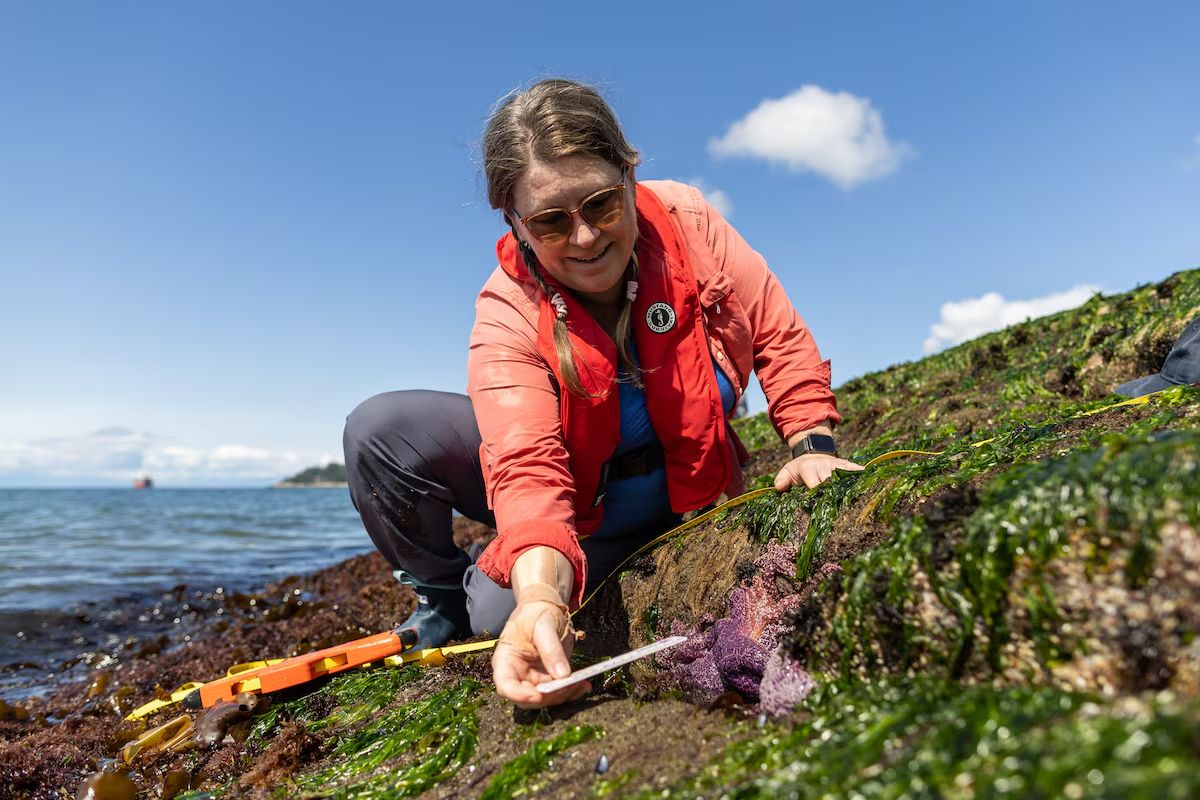
Dr. Gehman, measuring a sea star for size, has more experiments to run to see whether anti-bacterial solutions could help the animals.
Figuring out what was killing sea stars was a significant challenge. Dr. Gehman’s team didn’t know at first whether it was a sickness, pollution contamination or some other cause. After proving the disease was transmissible from a sick animal to a healthy one, they tested whether contaminated water could be made safe by heat-treating it. They found that it could, which suggested there was a pathogen they could kill.
When they did painstaking genetic testing to compare the gut biomes of sick stars with healthy ones, the team expected to find yet more complexity. Instead, the data they got back were so clear the team wondered whether they’d made a mistake, and reran their tests just to be sure.
They had found their villain.
But finding the killer and stopping it are two different things. Dr. Gehman’s team is now focused on potential solutions. Because the contagion is a bacterium, they can grow it in the lab and more easily use it to continue testing, but many questions remain.
When they worked to isolate the pathogen, Dr. Gehman said, their tests subjected sea stars to doses of the bacteria that were universally lethal. This summer they’re testing to see whether there is, in fact, a survivable dose. If there is, it could suggest that some sea stars have or are capable of evolving a resistance to the disease. Early results are encouraging.
“There’s some hint that there is a low dose that they can survive,” Dr. Gehman said. “So the question is: Is that genetically linked? And if it is, can we breed for that sort of increased resistance?”
Open this photo in gallery:
White lesions and twisted limbs are a sign that vibrio pectenicida is melting its host from the inside. This cookie sea star is far gone.Courtesy of Grant Callegari/Hakai Institute
One of the team’s most surprising discoveries feels ripped from the script of Project Hail Mary. The seemingly unstoppable vibrio pectenicida does, in fact, have natural predators of its own: bacteriophages, or phages for short, viruses that attack bacteria by infecting them and reproducing inside them.
“That’s incredible, and has really kind of blown my mind to think about because that means vibrio pectenicida has a natural enemy that’s also in the system,” Dr. Gehman said. That knowledge could give sea stars a fighting chance. The team is now exploring whether the phages can be used to create a kind of natural antibiotic to help sea stars fight off the disease.
“Hopefully, we can maybe use that superpower to treat them,” she added.
Dr. Gehman credits the discovery to a colleague at the University of North Carolina: Blake Ushijima, an expert in marine microbiology and microbial pathogens.
“Blake gave us instructions on what we were supposed to do, which was basically to take a Nalgene [bottle] diving, scoop some water near a sea star, close it up and send it to him,” Dr. Gehman said.
“So we took eight Nalgenes of seawater while diving up in the central coast of B.C., sent them to Blake, and he was able to isolate a bunch of phages that attack vibrio pectenicida.”
Open this photo in gallery:
Dr. Gehman, diving to tally sea stars in B.C.’s Burke Channel, wants to know how temperature affects the bacteria. Finding the right conditions for a major outbreak could help stop the next one.Courtesy of Bennett Whitnell/Hakai Institute
This summer, Dr. Gehman is working with another colleague, research scientist Melanie Prentice, at a lab on Washington State’s Olympic Peninsula, where they first discovered the bacteria. In a large, barn-like structure festooned with pipes and water tanks, Ms. Prentice is helping to oversee a series of experiments aimed at answering three key questions: Does water temperature affect how aggressively the bacteria behave, is there a dose that sea stars can reliably survive, and how well do the anti-bacteria phages help slow or stop the disease?
The tests will also help the team determine the relation between the outbreaks and rising ocean temperatures caused by climate change.
“When the seawater warms up, then we’ll start to see outbreaks in sunflower sea star populations that’ll kind of then taper off as the water gets cooler into the winter,” Ms. Prentice said. “So we know that temperature plays a role, but we don’t really know exactly what’s going on.”
Open this photo in gallery:
Sunflower sea stars get around on tiny tube feet. But when they reproduce, the current does the work: Each sex releases gametes that must mingle and fertilize by chance.Matt McKnight/Reuters
To test the bacteriophages’ effectiveness at fighting the bacteria, the team will expose healthy sea stars to lethal doses of vibrio pectenicida and then inject them with the phages to see whether the viruses can halt or slow the disease’s progress.
“I’m really excited to run experiments where we expose them and then they don’t die,” Dr. Gehman said. “I think that’s going to be really exciting.”
Successful tests could help scientists develop an anti-bacterial treatment regime that could be used at scale along Pacific coastlines to help blunt the effects of outbreaks associated with predictable ocean temperature spikes.
“Something that’s really cool about phages is that these are naturally occurring viruses,” Ms. Prentice said. “It’s a lot more preferable than a [synthetic] antibiotic treatment.
“It’s a little bit more of a natural kind of eco-based solution because this is a naturally occurring virus.”
Open this photo in gallery:Open this photo in gallery:
Sea stars are a keystone of ecosystems that have sustained First Nations for centuries. Members of the Cowichan Tribes can find them in this traditional clam bed on Vancouver Island, where they run a sea-garden conservation program.
Whether any of that comes to fruition, and how long it takes, all depends on how successful the team’s research is.
Ms. Prentice expects it could be years before even the protocol for an ecosystem treatment is developed, and longer still to navigate the necessary permitting and other requirements to actually deploy it safely at scale.
And time is not on their side. After raging for a decade, the wasting disease outbreak appears to have slowed. Some sea star populations have begun to rebound, with constellations of tiny baby sea stars blossoming.
But a looming El Nino in the Pacific this fall and winter threatens to drive ocean temperatures higher again, which could trigger another devastating outbreak.
As the climate warms, these events are stacking closer and closer together, adding pressure to their work, Ms. Prentice said. But she’s heartened by how much attention their research is getting.
“Honestly, I’ve never had so many people so interested in what we’re doing,” she said. “There’s so much that we have to learn about it.”
The way of water: More from The Globe and Mail
The Decibel podcast
Human-made ocean noise is stressful for whales, and researchers are beginning to understand how that hurts their health. Jenn Thornhill Verma spoke with The Decibel about the latest science. Subscribe for more episodes.
Canada’s marine species in depth
Inside the efforts to restore B.C.’s secret, ancient sea gardens
Everyone loves a puffin. Scientists are stumped about their beaks
Teaming up on salmon hunts, orcas and dolphins in B.C. have developed a strategy that really clicks