
Open this photo in gallery:
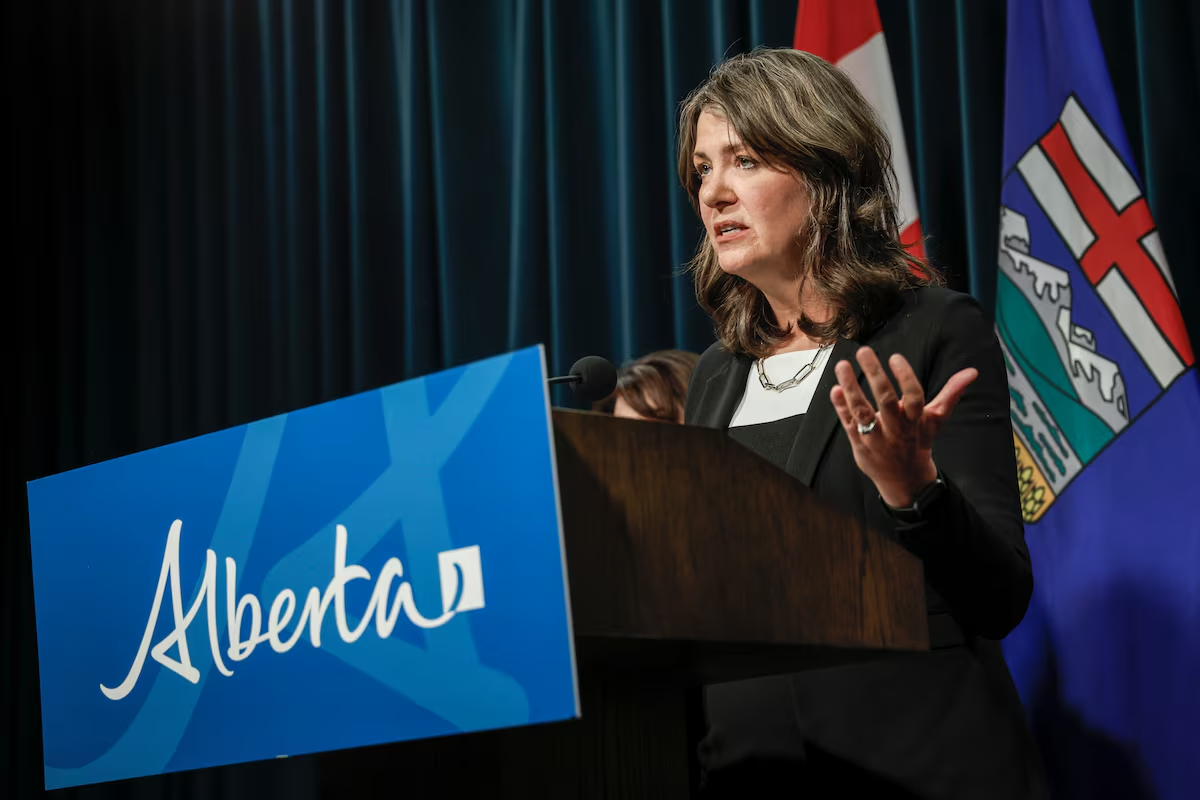
Contrary to Danielle Smith’s belief that the government will not have to intervene to finish building recovery centres, subcontractors allege money has dried up, their work is incomplete, and costs have climbed since they first signed on.Jeff McIntosh/The Canadian Press
Alberta Premier Danielle Smith says she expects construction of three addiction recovery centres in Indigenous communities to wrap up this year without requiring an extra infusion of cash, despite a thicket of liens and lawsuits alleging millions in unpaid bills and misdirected funds.
The government earmarked $104-million for the trio of facilities, which are key to the United Conservative Party’s strategy of tackling the province’s deadly opioid crisis by favouring treatment programs over harm reduction efforts. Ms. Smith, at the end of July, said Alberta picked up the tab for the facilities, but left it to each Indigenous community to select the contractor for their respective project.
The three facilities were to be finished by the end of 2025, but have all missed two extensions granted by Alberta’s Mental Health and Addiction department, according to documents the government disclosed in a progress report this spring.
Ms. Smith said she does not believe she will have to intervene to ensure the recovery facilities make it across the finish line.
“We’re not hearing that more money is necessary,” she told reporters last week. “We’re hearing that they are going to be completed before the end of the year with the budget that was established.”
But subcontractors, in court filings and in interviews with The Globe and Mail, allege money has dried up, their work is incomplete, and costs have climbed since they first signed on. The projects are caught in a tangle of legal action, with various parties sparring for control of millions of dollars allegedly earmarked for the facilities.
“Someone has to step in,” Renols Dehari, a mechanical contractor on two of the projects, said in an interview. “If they don’t pay, we’re not going back.”
Enoch Cree Nation, Tsuut’ina Nation and the Métis Nation of Alberta all contracted Melewka Homes Ltd. to build their recovery centres. Melewka, owned by Lewis Semashkewich and his son John Semashkewich, in court filings said it partnered with another company, AEHE Holding Corp., to win the construction contracts. The Semashkewiches allege the company was secretly controlled by Sam Mraiche, the Edmonton businessman at the centre of Alberta’s sweeping health care procurement affair, who allegedly demanded “exorbitant amounts of money” to keep project payments flowing. Melewka also alleges Mr. Mraiche threatened to use his influence to have the company’s recovery centre contracts cancelled.
Scott Hutchison, a lawyer for Mr. Mraiche, previously said the legal feud “concerns a commercial dispute in which Mr. Mraiche has played no role and has no business or financial interest whatsoever.”
As part of the battle, AEHE and its principal Mohamed Eldassouki, who is Mr. Mraiche’s brother-in-law, is suing Melewka, alleging the elder Semashkewich fraudulently took control of one of AEHE’s bank accounts.
First Nation’s lawsuit against its ex-lawyer links Sam Mraiche to Alberta recovery site procurement
None of the allegations have been tested in court and all of the parties have previously denied wrongdoing. Lawyers for Lewis Semashkewich, Mr. Eldassouki and Mr. Mraiche did not respond to requests for comment.
Meanwhile, Melewka and its subcontractors have filed liens exceeding $10-million against the Métis Nation project in hopes of recouping money for work on that recovery centre. Subcontractors also allege they are owed for work performed on Enoch and Tsuut’ina, but those facilities are shielded from liens because they are on reserves. In those cases, some subcontractors are suing Melewka for the money.
Mr. Dehari’s company, Inso-Energie Inc., was subcontracted to work on the recovery facilities for the Métis Nation and Enoch. He said his business completed roughly 60 per cent of its work at the Métis Nation’s recovery centre, and had yet to be paid for any of it. He estimates the bill amounts to roughly $180,000 after interest.
He also said he had not been paid for roughly 20 per cent of his company’s work on Enoch’s recovery centre.
Mr. Dehari said the experience has shaken his trust in Ms. Smith’s government, which he believes should be communicating directly with subcontractors and making them whole.
“The government should know where their money goes,” he said.
Materials and labour are now more expensive than when Inso-Energie started working on the projects, which will make it difficult for the Premier to keep her word that costs will not balloon, Mr. Dehari said.
“I don’t know how she’s going finish this on budget, because we definitely don’t want to go back with the same pricing.”
Lydia Vokurka, a manager at HVAC contractor Northern Alberta Heating (2013) Ltd., began contacting government officials about her company’s unpaid bills for the Métis Nation’s recovery centre in January. “I’ve written so many e-mails,” she said in an interview.
The subcontractor is owed nearly half a million dollars, she said.
“The government has not helped with this situation,” she continued. “They are completely ignoring it, and simply saying, ‘Oh yeah, no problem. The project will be completed. Everything will be done.’ ”
The Métis Nation terminated its contract with Melewka near the end of March, when the project was roughly 80 per cent complete, according to a progress report the province published in May. The Indigenous organization, in a statement, declined to address whether it has picked a new contractor, re-evaluated timelines or revised its budget, noting the matter is before the courts.
Ms. Vokurka said it is “very difficult to believe” that the Métis Nation’s project will be finished without additional funding.
“It’s very challenging. The government left us holding the bag here, and it’s not our fault.”
Two contractors with unfinished work at Tsuut’ina’s recovery centre said they had not been paid in months – but want to return to complete the job.
Trish Johnston, president of A-1 HVAC Inc., said that while she was “proud to support the Tsuut’ina Nation,” her business is owed more than $700,000, including costs for specialized, made-to-order equipment. “We have not been paid since November of 2025, and the resulting financial strain is significant,” she said.
“This has put our company in such a tough spot,” Ms. Johnston said. “While we continue to support the project and its purpose, our experience would make it very difficult to take part in a similar project again without stronger payment and security measures in place.”
Tsuut’ina did not address questions about its timeline and budget, citing litigation. The First Nation is suing its former lawyer over alleged irregularities in the procurement process for its recovery centre. Tsuut’ina, in a lawsuit first reported by The Globe in July, alleged lawyer Terry Braun worked with Mr. Mraiche to sole-source the construction contract for its facility.
Tsuut’ina alleges its recovery centre project has been marred by “red flags,” including circumvented procurement processes, overpayments and duplicated invoices, according to its statement of claim.
Mr. Braun did not respond to a request seeking comment. Mr. Mraiche is not party to that lawsuit and his lawyer did not respond to a request for comment. None of the allegations have been tested in court.
Alberta in its spring progress report said construction at Tsuut’ina’s recovery facility was 83 per cent complete.
Enoch spokeswoman Erin Stroud, in a statement, said the recovery centre on its territory is finished, save for paving the parking lot.
“The project is on budget, there are no claims, no liens, and all payments to subcontractors are up to date,” she said. Ms. Stroud did not reconcile Enoch’s statement with the allegations of unpaid invoices.