
Listen to this article
Estimated 3 minutes
The audio version of this article is generated by AI-based technology. Mispronunciations can occur. We are working with our partners to continually review and improve the results.
Canada’s economy grew by 0.3 per cent in May, continuing the country’s growth for a second straight month and putting the economy on track for a solid second quarter, according to Statistics Canada.
The increase topped Statistics Canada’s own initial estimate for 0.1 per cent growth in the month.
The agency says 13 of 20 industrial sectors — including construction, manufacturing, finance and insurance and the public sector — contributed to the month’s gains.
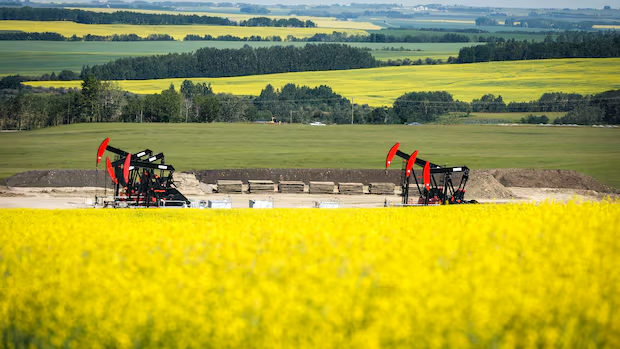
The mining, quarrying, oil and gas extraction sector rose one per cent in May, leading growth for a second straight month. Some maintenance work that usually happens in the month was completed early or deferred, which paved the way for more extraction.
Transportation and warehousing also increased, as pipelines pushed more natural gas out of the country and onto the market.
Offices of real estate agents were also especially busy due to a rise in home-selling activity, boosting the real estate and rental and leasing sector.
An early estimate for June also shows the economy on track to expand by 0.2 per cent in that month. With Statistics Canada also revising April’s GDP growth up slightly to 0.6 per cent, that puts the Canadian economy on track for a solid second quarter of growth.
WATCH | What is holding back the Canadian economy?:
What is going on with the Canadian economy?
Canada’s economy contracted for a second consecutive quarter, which some would call a technical recession. But what is really holding back the Canadian economy? Power & Politics hears from Marc Desormeaux, an economist and the vice-president of policy with the Business Council of Canada, about why this isn’t a ‘true’ recession and how the country’s bottom line is being impacted by the U.S. trade tensions.
The data agency’s advance estimate has real GDP rising 3.4 per cent on an annualized basis in the second quarter, marking a sharp rebound from a mild contraction in the first three months of the year.
The decline in the first quarter of 2026 made for the second straight quarter of GDP contraction on an annualized basis, which led to fears of a technical recession.
But BMO chief economist Doug Porter said these new numbers show that the weakness earlier this year was overstated.
“After all the collective angst about a possible technical recession just a few months ago, it’s now clear that the underlying economy is still grinding ahead,” Porter wrote in a note to investors.
Policymakers likely won’t read too much into these quarterly numbers yet, though, according to CIBC economist Andrew Grantham, since the numbers are often revised.
Plus, he says some one-off factors — like oil maintenance being pushed, and positive impacts from the FIFA World Cup — likely helped boost GDP in the second quarter, so Grantham predicts growth to be a bit slower in coming months.
“We continue to see slack in the economy fading only slowly and for the Bank of Canada to keep interest rates on hold throughout the remainder of the year,” Grantham said in a note to investors.