
To Éric Cyr, this feels like a last kick at the can.
More than 30 years after he voted for Quebec’s separation from Canada, a political party on the cusp of returning to power is at last promising a third referendum on independence.
Mr. Cyr, 57, still remembers being called a “frog” when he lived in Labrador City, N.L., as a child. “It’s like I was an immigrant in my own country,” he said. Today, he lives a short drive away in the northern mining town of Fermont, Que., in a provincial riding where a majority voted to leave the first two times Quebec held referendums on separation, in 1980 and 1995.
Open this photo in gallery:
Quebec’s second referendum in 1995 was a setback for the sovereignty campaign, then championed by Lucien Bouchard of the Bloc Québécois.
The way forward seems obvious to him. Any true sovereigntist must vote for the Parti Québécois in the coming provincial election, which hasn’t yet been called but must be held by Oct. 5 at the latest. “There won’t be another opportunity,” he said.
But nearly 1,000 kilometres away, outside a café in Montreal, two twentysomethings are not quite on board. Born after 1995, they’re part of a new generation of sovereigntists who do not all share Mr. Cyr’s sense of urgency. Instead, they take a joyful approach toward independence, immersed in a movement heavily influenced by memes and online culture.
These two young voters are not enamoured of the Parti Québécois or its leader, Paul St-Pierre Plamondon, who has pledged to hold a referendum within a first mandate if his party wins the election. For them, the ends don’t justify the means. “I’m almost thinking of spoiling my ballot in the next election,” said Aymeric Lalonde, 20.
“I would really have a hard time voting for PSPP,” added Delphine Marchand-Roy, 25, referring to the PQ Leader by a common shorthand.
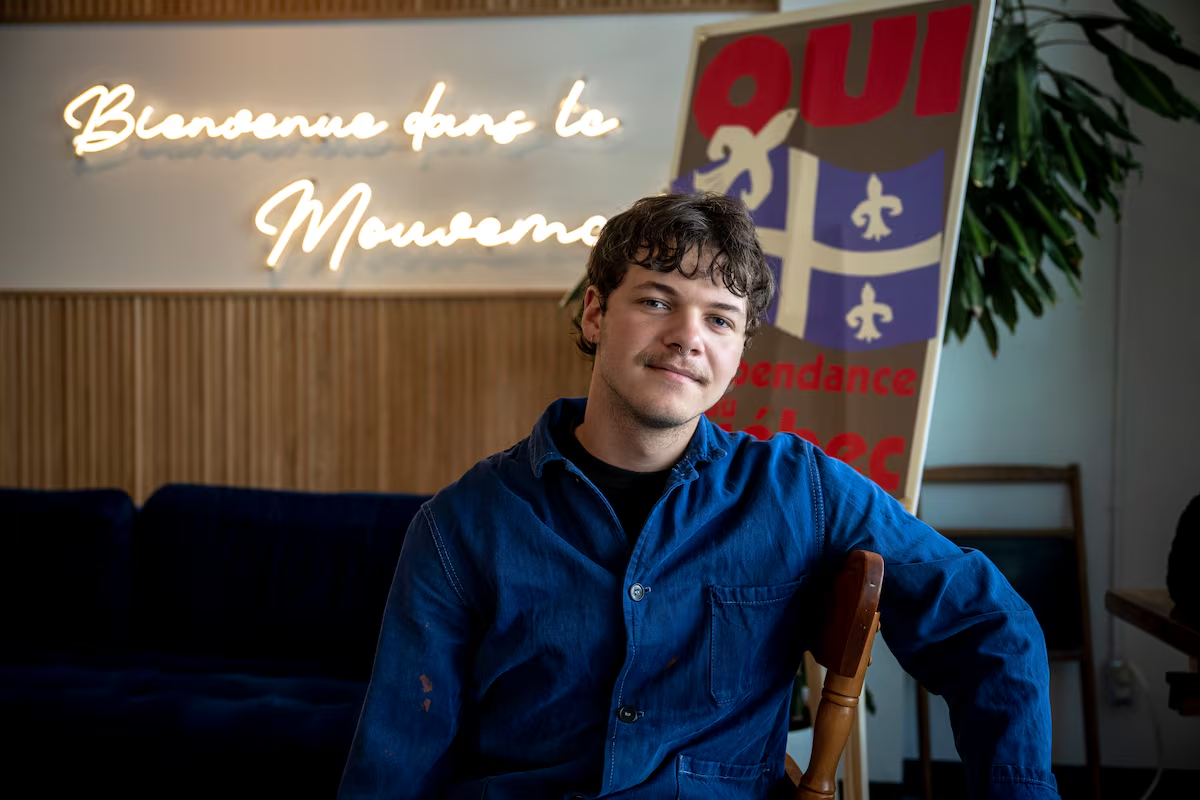
‘Welcome to the movement,’ reads the sign behind Aymeric Lalonde at Club Pays, a pro-independence café in Montreal. It’s a venture from OUI Québec, a group trying to build youth support for sovereignty.
For the most part, it used to be that if you were a sovereigntist in Quebec, you voted PQ. If you weren’t, you voted Liberal. But the province’s political landscape has fractured in recent years, with polling showing sovereigntist votes now split between four parties – all likely to win seats in October – despite the fact that only two are in favour of separation.
Support for independence, currently hovering around 30 per cent, is low enough to make the prospect of Quebec secession seem remote, and it has taken a hit since U.S. President Donald Trump returned to the White House last year.
Mr. St-Pierre Plamondon, who is hoping to turn his current lead in the polls into a majority government, faces no small challenge as he looks to unite a disparate group of young idealists and battle-scarred warriors spanning several generations. They all want to see an independent Quebec. But they don’t all agree on what it should look like.
Open this photo in gallery:
The PQ’s Paul St-Pierre Plamondon leads the fourth-place party in the Quebec City legislature, something he hopes to change.Jacques Boissinot/The Canadian Press
In Fermont, it’s hard for Mr. Cyr to accept the idea of a sovereigntist not voting PQ. He fears that if Quebec remains in Canada, the French language will “eventually become a relic.”
Quebec’s changing demographics mean it’s now or never, Mr. Cyr said. He believes immigrants to the province see themselves as primarily Canadian and are unlikely to vote for independence. “It’s as if it dilutes the francophone pool,” he said. “I’m convinced this is the last chance. Honestly, if they really claim to be sovereigntists, there’s no other option but to vote for the Parti Québécois.”
Mr. St-Pierre Plamondon has promised to slash immigration, claiming the cuts are necessary to protect the French language. But it’s that kind of position that has alienated voters like Ms. Marchand-Roy, who accused him of adopting “an old narrative.” She said she was unsure if she would vote “yes” in a referendum organized by the PQ.
Open this photo in gallery:
With the St-Jean Baptiste Day festivities behind them, and an election ahead, separatist parties have kept up their messages about the status of French in Quebec.Graham Hughes/The Canadian Press
Recent polling shows the level of support for sovereignty is broadly similar across age groups. That’s a change from decades past, when independence campaigns were “driven by younger generations,” said Sébastien Dallaire, chief insights officer at polling firm Leger. “How do you put forth a vision that really brings together young and old?”
The politics of sovereignty have also grown more complicated in other ways. Leger’s polling shows sovereigntist votes divided between the PQ and the left-leaning Québec Solidaire, which support independence, as well as the governing Coalition Avenir Québec and the Conservative Party of Quebec, which don’t. Moreover, a sizable minority of PQ supporters say they would vote “no” in a referendum.
“The party landscape is really muddied when it comes to support for sovereignty right now,” said Mr. Dallaire.
Some of the mementoes around Club Pays – an FLQ manifesto and referendum-themed shirts – are from an era of the sovereignty movement that twentysomethings are too young to have experienced firsthand.
Ms. Marchand-Roy and Mr. Lalonde, both university students, were born decades after the Quiet Revolution of the 1960s that saw francophones become “maîtres chez eux” by claiming leadership positions in their own province, and that fostered the rise of Quebec nationalism. They never personally experienced the heartbreak many sovereigntists felt after the two failed referendums.
Their version of sovereignty thrives on Instagram and TikTok, where young people share memes celebrating Quebec culture, and it has spilled over into the real world.
In June, the non-partisan sovereigntist group OUI Québec drew 12,000 people to a party at a Montreal park for St-Jean Baptiste Day.
The two students spoke with The Globe and Mail recently at a new, explicitly sovereigntist café in La Petite-Patrie, a diverse neighbourhood of Montreal. Called Club Pays, the spot was opened earlier this year by OUI Québec, which is working to drum up support for independence, especially among young people.
Inside, a menu offers “Québécanos” – in place of Americano coffees – and “biscOUIts.” A bookshelf features the writings of former PQ premiers René Lévesque and Jacques Parizeau, who helmed the first two referendum campaigns. “Bienvenue dans le Mouvement!” shout neon letters on the wall, welcoming new recruits.
The lighthearted vibe seems a far cry from the struggle for equality that drew their predecessors to the cause. “I think it’s a completely different movement, and we’re really more focused on hope,” said Mr. Lalonde, the youth co-ordinator for OUI Québec.
Swapping ‘Quebecanos’ for Americanos and ‘Montreal fogs’ for London fogs, Club Pays caters to a young crowd in La Petite-Patrie. Buttons at the counter read ‘Quebec, country of possibilities.’
Sonia Trépanier, born in 1944 in a working-class neighbourhood of Montreal, remembers what it was like to be an outsider in her own home. Working for Bell Canada in her early 20s, she learned quickly that her mother tongue was not welcome. “If you don’t speak English, you’re out,” she recalled being told.
When the Parti Québécois became a major political force under the leadership of Mr. Lévesque, elected premier in 1976, it “let us dream,” said Ms. Trépanier, 81.
“I think it gave Quebec francophones a sense of worth to see that they could have and hope for everything that our anglophone colleagues had and hoped for.”
Ms. Trépanier voted for independence in 1980 and 1995, for “a country where we would feel respected.” She believes sovereigntists will keep fighting for independence, even if a third referendum fails. “If this doesn’t work, there will be another one,” she said.
Open this photo in gallery:
Sonia Trepanier is a retired math teacher who cast a ballot for ‘yes’ in 1980 and 1995.
But others who recall the trauma of defeat are less sanguine. “If we say ‘no’ to ourselves once again, we won’t be able to count on Ottawa to protect our language and culture,” said 67-year-old Guy Couillard in an e-mail exchange. “I believe that we won’t see conditions like these again in 10, 20, or 30 years.”
Mr. Couillard, who lives on Montreal’s suburban South Shore, said the failed referendums and constitutional negotiations of the 1980s and 1990s helped turn him into a “fervent sovereigntist.”
He bristled at the memory of receiving a phone call during the 1995 referendum campaign from an unknown Albertan who tried to convince him – in English – to vote to remain in Canada.
“I was so offended that he would presume to tell me how I should vote that it convinced me even more strongly to vote ‘yes,’ ” he said.
Open this photo in gallery:
Guy Couillard is a retired architect and ‘fervent sovereigntist.’
In June, the Parti Québécois published its Livre bleu, a 524-page tome outlining the party’s vision for secession. The plan includes promises that an independent Quebec would have its own army and its own currency.
Ms. Trépanier said she was reassured to know the PQ has such a detailed plan for independence. But Mr. Lalonde, the youth co-ordinator, remains unconvinced, saying he wishes a referendum could be led by civil society rather than the government. “I’m really having a hard time seeing a coherent vision for society in what’s being proposed,” he said.
Behind the counter at Club Pays, Alirio Carriço made drinks for the handful of afternoon patrons. After moving to Quebec from Brazil four years ago, he found a welcoming community among these young sovereigntists, who he said are passionate about Quebec music, theatre and literature.
Mr. Carriço, 33, said he agrees that Quebec is a culture under threat, but he added that Mr. St-Pierre Plamondon’s position on immigration strikes him as “a little harsh.” He said the independence project often isn’t well-explained to newcomers. “We want people from other places to make the choice and embrace the culture,” he said.
Open this photo in gallery:
Alirio Carriço, at right with Mr. Lalonde, found a community with sovereigntists after moving here from Brazil.
Ms. Trépanier, who has also been volunteering with OUI Québec, said she knows Mr. St-Pierre Plamondon’s rhetoric doesn’t appeal to everyone. “He doesn’t have the temperament to be endearing the way René Lévesque was.”
Still, she’s planning to visit retirement homes this fall to convince other seniors to set aside their fears and rally for the movement once more. In October, she will vote PQ.
“Just because you’re old doesn’t mean you have no more life, no more dreams,” she said. “I want a country before I go.”
Federalism’s future: More from The Globe and Mail
The Decibel podcast
Alberta separatists claim that leaving Canada will make them better off. Will it really? Oliver Moore from The Globe’s editorial board spoke with The Decibel about the legal myths and realities around the independence movement. Subscribe for more episodes.
Commentary
Konrad Yakabuski: PQ’s new blueprint for sovereignty sets the stage for a high-stakes election campaign
Tyler Dawson: Despite what the separatists think, Albertans actually aren’t that mad
Andrew Coyne: Canadian conservatives have a patriotism problem