
Open this photo in gallery:
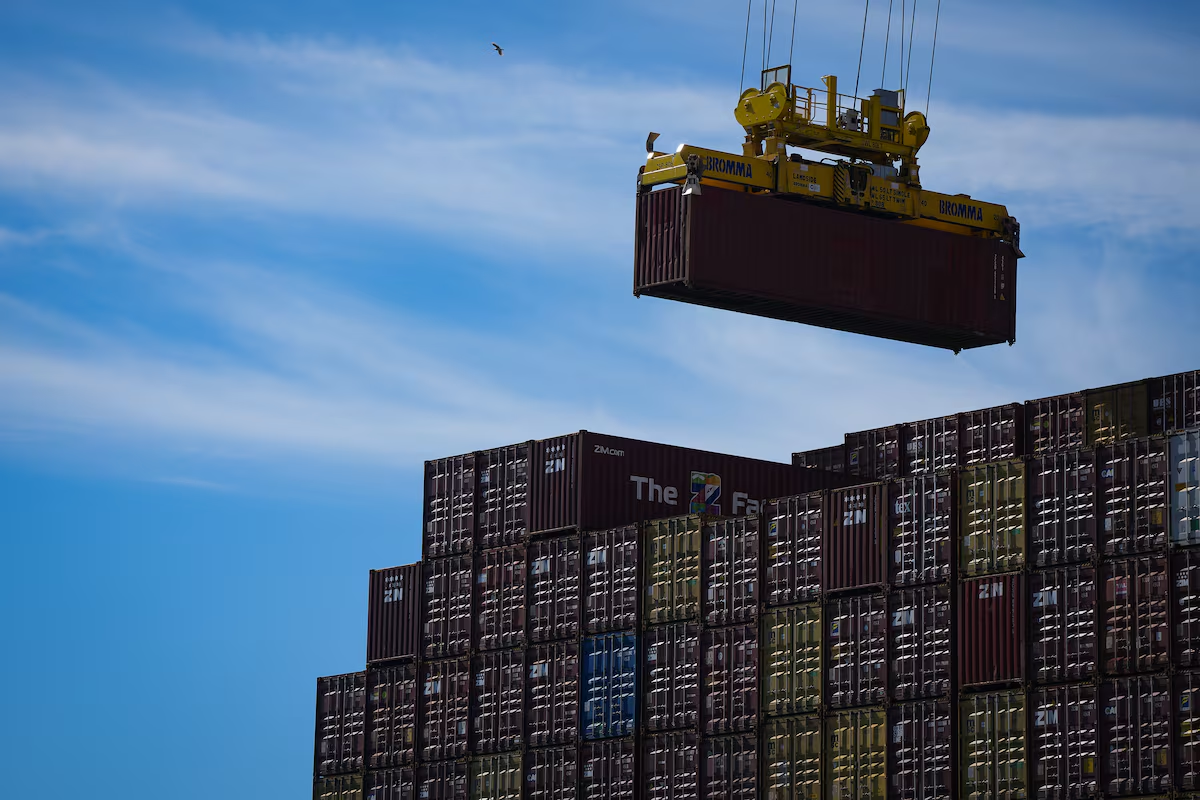
A container is unloaded in Delta, B.C., on Thursday. Statistics Canada’s advance estimate puts the economy on track for annualized growth above 3 per cent in the second quarter.DARRYL DYCK/The Canadian Press
The Canadian economy extended its spring rebound with stronger-than-expected growth in May, but a new wave of tariffs could temper the recovery anticipated in the latter half of the year.
Real gross domestic product jumped by 0.3 per cent in May – coming in above forecasts from economists – and an advanced estimate for June showed a further 0.2-per-cent gain, Statistics Canada reported on Friday.
The increase puts the economy on track for annualized growth above 3 per cent in the second quarter, higher than the Bank of Canada’s recent 2.5-per-cent projection. It is also well north of the United States’ 1.5-per-cent expansion for the same quarter.
Earlier this year, after two back-to-back quarters of negative annualized growth, Canada entered what’s called a “technical recession.” However, April GDP data suggested the Canadian economy has recovered from that period of stagnation.
Coupled with May’s expansion and June’s preliminary estimate, the data suggest the second quarter is on track for rebound, said LJ Valencia, an economist at Desjardins.
But the resilience could be short-lived, Mr. Valencia warned, as trade uncertainty and higher energy prices from geopolitical conflict risk weighing on the outlook.
Growth could be challenged by Washington’s new slate of tariffs, which are poised to target a range of industries that had previously been exempt from the White House’s protectionist trade policies.
U.S. economic growth slows to 1.5% in second quarter as inflation exceeds Fed target
On July 20, the Trump administration announced 50-per-cent tariffs that would affect industries concentrated in British Columbia, Ontario and Quebec. The announcement has sent a wave of concern through the Canadian business community, forcing some companies to pause investment and hiring plans.
The new levies – expected to affect around 5 per cent of Canadian exports to the U.S. – would take effect on Aug. 19, leaving Canadian exporters less than three weeks to prepare.
Washington also decided against extending the United States-Mexico-Canada Agreement on July 1, pushing the continental trade pact into a period of annual reviews and adding another layer of uncertainty for exporting sectors.
Strength across May was broad-based, with activity rising in 13 of the 20 industrial sectors, and led by resources, construction and real estate.
The public sector also grew in May, boosted by temporary hiring and operational activities for the 2026 census.
Production in the oil and gas sector posted the largest gain in May, in response to elevated oil prices stemming from the conflict in the Middle East.
Western Canada Select, the benchmark price many Alberta oil producers use within North America, averaged US$83 a barrel in May.
Support activities in the sector, such as rig drilling and maintenance work, surged almost 10 per cent over the month, also driven by the increased production. But the energy industry will need more certainty around policy and pipelines to drive growth over the medium to long term, said Mark Parsons, chief economist at ATB Financial.
“Near term, it’s providing a boost to the Canadian economy, which is a welcome sign because Canada needs growth wherever it can get,” Mr. Parsons said in an interview.
The Trans Mountain system is the only pipeline network in Canada that transports crude oil to the West Coast, where it can be shipped overseas at a premium.
Trump’s tariffs have sparked a lobbying frenzy in Washington that’s only growing stronger
Canadian exports to Asia-Pacific markets are priced against the global Brent crude benchmark, which averaged above US$100 a barrel in May.
“There’s more incentives to send our oil products overseas, but we just don’t have the capacity now to do that.” Mr. Valencia said.
The Trans Mountain system entered apportionment for the second month in July, meaning that shipping requests to move crude oil exceeded the pipeline’s physical capacity for the month.
Because of capacity constraints, the sector’s growth could be limited to the short term.
Mr. Valencia said monthly GDP, measured by industry output, should be interpreted cautiously. Monthly GDP suggested the economy would expand in the first quarter, but quarterly GDP – the comprehensive expenditure-based metric – wound up revealing a contraction.
Other indicators such as household spending, roughly captured through retail trade data, and firmer second-quarter job numbers signal that a rebound is likely, Mr. Valencia said.
Douglas Porter, chief economist at BMO Capital Markets, said in a note on Friday that May’s data will provide the Bank of Canada with more evidence that the economy is adapting to trade uncertainty.
“But it likely won’t change the bigger picture concerns of fresh tariff threats and lofty energy prices – we still see the Bank on hold this year,” Mr. Porter said.