
Listen to this article
Estimated 4 minutes
The audio version of this article is generated by AI-based technology. Mispronunciations can occur. We are working with our partners to continually review and improve the results.
Close to 20 years after the killing of Rachelle Wrathmall in Sherbrooke, Que., a major development is rekindling hope for her loved ones that justice might finally be within reach.
Her husband Rafiou Sow, who was arrested in Guinea earlier this month in connection with Wrathmall’s 2007 death, is now facing murder charges in the West African nation, according to French-language daily La Presse. The information has also been widely reported in local media.
Wrathmall’s friends Paraskevi Mazarakiotis and Chantal Morin told Radio-Canada they’re happy that things are finally moving forward.
“In the 19 years since the murder was committed, this is the first time there has been such significant progress on the judicial front,” Morin said.
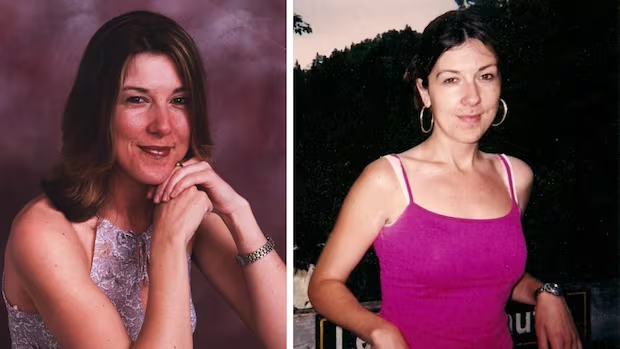
Wrathmall was 31 years old when she was stabbed to death. Her body was found inside the Lennoxville home she shared with her father, according to the Sûreté du Québec.
 Rachelle Wrathmall, seen is this undated photo, was killed in 2007. Her body was found inside her Lennoxville home, in Sherbrooke, Que. (Meurtres et Disparitions Irrésolus du Québec)
At the time of her death, Wrathmall had been married to Sow, a Guinean national, for close to a year, but police say he had been living in the United States after Immigration Canada refused to recognize his legal status.
“She was sponsoring him with a view to his being granted Canadian immigrant status,” according to a post on the SQ’s cold case website.
Quebec provincial police had long sought to interview Sow, who was considered to be an important material witness in the case.
Sow’s arrest in Guinea came after La Presse revisited the cold case and travelled to the nation in West Africa to interview Sow. During the interview, he denied ever being married to a woman named Rachelle.
La Presse’s reporting details how Sow, who became a public figure in Guinea as the leader of an opposition political party, fled Canada for his home country the day before Wrathmall’s body was found.
Road ahead could be long, says criminal law professor
For Mazarakiotis and Morin, the recent developments are bringing up mixed emotions.
The friends said they were aware of violence in Wrathmall’s relationship with Sow and it got to a point where they feared for her life, and shared their concerns with her.
“It’s actually quite difficult, we’re reliving the same thing and there’s a lot of emotion,” Mazarakiotis said. She added they’re hopeful that justice will be served but are trying to temper their expectations.
“We have hope, but we don’t want to hope too much,” she said.
 Paraskevi Mazarakiotis, left, and Chantal Morin, friends of Rachelle Wrathmall, are hopeful her accused killer Rafiou Sow will face justice. (Antoine Desrosiers/Radio-Canada)
Simon Roy, who teaches criminal law at the Université de Sherbrooke, said although Sow has been charged with murder in Guinea, the road ahead could still be long.
Under Guinean law, inspired by the French legal system, citizens who commit a crime abroad can be tried in their home country.
And while in theory it might appear straightforward, in practice, it’s more difficult, Roy said.
The fact that it’s not a recent crime also complicates matters, with evidence dating back nearly 20 years.
“Witnesses will need to be tracked down and made to testify there, [where ] the local rules of justice apply,” he said.
‘His reputation is at stake’
Both Paraskevi and Morin have stated they would be willing to testify but have not been contacted by Guinean authorities.
Quebec provincial police told CBC News they are also willing to collaborate with Guinean authorities but have yet to receive a request via Interpol —The International Criminal Police Organization.
Canada does not have a formal extradition treaty with Guinea.
In order for Sow to face Canadian justice, lawyer Philippe Larochelle says the Canadian government would have to make a request to have him extradited.
Roy, however, said countries with civil law jurisdictions “generally refuse extradition except in very rare cases, because they believe they are capable of trying their own citizens.”
Wrathmall’s friends say the fact people will now likely associate Sow with her death is in itself a small victory.
“He’s fallen from his pedestal,” Morin said. “His reputation is at stake,” Mazarakiotis added.
The friends also find comfort in knowing Sow will see that Wrathmall’s loved ones have never stopped seeking justice.