
Open this photo in gallery:
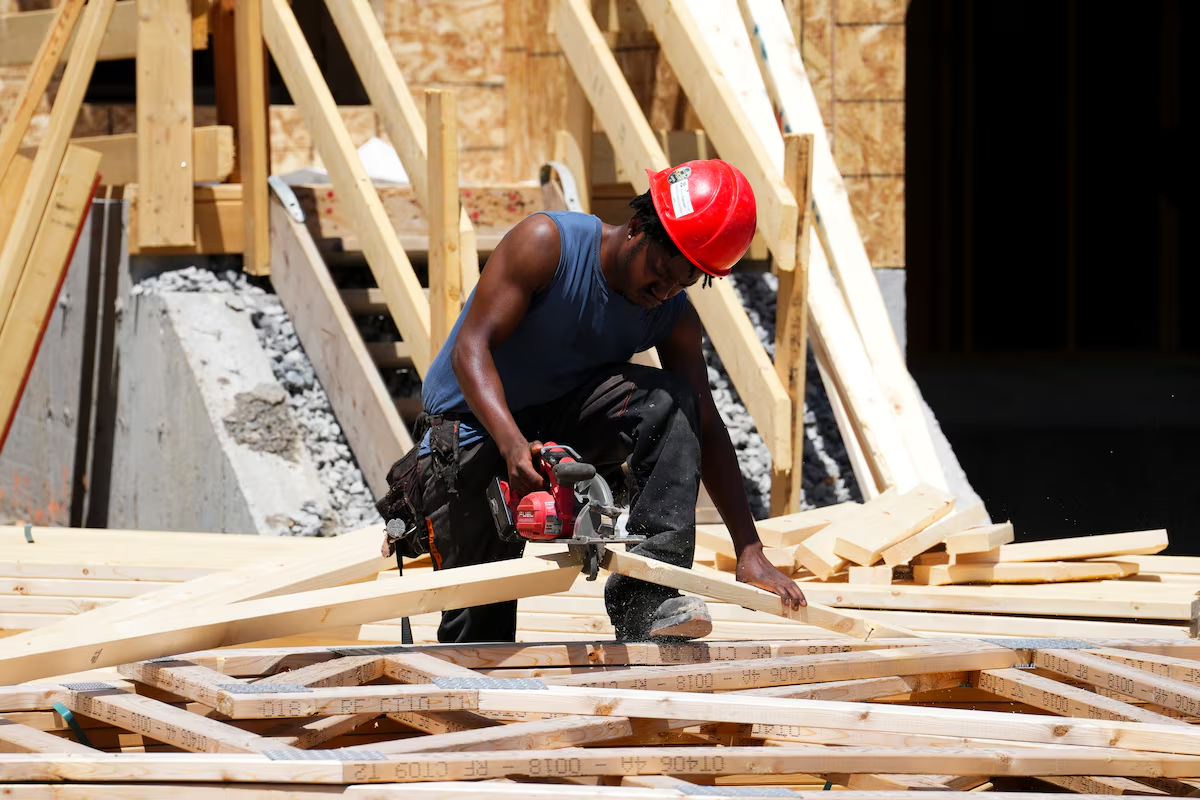
Carpenters build new homes in Ottawa in June.Sean Kilpatrick/The Canadian Press
Canada cannot restore housing affordability without first stopping the relentless rise in home values.
So it should have been cause for celebration when home values began to move in the right direction. Over the past three years, average home values declined after inflation, particularly in British Columbia and Ontario, Canada’s least affordable housing markets.
Instead, it appears to have triggered alarm.
Recent announcements by Ottawa, B.C. and Ontario suggest governments increasingly fear that even modest declines in housing prices could undermine housing construction itself. Developers argue that projects no longer pencil out. Construction costs remain high. Financing remains expensive. Buyers cannot afford the prices needed to make many projects viable.
The implication is deeply disturbing: Canada appears to have built a housing market that constructs homes only when housing becomes less affordable. The collateral damage falls on younger Canadians, whose hopes for affordable homes and rents are sacrificed to preserve a model of housing production that appears overly dependent on rising prices.
This isn’t the first time younger Canadians have been asked to make such a sacrifice. For years, politicians sidestepped an uncomfortable question: Should preserving housing windfalls for existing owners matter more than pricing younger Canadians back into the market?
Rather than confront that intergenerational tension directly, governments shifted the conversation to housing starts, zoning reform and supply targets. They avoided saying that restoring affordability might require little or no growth in home values, asking younger Canadians to trust that more supply today would eventually deliver affordability tomorrow.
Newcomers to Canada could feed a future market upswing, Statistics Canada data suggest
Many younger Canadians accepted that bargain in good faith. They embraced more apartments, greater density, secondary suites and neighbourhood change. They were not the generation fighting new housing. They were the generation asking to be priced in.
Now the bargain itself appears to be changing. Just as home values begin to reconnect with earnings, governments increasingly seem concerned about something else: the viability of the development industry itself.
Earlier this month, the Carney government and B.C. Premier David Eby announced plans to convert more than 2,200 vacant condominium units into affordable housing in British Columbia. Few details have been released. Governments have not said what developers will be paid, how affordability will be defined or how much public financing will be involved.
But a similar plan in Ontario offers an important clue. It aims to convert approximately 2,200 unsold condominium units into rental housing using $300-million in provincial financing. Together, the Ontario and B.C. initiatives point toward a common conclusion: Governments increasingly worry that falling prices and unsold inventory could undermine the economics of commercial housing development.
Do we really expect young Canadians to wait until 2060 for affordable housing?
This concern for private housing development stands in contrast to recent government decisions affecting non-profit housing. British Columbia’s 2026 budget reduced support for the Community Housing Fund, a major source of financing for non-market housing providers. The BC Non-Profit Housing Association estimates the decision will reduce below-market housing completions by roughly 2,000 homes annually – nearly matching the number of condominiums governments now propose to acquire.
The comparison is difficult to ignore. Governments appear increasingly willing to finance completed condominiums that investors no longer want, while curtailing support for non-profit organizations constructing purpose-built affordable housing.
Faced with these shifting priorities, younger Canadians are entitled to ask whether affordability is merely a slogan. If housing could not become more affordable because homeowners objected, and now cannot become more affordable because developers object, when exactly is affordability supposed to arrive?
Governments should be careful about forcing younger Canadians to ask this question. Around the world, younger voters increasingly lose faith in institutions that appear more committed to protecting existing wealth than expanding their opportunity.
India’s emerging Cockroach movement – which started as social media satire after the Chief Justice of India called the unemployed “cockroaches” – gives voice to young people who feel belittled by established institutions. In Britain, Keir Starmer’s political collapse reflects the perception that mainstream parties are failing to improve material conditions, including the deep frustration of younger generations struggling with housing costs and economic insecurity.
Canada is not immune. Younger voter turnout rose in 2025, and younger voters were more likely to support the official opposition’s promises on affordability and economic change.
That makes the 2027 renewal of Canada’s National Housing Strategy especially important for the Carney government. It must finally answer the question politicians have spent years avoiding: Should Canada want home prices to rise, stall or fall?
A housing strategy without an answer is simply a construction plan. And if homes can be built only when housing remains unaffordable, younger Canadians have every reason to doubt that construction alone will ever deliver the affordability they deserve.
Dr. Paul Kershaw is a policy professor at UBC and founder of Generation Squeeze, Canada’s leading voice for generational fairness. You can follow Gen Squeeze on X, Facebook, Bluesky and Instagram, as well as subscribe to Paul’s Hard Truths podcast.