Canada and the U.S. are working on the final text of a trade agreement that is expected to include U.S. President Donald Trump slashing tariff rates on Canadian goods in exchange for a commitment to restore American liquor to provincial store shelves, among other possible concessions.
Prime Minister Mark Carney briefed premiers Wednesday evening on the outlines of a deal that is starting to come together, one that officials are pitching as a way to help tariff-battered sectors but will likely draw criticism because it doesn’t eliminate Trump’s tariffs entirely.
While none of the details of what’s being considered have been made public, a source with knowledge of the forthcoming agreement said U.S. tariffs on Canadian steel and aluminum are being lowered from 50 per cent to 25 per cent. Discussions regarding derivatives and exemptions are ongoing.
The deal is also expected to cut Trump’s headline tariff rate on Canadian-built cars and trucks from 25 per cent to 15 per cent, a source said.
CBC News agreed not to name the sources because they were not authorized to speak publicly.
Since the North American auto market is so highly integrated, a vehicle assembled in Canada often contains 50 per cent or more of U.S.-manufactured components. If the tariff is applied only to the non-U.S. portion, the effective rate would drop by up to half (7.5 per cent), the source said.
Two premiers spoke publicly after the meeting and praised what Carney and his team are putting together with Trump.
Saskatchewan Premier Scott Moe said Carney is poised to broker a “best-in-class trade agreement” with the Americans, one that will be the “strongest of any country in the world,” delivering preferred market access.
Moe said the trading relationship could never return to how it was, given Trump’s known affinity for protectionist policies, especially tariffs.
“The status quo we had two years ago was not possible,” Moe said, while adding Canada is in a “much better” position than it was just 24 hours ago given the threatened 50 per cent tariffs have been halted and more tariff relief is a distinct possibility.
Nova Scotia Premier Tim Houston said he was “really optimistic” about what he heard from Carney and the negotiators.
“The broad strokes seem really good for Canada,” he said, adding that Canada’s system of supply management “remains intact,” and the defence procurement provisions of the deal will be favourable to this country.
“All in all, we’re moving in a good direction,” he said.
WATCH | Trump says deal is good for U.S. farmers:
Trump claims certain Canadian tariffs on U.S. goods will be ‘non-existent’
U.S. President Donald Trump says Canada and the U.S. have reached a ‘very fair deal’ for both countries, after pausing threatened 50 per cent tariffs on a broad range of Canadian goods. Trump says tariffs on U.S. farm goods are ‘going to be eviscerated down to zero,’ when the deal is finalized.
Houston said Carney has asked provinces to put U.S. beer, wine and spirits back in government-run liquor stores. The premier said that’s something he’s “willing to do for the prime minister at this point.”
“Whether Nova Scotians or Canadians will actually buy it when it’s back on the shelves, that’s a whole other discussion,” he said.
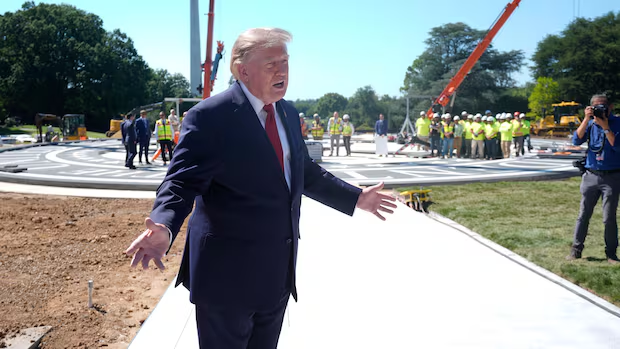
Trump for his part said earlier Wednesday he has brokered what he called “a very good deal” with Canada that will work out well for both countries, while giving few details on what exactly has been negotiated.
Carney said in his own statement on social media that there had been “significant progress” with the Americans, and framed the prospective deal as one that will position Canada well compared to other countries also grappling with Trump’s tariffs.
According to a readout provided by the Prime Minister’s Office, Carney asked the premiers to stick together and follow a “Team Canada” approach as these negotiations near the end.
Carney “reiterated that the government’s goal is to secure the best deal for Canadians — one that provides the greatest possible U.S. market access for Canadian businesses,” according to the readout.
He also told premiers that, even with a possible U.S. deal in the offing, the government’s commitment to “building our economic strength at home and diversifying our partners abroad” is unchanged, the readout said.
Canada seeking relief on metals, autos, lumber
Canada has been demanding relief for the steel, aluminum, auto and lumber sectors weighed down by 25 per cent or higher levies on their goods for more than a year.
As previously reported, the U.S. has offered to lower those rates as part of these negotiations, but just how low has been a point of contention.
“Basically we’re going to have no tariffs into Canada anymore — Canada was charging us tremendous tariffs,” Trump said.
The vast majority of U.S. products already trade into Canada tariff-free, but Ottawa has levied some retaliatory tariffs on U.S. autos, steel and aluminum imports since the outset of the trade war.
WATCH | Trump pauses tariffs:
Trump pauses 50% tariffs, saying new trade deal reached
U.S. President Donald Trump has paused 50 per cent tariffs on Canada, saying the two countries have reached a new trade deal that just needs to be finalized. In a statement, Prime Minister Mark Carney said ‘substantial progress has been made.’
Canada also has tariffs on some dairy imports that exceed a set quota. But American producers do not export enough dairy to meet Canadian tariff rate quota thresholds.
U.S. auto tariffs have caused significant economic dislocation, plant closures and lost jobs, particularly in Ontario, Canada’s industrial heartland.
“They were paying a high number, we’re reducing it a little bit,” Trump said of auto tariffs. “You gotta give something.”
Trump said what’s being negotiated is “great for our farmers.”
Top negotiators met earlier
Canada-U.S. Trade Minister Dominic LeBlanc met with U.S. Trade Representative Jamieson Greer in Washington on Wednesday morning for more talks.
Speaking briefly to reporters on his way out of the roughly 30-minute long discussion, LeBlanc answered a question about whether Canada’s supply-managed dairy sector, long targeted by U.S. negotiators, will be affected by the terms of this prospective agreement.
WATCH | Canadian, U.S. negotiators answer questions:
Greer and LeBlanc speak to reporters as trade talks continue
Speaking to reporters after a meeting in Washington, United States Trade Representative Jamieson Greer said Canada and the U.S. have ‘eliminated some of the irritants we’ve had over the past year.’ Canada-U.S. Trade Minister Dominic LeBlanc said he is ‘very confident’ in discussions about the dairy sector.
“The prime minister was very clear, we need to protect supply management. We need to ensure that the supply management regime remains entirely intact and I’m confident that that’s the case,” LeBlanc said.
He said Canada’s chief trade negotiator, Janice Charette, will be staying in Washington for the rest of the week because she is “finalizing the important work that we need to do over the next little while.”
Greer framed the forthcoming deal as a win-win, saying “we’re happy where we ended up”
“We’ve reached an agreement that will not only continue to protect American workers, American jobs, American supply chains, but really strengthen the North American economy and create a situation where North America will continue to be an energy powerhouse, a manufacturing powerhouse,” he told reporters gathered outside his office.
Beyond Greer’s assertion that there will be changes to some Canadian policies, Trump alluded to a possible revival of the Keystone XL pipeline, a long-defunct project that could carry oil from Alberta to the U.S. Gulf Coast.
Trump already signed an executive order in April authorizing the construction of a similar cross-border pipeline.
WATCH | Trump’s order revives parts of pipeline:
Trump signs order to revive parts of cancelled Keystone XL pipeline
U.S. President Donald Trump has signed an order authorizing a proposed project to transport Canadian oil across the border as part of an effort to revive parts of the cancelled Keystone XL pipeline. South Bow, the Canadian company behind Keystone XL, is partnering with U.S. company Bridger Pipeline on the proposed project.
The Americans have long demanded U.S. liquor be put back on the shelves of provincially run stores, ending a boycott that has been devastatingly effective. The Trump administration is also pushing for Canada to remove its retaliatory tariffs on U.S. autos.
Carney said his government is working on a deal that will “address outstanding trade issues and deliver greater certainty and real benefits for Canadian businesses, workers, farmers and families.”
Conservative Leader Pierre Poilievre said he’s “relieved” there seems to have been some progress made on the trade front but said anything less than “an even better deal than we had before,” something he said used to be Carney’s own metric for success, would be considered a failure.
“That should mean no tariffs on steel, aluminum and autos and an exemption to Buy American,” Poilievre said.
The business sector welcomed Trump’s tariff pause and urged the two sides to get a broader deal done quickly.
Candace Laing, president and chief executive officer of the Canadian Chamber of Commerce, said in a statement that “an extension doesn’t bring the certainty that a signed interim deal would.”
“We know that stability is in short supply and businesses will take any ounce they can get. This limbo state is not anyone’s preferred outcome — time is of the essence,” she said.