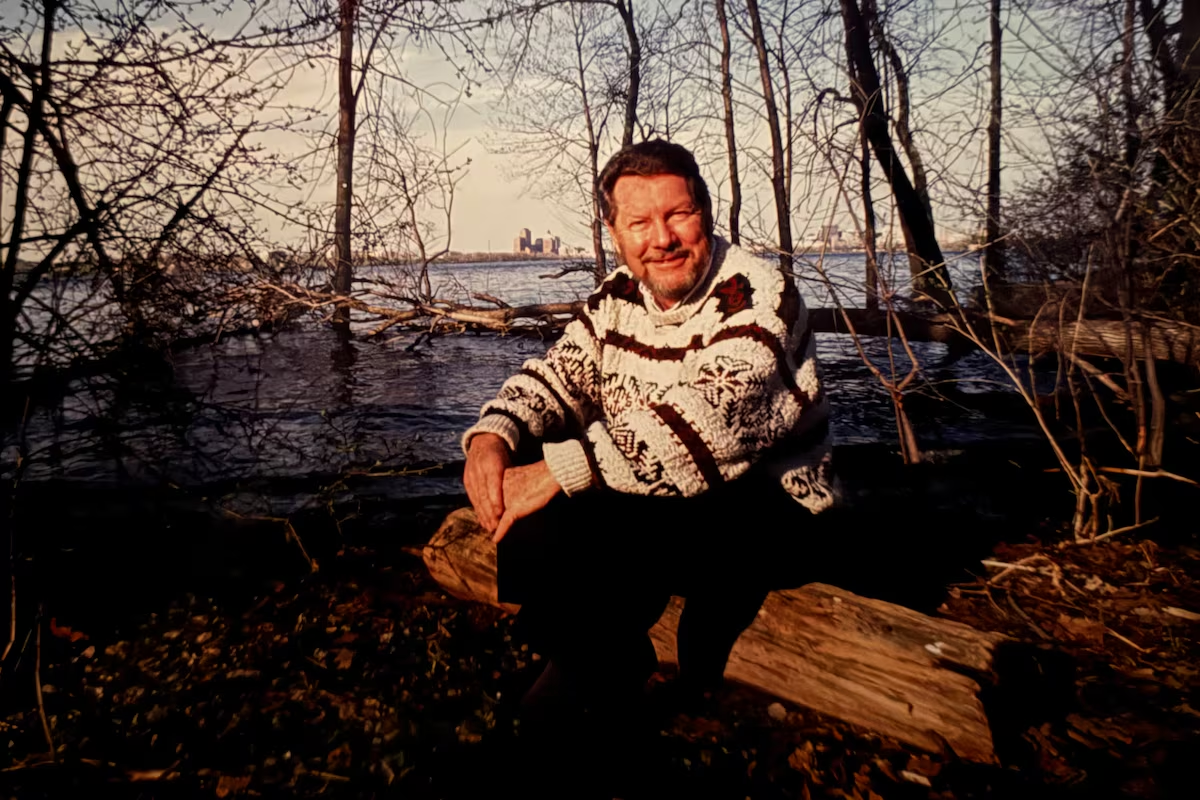

Open this photo in gallery:
Jim Bruce, who died on Aug. 23, was a founding member of the Intergovernmental Panel on Climate Change.The Bruce family/Supplied
Jim Bruce was one of Canada’s foremost scientists and international representatives concerning environmental and climate issues. He provided extraordinary leadership that helped to rehabilitate the Great Lakes and through proposing the UN’s Intergovernmental Panel on Climate Change (IPCC) was among the first to show how the world could address the damaging climate change caused by the burning of fossil fuels. He became a globally renowned and trusted voice who raised awareness about the risks of climate change, especially flooding and drought.
“If climate change is a shark, water is its teeth,” Mr. Bruce said, according to MP Francis Scarpaleggia, who quoted the scientist when addressing the House of Commons in 2022. “Like a fish that doesn’t notice the shark until it feels its sharp bite, humans will first feel the effects of climate change through water.”
Mr. Bruce, a leading member of the IPCC, was the only Canadian representative in the delegation that accepted the 2007 Nobel Peace Prize jointly with former U.S. vice-president Al Gore, who was honoured for his work on climate change, including the Oscar-winning film An Inconvenient Truth.
Jim Bruce died at the age of 97 in Ottawa on Aug. 23. He had suffered for many years from inclusion body myositis (IBM).
“[Mr. Bruce] was one of the first to raise and develop to prominence so many issues like floodplain mapping, hydrometeorology, the imperative to control climate change. There’s both a scientific and organizational legacy,” said John Pomeroy, distinguished professor at the University of Saskatchewan. “He showed us that Canada could be leaders in such matters. He was a great Canadian.”
Rower Archie MacKinnon helped usher in a golden age for his sport on Canada’s West Coast
James Philip Bruce was born in Toronto on Sept. 29, 1928. His father, Peter Bruce, worked in the shoe department at Eaton’s department store. His mother, Winnifred Bruce, was an elementary school teacher who left her job when she had children. She later continued her vocation as an English as second language instructor. As a young person, Jim accompanied his father, a tenor vocalist, on piano and organ at church services.
Mr. Bruce received a bachelor’s degree from the University of Toronto in 1948. That year he began a career at the Meteorological Service of Canada working mostly at air force bases. In 1949 he married Ruth (née Richardson), to whom he was married for 77 years. In 1952, Mr. Bruce went back to the University of Toronto and earned a master’s degree in physics.
The devastation of Hurricane Hazel in 1954 was a pivotal moment in his understanding of climate. He did floodplain mapping which led to the mitigation of future risk in the immediate area of the Humber River in Toronto’s west end, where loss of life and extensive property damage had occurred, and elsewhere.
Open this photo in gallery:
The aftermath of Hurricane Hazel on Oct. 18, 1954. The devastation wrought by Hazel was a pivotal moment in Mr. Bruce’s understanding of climate.The Globe and Mail/The Globe and Mail
Mr. Bruce and others developed systems to prepare for and avoid risks of flooding in several parts of Canada. That work also led to the creation of park space around urban rivers. His son, Peter Bruce, a former senior civil servant and now a learning and leadership associate at the Institute on Governance, a think tank, posed the query: “Do you know why it’s green around the Don Valley Parkway [in Toronto]? It’s because of my father.”
He was head of hydrometeorology for the Meteorological Service of Canada, based in Toronto, from 1959 to 1967. Mr. Bruce then moved to Burlington, Ont., where he led the Centre for Inland Waters and became co-chair of the International Joint Commission (IJC), dedicated to protection of water quality of the Great Lakes. That was the beginning of a series of international roles that saw Mr. Bruce involved with IPCC and the World Meteorological Organization in Geneva.
In 1988, he helped organize a landmark conference in Toronto titled “The Changing Atmosphere: Implications for Global Security.” That gathering marked the first time a global conference called for a reduction – 20 per cent – in greenhouse gas emissions. Mr. Bruce helped write the conference statement, which began: “Humanity is conducting an unintended, uncontrolled, globally pervasive experiment whose ultimate consequences could be second only to a global nuclear war.”
Following that Toronto conference, Mr. Bruce was among an international team that formed the IPCC. This body provides scientific assessments that inform decision-makers at United Nations climate conferences, known as Conferences of the Parties (COPs), and has helped shape international agreements including the 2015 Paris Agreement.
Mr. Bruce reflected on his IPCC experience in his 2016 book A Canadian Environmental Chronicle (1954-2015). “While many climate activists have rightly considered IPCC Reports to be cautious in tone, this characteristic is inevitable in reports that represent a consensus of a large, diverse, international group of scientists,” he wrote.
In a 2022 interview with John Woodside for Canada’s National Observer, Mr. Bruce signalled his growing dissatisfaction on the climate-change mitigation front: “Now it [the IPCC] hasn’t been very successful in getting real action, in my view, but that’s a political problem.”
Public awareness, however, has grown. Mr. Bruce wrote about the moment he and his colleagues returned to their hotel after the Nobel Peace Prize gala: “We were astonished to find a large crowd waiting for our return from the ceremony. They began shouting ‘I-P-C-C, I-P-C-C’ and continued for some time. In my experience, this only happened to winning sports teams.”
Filmmaker Georgina Lightning set out to change how Indigenous people were seen and heard
His daughter Cathy Bruce, president and vice-chancellor of Trent University, laughingly recalled chatting with her father before he headed to Oslo: “He asked, ‘Do you think I should rent a suit?’ I said, ‘Dad, maybe this is a time you should buy a new suit.’” Dr. Bruce said she tries to implement her father’s style in valuing mentoring and in striving to make complex ideas understandable both in speech and writing.
Dr. Pomeroy first met Mr. Bruce in 1981 at the University of Saskatchewan. “I was a 20-year-old undergraduate asked to drive to the airport to pick up this leading figure. I was terrified. It turns out he was a nice, humble person who immediately put me at ease.”
Earlier this month, Dr. Pomeroy was among the scientists who honoured Mr. Bruce at the World Climate Research Programme’s International Network for Alpine Research Catchment Hydrology meeting in Kananaskis, Alta.
Mr. Bruce’s scientific output alone is a significant legacy, Dr. Pomeroy said, pointing to a breakthrough 1965 text on hydrometeorology and the instrumentation embedded by Mr. Bruce’s team in the Canadian Rockies headwaters of the Bow River in the early 1960s that helped scientists later understand the causes of the massive floods of 2013 and how better to predict such events.
Elizabeth Dowdeswell, former lieutenant-governor of Ontario, met Mr. Bruce in the 1980s when they both worked for the federal government. She came from behavioural sciences rather than a meteorological or hydrological background.
“He was always there for you, teaching in the most gentle way. He was a mentor,” Ms. Dowdeswell said, adding that she felt welcomed by Mr. Bruce. She would assume senior roles at Canada’s Atmospheric Environmental Service and as head of the United Nations Environment Programme in Nairobi, Kenya. She fondly recalled an interaction early in her Ottawa stint when she was “flabbergasted” by the number of acronyms used in the governmental scientific reports. “I told Jim I was determined to write a report without acronyms. Jim said, ‘good luck with that!’”
Open this photo in gallery:
In 1988, Mr. Bruce helped organize a landmark conference in Toronto that called for a 20 per cent reduction in greenhouse gas emissions.John Evans/Supplied
Green Party Leader Elizabeth May, formerly an activist and environmental lawyer, first encountered Mr. Bruce after she became an adviser to Thomas McMillan, then federal minister of the environment, and through the intense period of the 1988 Toronto conference, after which Ms. May resigned from the minister’s office. Their relationship deepened from 1999 to 2005 when they both served on the board of the International Institute for Sustainable Development (IISD).
Ms. May admired Mr. Bruce’s ability to engage with diverse colleagues and to make complex scientific issues understandable. Mr. Bruce “was a kind of polymath,” she said. “He had moral courage, mental clarity and depth of scientific expertise. I relied on him and loved him enormously.”
Jim and Ruth Bruce led an active, engaged family life. As long as his health permitted, Mr. Bruce played both jazz and European classical on the piano. He particularly admired Oscar Peterson, Diana Krall and J.S. Bach. Both Cathy Bruce and her brother, Peter, remember music and travel as indelible parts of family life.
“My father took us on lots of adventures,” Peter recalled. “He was very interested in archaeology and history.” Skiing also figured at a family chalet at Mont Sainte-Marie in the Gatineau region and in the Alps when members of the extended family visited Jim and Ruth while they were stationed in Geneva.
Ms. May made a point of regularly dropping by Jim and Ruth Bruce’s condo overlooking the Ottawa River. Her most recent visit took place last winter. “Jim never lost hold of moral certainty based on clear evidence and science.” She recalled that even with his deteriorating medical condition, “I never heard a syllable that could amount to self-pity. He grabbed every moment to get all the joy from life that he could.”
Both Ms. May and Ms. Dowdeswell said their final conversations with Mr. Bruce included discussion of climate change. Mr. Bruce was particularly alarmed about Canadian backsliding, Ms. May said. “We were both angry to the point of tears.”
After leaving the federal civil service and WMO, Mr. Bruce remained engaged with writing, speaking at conferences and advising on domestic and international panels. He expressed mounting concern over what he saw as insufficient action on the environment.
“One of the long-standing requirements of government,” he wrote in his 2016 book, “is to ensure stewardship of our inherited land, air, water and wild creatures – to pass them largely unharmed to the next generation. This role has recently been abysmally short-changed.”
Before that book was published, Peter had expressed concern that the conclusion his father drafted might be too dire, so he advised his father to tone it down a bit, which he did. But more recently, upon reflection, Peter thought, “Well, Dad, I guess you were right again.”
Among his many honours, Jim Bruce was named an officer of the Order of Canada and Fellow of the Royal Society of Canada in 1997, was awarded honorary doctorates from McMaster and Waterloo universities as well as being a member of the IPCC delegation for the 2007 Nobel Peace Prize.
Mr. Bruce leaves his wife, Ruth; children, Peggy Marcoux, Peter Bruce, Connie Bruce and Cathy Bruce; eight grandchildren and seven great-grandchildren.
You can find more obituaries from The Globe and Mail here.
To submit a memory about someone we have recently profiled on the Obituaries page, e-mail us at obit@globeandmail.com.