
Listen to this article
Estimated 4 minutes
The audio version of this article is generated by AI-based technology. Mispronunciations can occur. We are working with our partners to continually review and improve the results.
Erin Millions had taught university students about residential schools for years.
She was shocked when, in 2023, a student asked her if children really died in them.
“That was really the first time that a student had directly repeated those residential school denialist narratives,” she said in an interview with CBC. “It was one of those moments that made me go ‘OK, I’m going to need to start confronting this more directly.'”
The Saskatchewan-raised assistant professor at the University of Winnipeg, who identifies as a settler historian, says the question was part of a growing wave of residential-school denialism.
Actions like this drove Millions to contribute to a new book.
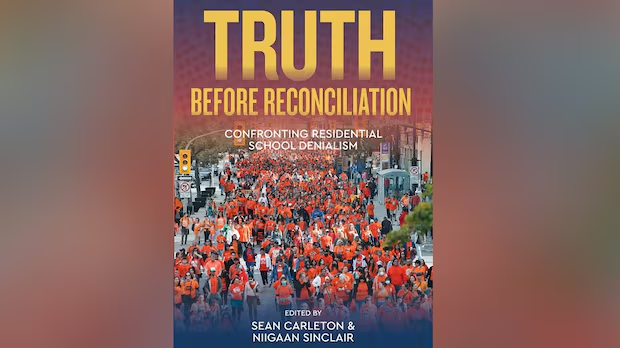
Truth Before Reconciliation: Confronting Residential School Denialism is a peer-reviewed collection of writing by academics and activists that seeks to refute residential school denialism.
 Erin Millions said seeing more misinformation about residential schools among her students led her to care more about residential school denialism. (Maeve Ellis)
Sean Carleton, one of the two co-editors, says denialism comes in many forms, from focusing on the skills children learned to misrepresenting discoveries of potential unmarked graves near former residential schools.
“It’s folks that are disingenuously engaging in public discourse around residential schools, trying to downplay and minimize the harm and hurt of that system,” said Carleton, an associate professor in history and Indigenous studies at the University of Manitoba, who also identifies as a settler historian.
WATCH | As more potential unmarked graves are found at residential school site, a project to honour them begins:
As more potential unmarked graves are found at residential school site, a project to honour them begins
English River First Nation in Saskatchewan is taking steps to honour those who died at Beauval Indian Residential School. In 2023, a ground-penetrating radar search identified 93 graves at the site. This summer, the First Nation said at least 60 more anomalies, which are not yet confirmed to be graves, have been found. The community says all of the graves will be honoured with markers.
He cited a recent example from late August, when Rebel News announced it was selling orange T-shirts on its website for the National Day for Truth and Reconciliation and that the shirts are about “challenging the identity politics that Canadians are increasingly pressured to accept and standing up for the whole truth in our complex Canadian history.”
“Still no proof” and “Canada was built not stolen” are among the statements printed onto the shirts.
Carleton said accurate information about Canada’s past will help the whole country heal and move forward.
“Residential school denialism is cowardly. It is a way of poisoning our relationship. It is poisoning our own well,” he said.
“We don’t need to do it. We can challenge the source of information that, often, this denialism is coming from and find ways to connect with one another.”
Millions focuses on the importance of public works to counter denialism. She advocates renaming streets in Winnipeg originally named after Bishop Vital-Justin Grandin, a 19th-century architect of the residential school system.
“Commemoration — whether it’s plaques, it can include naming as well — serves two purposes of education, but also healing,” she said.
 One of the street signs that Millions advocated for renaming. (Erin Millions)
Michelle Good, an author of a chapter in the book and Order of Canada recipient, said she has seen an increase in residential school denialism.
Good, who is of Cree ancestry and a member of the Red Pheasant Cree Nation in Saskatchewan, said residential schools were a genocide, like the Holocaust, and called for similar legal limitations on denying it. In Canada, promoting antisemitism by condoning, denying or downplaying the Holocaust is a crime. There are also laws against publicly promoting hatred against other identifiable groups.
“Why the difference? Why is one not considered a criminal act and the other is? I think that’s a question we should be asking ourselves as a nation,” Good said.
In 2022, the House of Commons unanimously voted to call on the federal government to recognize Canada’s residential schools as genocide.
 Michelle Good speaks at the book launch on Sept. 17 in Winnipeg. (University of Manitoba Press)
Good said denialism is a problem that must be addressed.
“When you see people from out of town specifically disrupting events that are talking about reconciliation, you know that this is a problem in our country.”
A national 24-hour Indian Residential School Crisis Line is available at 1-866-925-4419 for emotional and crisis referral services for survivors and those affected.
Mental health counselling and crisis support are also available 24 hours a day, seven days a week through the Hope for Wellness hotline at 1-855-242-3310 or by online chat.