
Open this photo in gallery:
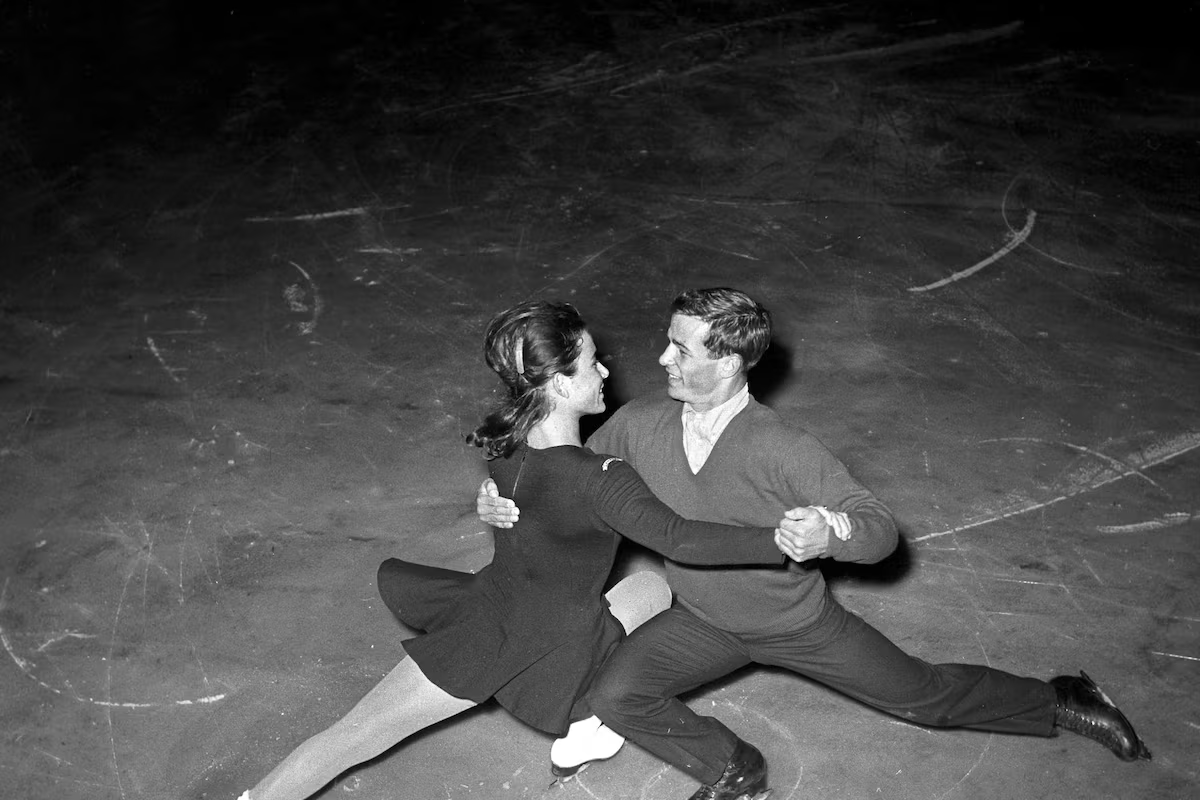
Canadian iceskaters Maria and Otto Jelinek in October, 1961. After his skating career, Otto went on to become a businessman, member of Parliament and federal cabinet minister, before eventually returning to the Czech Republic.dpa/Reuters
It was the depth of the Cold War and the government of Czechoslovakia had scored a coup, securing the World Figure Skating Championships for Prague, an opportunity for the Communist regime to show off.
But there was a problem. Canada’s pairs champions, the brother and sister duo of Otto and Maria Jelinek, were Czech citizens. They had escaped Czechoslovakia with their family in 1948 and sought refuge in Canada, settling in Oakville, Ont. The last thing the Czechoslovak regime wanted was to highlight the success of Czechs in the capitalist West. They refused the Jelineks their visas.
But after the International Skating Union threatened to pull the event from Prague, the Czechoslovak government agreed to allow the Jelineks to relinquish their citizenship and perform at the 1962 event as Canadians. “We were granted visas reluctantly and came to Prague not knowing what to expect,” Mr. Jelinek said in a 2015 interview.
Mr. Jelinek, who was 21 at the time, shouldn’t have been worried. The Czechoslovak public embraced the Jelineks, cheering them on the street and in the arena, where they won the world championship’s pairs event, skating to music from Dvořák and Smetana, both Czech composers. “They stood there for hours, just to see us, to touch us.”
“Winning in Prague was the highlight of our careers,” Mr. Jelinek told another interviewer. “I felt very strongly that I wanted to stick it to the Communist regime and this was an effort that paid off.”
Mr. Jelinek, who died on Sept. 5 in Mississauga, Ont., at 86, went on from his skating career to become a businessman, member of Parliament and federal cabinet minister, eventually returning to the Czech Republic where he spent almost 20 years as a consultant and as Canada’s ambassador to the Central European state.
Throughout these varied careers, Mr. Jelinek was hard-working and single-minded, never afraid to express his views, which in politics sometimes got him the wrong kind of attention.
“He was an ambitious guy,” recalled his younger brother, Henry. “We were brought up with self-discipline and to be competitive. And he [Otto] was very competitive. A go-getter.”
“I’m not a really smart guy,” Otto once told another interviewer. “I am a persistent guy. There are smarter guys in the world than I am.”
Open this photo in gallery:
Progressive Conservative MP Otto Jelinek in the House of Commons in November, 1981.Clark/The Canadian Press
Otto Jelinek was born in Prague on May 20, 1940, the middle of five children of Henry Jelinek and his wife, the former Jarmila Zizka. His father was a wealthy industrialist, whose family-owned company manufactured cork stoppers and metal bottle caps for the brewing industry.
When the Communist government nationalized the company in 1948, Otto’s father decided it was time to leave. Through an arrangement with a South American diplomat, whom Henry Jr. said was “paid heavily,” Mrs. Jelinek and four of her children piled into the diplomat’s car and drove to the Austrian border, claiming they were on an overnight trip to the mountains.
The children were told to pretend that the diplomat, who drove the car, was their father and that they only spoke Spanish and to forget their Czech. Despite a few tense moments, the ruse worked, and the family drove all the way to Switzerland, where their father was waiting, along with their oldest brother.
They eventually got to Canada, where the initial welcome wasn’t always warm. “Canada at that time didn’t seem so tolerant of immigrants. And because we spoke Czech among us in Toronto, we were sometimes spat upon in streetcars,” Otto said later. The Jelineks settled in Bronte, a village along Lake Ontario that became part of Oakville and their father re-established the family cork business.
Otto attended Appleby College and a local high school before continuing his studies in Davos, Switzerland but, he never attended university. After winning the world pairs championship, Mr. Jelinek and Ms. Jelinek went professional, performing for several years with the Ice Capades. Mr. Jelinek also became a colour commentator on figure skating for CTV.
Open this photo in gallery:
Otto and Maria Jelinek skating in the 1960s.The Canadian Press
In 1970, at the age of 30, he launched his business career, founding Canadian Skate Industries, which manufactured hockey and figure skates. Two years later, he made his debut in federal politics, winning election as Progressive Conservative MP for the Toronto riding of High Park-Humber Valley. He later moved to the riding of Halton, winning six consecutive elections and serving 21 years in Ottawa.
Mr. Jelinek became an outspoken member of the Tories’ right wing. He defended free enterprise, supported capital punishment and opposed the metric system. He also alleged that Pierre Trudeau, prime minister at the time, was a Communist with links to China and the Soviet Union.
“Under the Trudeau administration, we have lost all opportunity and freedom of enterprise,” Mr. Jelinek said in 1978. “And we all know of his background. He was once barred from entering in the U.S. … He’s bringing this belief, this philosophy of his, to the rest of society.”
Mr. Jelinek finally entered the federal cabinet in 1984 as minister of fitness and amateur sport, appointed by Brian Mulroney, whom Mr. Jelinek had supported for leadership of the Tory party. He later held the portfolios of multiculturalism, national revenue and supply and services.
“I have a view on everything,” he told reporters in 1993, saying that when it came to multicultural policy, he resented being called a hyphenated Canadian. “I believe we have to get rid of hyphenated Canadians.”
When sprinter Ben Johnson was stripped of his gold medal at the 1988 Seoul Olympics because of doping, Mr. Jelinek came to his defence. “Ben Johnson has said he didn’t know. And I believe him … I believe him as I would believe my own mother.”
He also once complained that Ottawa was forced to spend so much on health care “just because every time a little kid has a runny nose, the mother takes him to a doctor.”
Open this photo in gallery:
IOC President Juan Antonio Samaranch smiling with Canadian Sports Minister Otto Jelinek during the opening of the speed skating oval in Calgary in September, 1987.Patrick Price/Reuters
Later, as minister of national revenue, Mr. Jelinek defended border seizures by Customs officers of gay literature and attacked the Canada Council. “Some of these ridiculous grants are enough to make me bring up,” he told a business audience in 1990, referring to funding for a gay theatre group. “Whether the arm’s-length funding policy is sacrosanct or not, we’re going to tamper with it.”
Mr. Jelinek was revenue minister in the fractious period before the 1991 imposition of the GST, forcing him to defend the new tax before angry groups of small-business people. He noted to a journalist that the revenue job was a lot less interesting than the sports portfolio and that “the fun had gone out of it but the challenge is there.”
After the departure of Mr. Mulroney, Mr. Jelinek briefly mulled a run for the Progressive Conservative leadership, but in the end left politics and didn’t run in the 1993 federal election.
A year later, Mr. Jelinek decided to take a two-year sabbatical in Prague, his hometown, which turned into a stay of almost two decades. It was in the heady years just after the fall of Communism when business was opening up through privatization and foreign investment.
Mr. Jelinek became a prominent member of the business community as chair for Central Europe of Deloitte, the accounting and management consulting firm. He ran his own consulting firm. For a time he was chair of the Czech subsidiary of the Canadian mining company TVX Gold, which was trying to build a gold mine in Bohemia. But the project had to be shelved in the wake of strong opposition from local residents.
Margaret Huber, who was Canada’s ambassador in Prague from 2000 to 2003, said that Mr. Jelinek was “well-connected in Czech circles, whether political, economic or social” and was very helpful to visiting Canadian officials and businesspeople in helping them navigate the country. “He would always make himself available,” she said.
Open this photo in gallery:
Former Canadian Olympians Otto Jelinek, Catriona Le May Doan and Charmaine Crooks attend a news conference in Prague, Czech Republic in June, 2003, as a part of the 2010 Olympic bid for Vancouver.JONATHAN HAYWARD/The Canadian Press
The Czech government appointed Mr. Jelinek as tourism and international business development co-ordinator, reporting directly to the prime minister. But there was controversy as well. After the Czech Republic joined NATO, the government agreed to lease a fleet of Gripen fighter jets from the Swedish firm Saab and BAE Systems of the U.K.
In 2007, Swedish TV alleged that secret payments had been made to three Czech intermediaries, including Mr. Jelinek, to help secure the contracts. Asked about the allegations by The Guardian, Mr. Jelinek said that he had been paid by BAE as a private citizen, adding that “it is personal, like my sex life.”
BAE later admitted to charges of false accounting and was fined US$450-million in the U.S. and the U.K. related to several contracts, including the Gripen deal in Czech Republic. But no charges were ever laid against Mr. Jelinek.
In 2010, Mr. Jelinek retired and returned with his family to Oakville but in 2013, he was asked by prime minister Stephen Harper to return to Prague, this time as Canada’s ambassador.
When the Jelineks fled their home in 1948, they left behind their villa in the centre of Prague, which later became the Austrian ambassador’s residence. In 2014, 80 members of the extended family came from Canada and elsewhere to celebrate Christmas in the house, lent to them by the Austrians.
“It was very emotional,” Henry Jelinek said. “There were lots of tears and lots of smiles.”
Mr. Jelinek’s stay as ambassador was brief. In 2016, shortly after the Liberals returned to power, Mr. Jelinek was one of several Harper-era appointees who were removed from their positions.
Shortly before leaving Prague, Mr. Jelinek was diagnosed with Parkinson’s disease, which “got progressively worse” after he returned to Canada, according to his brother Henry. The last few years, which included several back operations, were tougher still.
Mr. Jelinek was inducted into Canada’s Sports Hall of Fame in 1962 and Skate Canada’s Hall of Fame in 1994. He was honoured by the Czech government with the Medal of Merit for Diplomacy in 2024.
Mr. Jelinek leaves his wife, Leata; sons, Jamie and Misha; sister, Maria; and brothers, Richard and Henry.
You can find more obituaries from The Globe and Mail here.
To submit a memory about someone we have recently profiled on the Obituaries page, e-mail us at obit@globeandmail.com.