
Open this photo in gallery:
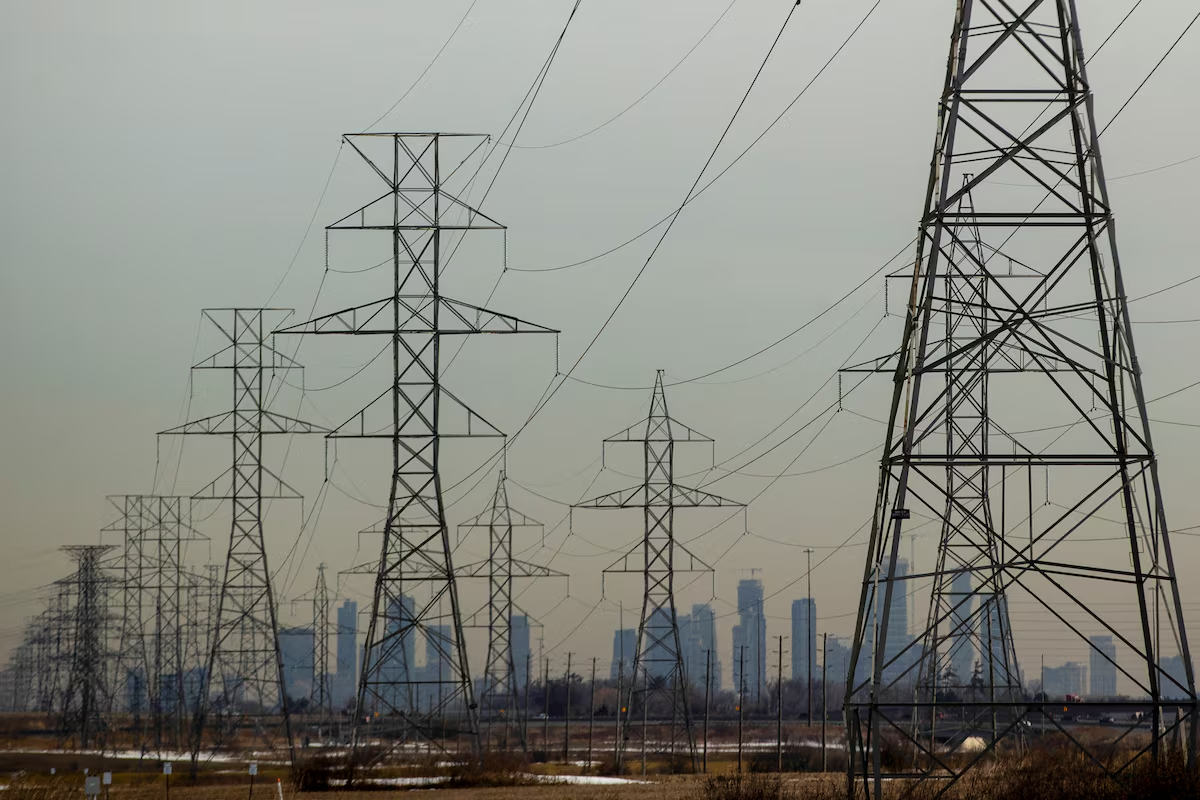
Several transmission-related proposals have been referred to the Major Projects Office for consideration as projects of national importance.Carlos Osorio/Reuters
It was right there on the cover: The latest federal budget, released last week, featured red-and-white transmission towers and power lines running across a mountainous landscape near the Churchill Falls and Gull Island power project in Labrador.
The budget represents Ottawa’s latest efforts to promote expansion of the nation’s power grid, which it regards as too fragmented. The priciest measures include tweaking investment tax credits in ways that could benefit major transmission projects. The budget also set aside tens of millions of dollars for studies intended to help various levels of government to plan interprovincial links, also known as interties.
The federal government has promoted interties for nearly a decade now, but early signature projects flopped. The Atlantic Loop, introduced around 2020, contemplated 1,000 kilometres of two-way transmission lines connecting the Atlantic provinces to Quebec, but the price tag kept rising and crucial partners backed away a few years later.
But that did not cool Ottawa’s ardour: Several transmission-related proposals have been referred to the Major Projects Office for consideration as projects of national importance. In addition to individual projects, the new agency promotes the Transmission InterConnect Investment Strategy, which promises to “identify high priority transmission projects, as well as possible financial solutions to help them move forward.”
Tim Weis, senior director of the Pembina Institute’s industrial decarbonization group, said intertie projects are complicated to execute because they’re costly and require co-operation between two or more provinces with different regulatory systems governing their electricity markets. Intertie projects often become mired in debates about which province would reap most of the benefits, and how costs should therefore be apportioned.
Madeleine McPherson, an associate professor at the University of Victoria’s civil engineering department, has spent the last decade creating large models of power systems, mapping generators, transmission lines, power demand and a host of other factors. Those models reveal that interties make power more affordable, she said.
A more interconnected grid also allows better access to the lowest-cost resources, including wind power in the Prairies and Atlantic provinces, by pairing them with hydroelectricity that can compensate for their constantly changing output, according to Dr. McPherson. Power grids also become more reliable when neighbours can help one another during extreme weather events.
What’s missing, she said, is a consistent approach for weighing costs and benefits of proposed interties to determine which ones are truly worth pursuing, and who should pay for them. Such frameworks have been used by jurisdictions such as Australia that enjoyed greater success at improving grid integration over the last decade.
Opinion: It’s hard to be ‘masters of our destiny’ when our destiny is shaped in the U.S.
The budget included two items aimed at addressing such issues. It allocated $26.4-million over 10 years to the federal natural resources department to support data and modelling capacity to improve planning of electrical systems. And it earmarked $37-million during the next fiscal year “to support robust cost-benefit analysis of proposed interties and inform cross-border cost-allocation discussions.”
Absent from the budget were obvious new sources of federal capital to pay for intertie projects. But it did expand eligibility of investment tax credits for what it describes as “clean” energy, so that high-voltage intraprovincial transmission projects will qualify. (What qualifies as high-voltage varies drastically by province, reflecting the fact that grids use different technologies and serve vastly different users.) Eligible property would include cables, towers and transformers.
The government forecast that the cost of the tax credit changes will be substantial and grow significantly over time: a total of $2.4-billion from 2027 to 2031, and $36.1-billion over the following decade.
The tax credit changes were well-received by several energy think tanks. The Canadian Renewable Energy Association said they were “smart” and “practical” and would lower the cost of high-voltage transmission projects.
“Transmission connects the lowest-cost new power to the people and businesses who need it,” Vittoria Bellissimo, the organization’s president and chief executive officer, wrote in a statement.
François Bouffard, an associate professor in McGill University’s electrical and computer engineering department, said the tax credits will help developers, who face rising capital costs for intertie projects.
Budget 2026: Ottawa to introduce legislation on private airport investments, high-speed rail
Dr. Bouffard said north-south transfers in electricity have long dominated the energy trade agenda across Canada, including in his home province of Quebec. But attitudes shifted significantly after Donald Trump’s return to the White House in 2025; energy sovereignty has gained importance. He observed a similar shift in neighbouring Ontario, where the provincial government had previously been averse to importing large amounts of electricity from Quebec.
“So perhaps there’s an alignment of planets that’s putting a lot more value in terms of our keeping our own electricity for ourselves.”
Keith Brooks, programs director at Environmental Defence, also welcomed the extension of the tax credits but said the government’s investments in electricity infrastructure were overshadowed by much larger funding toward oil and gas projects.
“Budget 2026 appears to be an attempt to paper over this government’s pro-fossil fuel agenda by dangling investments in clean electricity,” he wrote.
Dr. Weis at the Pembina Institute said the government’s sustained focus on interties is helpful to those projects, which can lose momentum if not continually pushed forward.
But he added: “There’s still a lot of work ahead to make these projects a reality.”