
Listen to this article
Estimated 3 minutes
The audio version of this article is generated by AI-based technology. Mispronunciations can occur. We are working with our partners to continually review and improve the results.
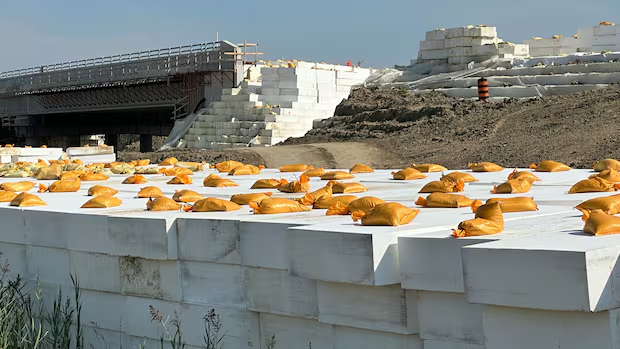
They’re hard to miss: Hundreds of large, white building blocks stacked several feet high near the new overpass project by Banwell Road and E.C. Row Expressway interchange.
They look a bit like Lego, but they’re not there for fun.
The blocks are actually called Expanded Polystyrene (EPS) geofoam blocks. And according to the City of Windsor, crews are using them to help built the embankments near the new overpass.
“EPS blocks are used in construction projects to avoid base ground settlements in a process called ‘compensated foundations’,” Jill Braido, a city spokesperson, told CBC News.
 The city says they’re using the blocks, called Expanded Polystyrene (EPS) geofoam blocks to avoid “base ground settlements.” (Darrin Di Carlo/CBC)
Instead of building bridge overpass approaches directly on regular soil and ground, crews replace a large volume of the dirt with EPS blocks before building the final road cap on top, she explained.
Mina Lee, a University of Windsor civil engineering professor who spoke with CBC Radio’s Windsor Morning on Thursday, said that the blocks are used instead of the dirt because geofoam is 100 times lighter than soil–which can be too heavy for the ground underneath.
“[The geofoam blocks] reduce the load that is applied underground,” Lee explained. “In Windsor we have lots of clay and that is sort of susceptible to settlement over time, so it helps with mitigating excessive settlement over time.”
Braido says the approach will ensure effective “long term stability of the bridge overpass approaches while offering lower overall labour costs compared to use of heavy traditional soil or gravel fill as the base material.”
And it’s an approach that appears to be becoming a staple of Windsor’s road infrastructure.
The city says the blocks were also used in the construction of the Gordie Howe International Bridge which opened to vehicular traffic back in July.
Unlike the styrofoam that easily crumbles in your hand, there’s no fear of these blocks cracking under pressure either. Lee says the geofoam material is highly compact, manufactured in a controlled environment and engineered to withstand the heavy loads it’s designed to carry.
There’s also an environmental benefit.
“Because [the geofoam blocks are] so lightweight it is very easy to transport whereas for dirt and soil you require multiple trips…to the construction site,” said Lee. “So from that sense, it reduces the greenhouse gas emissions coming from the transportations.”
She also adds the blocks are made from recycled materials, meaning “it could also be recycled after the lifespan of this infrastructure.”
As for how long that lifespan is, Lee says the geofoam should last from 50 to 100 years.