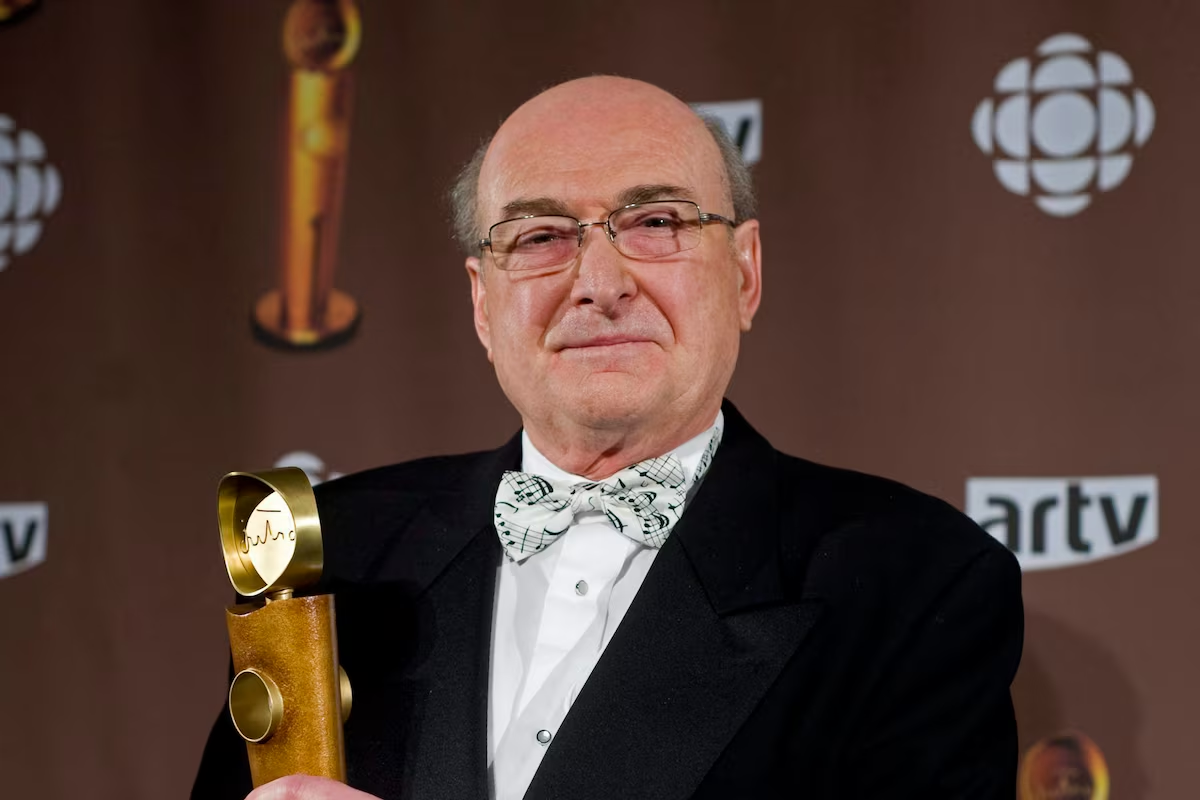

Open this photo in gallery:
René Malo receives the Prix Jutra-Hommage in Montreal in March, 2010. Malo was considered a ‘pillar’ of Quebec cinema.Graham Hughes/The Canadian Press
René Malo, who died on Aug. 23 at the age of 84, was a driving force behind what many consider to be a before-and-after event in Canadian cinema: the production of Denys Arcand’s 1986 bedroom comedy-drama The Decline of the American Empire.
The film was an unlikely success story and runaway hit, earning Canada’s first-ever Oscar nomination in the Best International Feature Film category. On a more fundamental level, it was a wonderful window into the uniqueness and vitality of Quebec culture for audiences in English-speaking Canada and around the world.
A serious-themed comedy of manners often compared to movies like The Big Chill and Annie Hall, it followed a group of talky, bourgeois intellectuals and libidinous academics from the University of Montreal as they navigated love, sex and relationships. Full of bawdy humour and many a verbose monologue, it touched on everything from adultery, prostitution and BDSM to homosexuality, the AIDS epidemic and the nature of love in an era of middle-class stability and prosperity. It was proof that Canadian films could be different, highbrow and entertaining all at once. Audiences loved it.
Along with the Oscar nomination, it won nine Genie Awards, including Best Motion Picture; the International Critics Award at Cannes; and the People’s Choice Award at TIFF. To this day, few Canadian films have equalled its performance. From a budget of $1.8-million, the film grossed $30-million worldwide. It paved the way for further success for Mr. Arcand, who garnered another Academy Award nomination for Jesus of Montreal (1989) and a win for The Decline’s sequel, The Barbarian Invasions (2003) – Canada’s first and only Oscar for Best Foreign Language Film/Best International Feature Film.
NDP MP Dick Proctor overheard an inflight conversation that sparked a national scandal
Not many people would have bet on Mr. Arcand’s edgy script, but Mr. Malo understood its potential.
“René was absolutely instrumental in getting the film made,” said co-producer Roger Frappier, a 50-year veteran of the Quebec and Canadian film industries who has worked with the likes of Denis Villeneuve, Jane Campion and Don McKellar.
“At the time there was a resistance within the National Film Board toward fictional films – they preferred documentaries. So I said I would do the movie in collaboration with the private sector. I sent the script to René and he loved it. He went to Telefilm Canada and he was responsible for the foreign sales.”
Despite the push, Telefilm Canada was initially unimpressed.
“It’s funny, because at the time, Telefilm Canada did not like the movie. They thought it would not make a penny,” Mr. Frappier said.
Mr. Malo was undeterred. His flair for business kicked in and, knowing audiences would respond positively after a series of advance screenings in France, he devised a plan to generate buzz for the film in Montreal.
“René had this very daring and risky idea: he opened The Decline of the American Empire in only one theatre at first – the Crémazie theatre, high up on Saint-Denis Street,” Mr. Frappier said. “He said ‘People from [northern suburb] Laval will come down to see it, and people from Montreal will go up.’ This was the intelligence of René Malo.”
Enthusiastic word-of-mouth led to sold-out screenings, with people scrambling to find tickets. The movie stayed at the Crémazie theatre for a full year.
Producer Perry Rosemond created the Canadian TV classic King of Kensington
The tactic was typical of Mr. Malo’s approach, according to Quebec screen legend Micheline Lanctôt, who worked with him for her directorial debut L’Homme à Tout Faire and its follow-up, Sonatine, which won the Silver Lion Award at the Venice Film Festival in 1984.
“I first met René in California, when he was there to discuss a deal with Warner Brothers to get the exclusive VHS rights for distribution in Quebec,” Ms. Lanctôt said. “I had written a screenplay, and René loved it. I had no intention of directing it, but he thought it was too personal to give to someone else, so he asked me to direct it, and I said, Why not? That was pretty bold.”
“He had a very well-supplied address book,” she continued. “I owe him everything, actually. He launched me, in a way. He got the film financed, and it ended up in the Director’s Fortnight at Cannes in 1980. We were flabbergasted. We had a really good time. He was lavish.”
René Malo was born in the small town of Joliette, Que., on March 7, 1942, the eldest son of a seamstress and a factory worker for the Joliette Steel Company. He attended a Collège Classique programme at the Séminaire de Joliette, firmly in the Jesuit tradition, where he was exposed to the arts, philosophy and a European-style education. It was an important influence on René, who came of age just as Quebec was shaking off centuries of religious conservatism, culminating in the Quiet Revolution of the 1960s.
“My dad had humble beginnings,” said his daughter Fanny-Laure Malo, who followed in her father’s footsteps and works in the film industry. “Growing up, he had to sleep on the couch, while his younger brother and sister shared the bedroom. But he was part of the generation that brought [modern rock] music and arts to small towns in Quebec.”
Rénald Paré, a childhood friend who lived in the apartment above the Malo family, was born only 14 days after René. They became business partners and remained lifelong friends.
“René was very extroverted,” Mr. Paré said. “He was admired by all the young women, and respected by all the young men.”
This extroversion led him and some friends to start their own boîte à chansons, or nightclub, in Joliette called Le Cabastran, from 1963 to ’66. While studying at the University of Montreal – which he quit after two years – he and the group organized summer concerts at Le Cabastran for Quebec impresario Guy Latraverse.
“At first, René was mostly drawn to theatre, but in those years he put on shows for people like Charles Aznavour, Johnny Hallyday and Robert Charlebois,” Mr. Paré said. “He became close with artists like Jean-Pierre Ferland and Claude Dubois and really helped their careers. Already by the age of 18, in the early sixties, he was deep into the world of show business. René was very warm, very generous. He was a great communicator and an excellent negotiator.”
“We’d start around Saint-Jean-Baptiste holiday [June 24], and have shows up until Labour Day,” Mr. Paré continued. “Then we’d take our profits and go down to Cape Cod for a week.”
At Expo 67 in Montreal, he was named director of variety shows for the Youth Pavillion, putting on a further 1,450 hours of concerts and shows – everything from jazz to rock, pop and French-language chansonniers, as well as debates, experimental theatre and audio-visual presentations.
In 1971, he founded his first film production company, Corporation Image M&M, which was followed by Malofilm Distributions in 1973 and Malofilm Communications Inc. in 1983. From 1971 onwards, Mr. Malo was involved in every aspect of the film business, from production and distribution, to promotion and international sales.
At its peak, Malofilm Communications Inc. boasted annual sales of $50-million, becoming one of Canada’s leading entertainment companies. Mr. Malo’s deft hand at running a company and turning profit was confirmed after he sold the company in 1996 for $21-million. Within three years, following an attempted rebrand and a series of financial losses, new owner Richard Szalwinski dismantled the company and sold its parts.
In his later years, diagnosed with Parkinson’s disease, Mr. Malo turned to philanthropy and founded the Fondation René Malo, supporting childhood health initiatives, and the René Malo chair at the University of Quebec at Montreal to help young filmmakers. He was a staunch defender and promoter of Quebec and Canadian cinema, playing an active role in the enactment of the Quebec Cinema Act, and the establishment of Telefilm Canada’s distribution and feature film funds.
“He was the first person to modernize the [film distribution] industry in Quebec,” Mr. Frappier said. “He was one of the great pillars of our cinema.”
Among the many honours he received in his life were the Air Canada prize for contributions to the Canadian film industry and the Prix Jutra-Hommage in Quebec. Mr. Malo was made a Knight of the National Order of Quebec in 2013.
“My father was the most intelligent person I’ve ever met,” his daughter said. “He was always optimistic about our filmmakers and had a will to fight for our culture. His vision was always grand. He was the protector.”
Mr. Malo leaves his wife, Marie Gagnon; their children, Fanny-Laure and Laurent Emmanuel Malo; his sister, Reine Malo; two nieces and two nephews.
You can find more obituaries from The Globe and Mail here.
To submit a memory about someone we have recently profiled on the Obituaries page, e-mail us at obit@globeandmail.com.