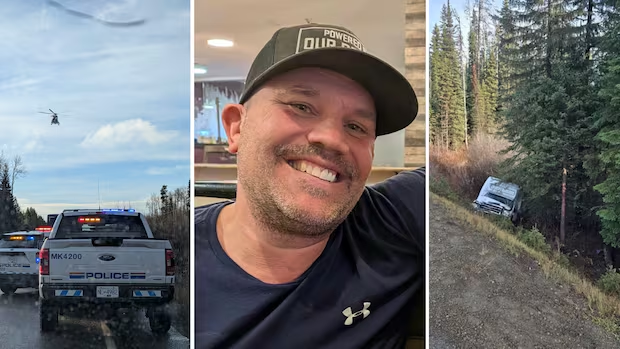
A lonely highway, a traumatized son, and up to 20 people in need of urgent care after a horrific bus crash: that’s the situation Rich Rogers found himself in Wednesday morning along Highway 39, just south of Mackenzie, B.C.
A former firefighter, he gave immediate life-saving treatment to the injured passengers until more help could arrive, reopening the mental trauma he tried to leave behind in his old career.
“Before I could blink Rich was running out of our car, down the steep bank and onto that bus,” his wife Corynn wrote online.
“He didn’t know what he would see in there, and I don’t truly want to know all the details. I do know he literally saved several lives.”
WATCH | Code Orange at two hospitals after bus crash:
About 20 people hospitalized after bus crash near Mackenzie
As she frantically tried to call 911 in an area with poor cell coverage, Corynn says her husband turned off the bus as it was filling with gas, checked for pulses and revived people who were unconscious.
It took six ambulances, five airplanes, and a helicopter to respond to the crisis, which resulted in a Code Orange being declared at the hospitals in both Mackenzie and Prince George, roughly 200 kilometres south of the scene.
But at first it was just Rogers, his family and the people in need of immediate care on an otherwise desolate northern highway.
Corynn says it was a miracle that her husband, a former City of Prince George firefighter, was the person who was there to treat the injured passengers before more help could arrive.

Corrine and Rich Rogers, along with their son, were the only other people on the road when the bus crashed into a ditch after driving toward them. (Corrine Rogers)
But the experience was also traumatic for Rogers, who left the job due to concerns about his mental health. Dealing with the aftermath of Wednesday’s experience, he requested to conduct a single interview with multiple media outlets, including CBC News, via an online video call from his home in Mackenzie, where he moved in September.
A key message was the impact such situations can have on those who jump into help, and the need to support first responders.
The following has been edited for length and clarity.
Describe what you saw for us when you were going down Highway 39.
It was kind of surreal. We kind of came around a little bit of a corner into a fairly big straight away in the distance as we were talking, I noticed something weird and the fact that the bus kind of started entering our lane, and it didn’t appear to be for any particular reason.
And then everything went into ultra-slow motion and I started slowing down. I could just feel and I could tell that something was about to happen.
LISTEN | Rogers shares his story:
Radio West9:51Witness account of shuttle bus crash near Mackenzie
Rich Rogers is a former city firefighter. He was driving along Highway 39, near Mackenzie when a shuttle bus crashed right in front of him. He shares the traumatic first moments after the crash as he rushed to help the injured.
At one point I thought they were gonna flip onto the highway on its side, but it seemed to just take off and shoot across the road and, unfortunately, on that that side of the road there was about a 20-foot-deep ditch.
They launched off the edge, for lack of a better word, and crashed into a tree and then the bus spun around and fell into the ditch and came to a stop.
During that time, my son and wife were in the vehicle with me, and my boy [his 12-year-old son] just started screaming “No, no, no,” over and over.

Rogers says his focus moving forward will be on helping his son recover from what they witnessed, as well as making sure he is looking after his own mental health. (Corrine Rogers)
I pulled over into the side road and I told my family just to stay put and to call for help. And I can’t even remember if I said it out loud, or if it was just in my head, “Man, I hope the bus is empty.”
Rogers says one person had been ejected from the bus and they didn’t appear to be breathing, so he started applying lifesaving measures and they started breathing again.
Another passenger who was hurt but mobile helped stabilize this person while Rogers moved onto to other injuries. B.C. Emergency Health Services confirms that three people were in serious condition while four others were in “serious but stable” condition.
Once ambulances arrived, Rogers continued to help until the scene was cleared.
This is obviously really hard.
I mean, part of the reason that I’m not a firefighter is I left due to mental stress.
So, yeah, it was a trying experience that we just went through but it’s kind of reminded me and made me thankful for the training that I did have and possessed.
It’s really tough. I went through a lot of emotional stress. I feel that I didn’t get the support and the help that I deserved. I didn’t know how to ask for it properly, either. And I don’t know that I was ready to ask for it.
My wife recognized it in me before I did, that I was struggling. And we’re definitely going to have to watch for those types of emotions and feelings creeping in again. But I believe that I’m more equipped to deal with those stressors now.
And how is your family navigating it?
The very first night my wife was extremely worried that my son wasn’t going to be able to sleep because he just kept saying in the car … that he all he could see is the bus keep crashing and crashing and crashing.
I’m thankful I was thoughtful enough to pull over about 100 meters away from the incident. In the back of my head I was thinking, “I don’t want my kid and my wife to have to see what is, or potentially could be happening.”
We just have to kind of make sure that he’s not being negatively affected, and that he knows that we’re here, that he can talk to us about whatever and anything that he needs to.
What kind of response have people been giving you?
I almost feel a little bit embarrassed because, honestly, doing this with you guys is harder for me than what I did.
I don’t really think of myself as a hero, I just think of myself as the wrong place, right time, right skills.
I just hope what I did can give those guys a chance to get healthy again, a chance for their family to spend some time [together].

Rogers says it’s important for first responders to receive support for the mental and emotional trauma they endure. He says he’s grateful he may have helped more people have more time with their family. (Corrine Rogers)
I think the only thing that people should know is there’s lots of people out there that would do what I did.
I think people need to respect the fact that when somebody says they’re hurting inside, and they can’t explain it, that it should be taken a little bit more seriously.
Like, I know my life would be a lot different right now if I was still still a firefighter.
I thought it was my dream career [and it] just destroyed my life.
But I have to move forward in my life, just like the people that were injured in that accident, and just do the best that I can from here for a while.