From university halls to garages in Montreal’s Metro network, public institutions across Quebec are quietly locking prayer rooms and rewriting employee guidelines as the province’s expanded secularism law takes full effect.
Law 9 significantly broadens the reach of Bill 21 and extends restrictions.
The religious symbols ban passed into law in 2019 now applies to daycare staff and prayer spaces are now forbidden in places like university campuses, or the facilities of a transit agency like Montreal’s Société de transport de Montréal.
But as institutions rush to comply with the changes, administrators and legal experts warn that the government has left them navigating a complex legal grey zone with few clear guidelines on how to actually enforce the rules.
Law 9 took effect on Sept. 1.
Prayer rooms closed, chapels can stay
Concordia University — which had a large prayer room, according to the Muslim Student Association — says it no longer has any places set aside for prayer.
McGill University says it intends to comply with its legal obligations as well. Dawson College declined to comment.
“All the signs have been taken down,” said Ezekiel Montoya Desjardins, the vice-president of external affairs at the Dawson Student Union, who managed the prayer rooms there.
Signage and some furnishings, like carpeting, have been removed and the rooms are empty now. Montoya Desjardins said he understands the government’s position, but secularism doesn’t need to be defined as no religious activity.
“I think that it means there is neutrality in all religions at school,” he said, noting that the prayer rooms were mostly used by the Muslim community, but were open to everyone.
 Law 9, adopted by the Quebec government in the spring, puts limits on praying in public. (Radio-Canada)
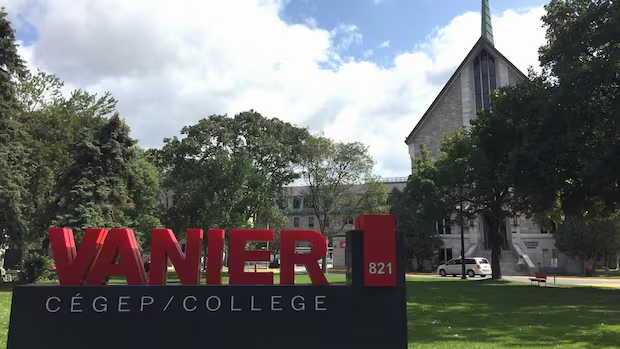
As for Vanier College, Benoit Morin, the school’s director general, said the small prayer room has been locked since the start of August. A notice on the door says Muslim students can head across the street to a mosque to pray.
While prayer rooms like that one close, religious practice in chapels, like the one at Université Laval, Concordia, McGill and Bishop’s University, is allowed.
Vanier catching up with the law
Morin said the school is still working on two important steps included in the law. The first is establishing a process whereby religious accommodations can be requested and determined by management, and initiating a complaints process as well.
Before, students would ask professors for religious accommodations. Now that request will go up to Morin’s office, for him or someone he delegates to decide.
And when it comes to complaints about someone not operating in line with the multiple existing secularism laws, there needs to be a new, separate registry for Law 9 complaints that can be audited by the ministry, he said.
The school also created new training for security guards to teach them about Law 9 and give warnings to people if they see something that isn’t in line with the law, he said.
LISTEN | Exploring some of the effects of Quebec’s expanded secularism law:
Let’s Go10:08Secularism law expansion goes into effect for STM, daycare workers
New rules are going into effect as of today as part of Law 9, the latest expansion of Quebec’s secularism laws. We’ll go over what changes concretely for places like schools, daycares, and even the STM. Let’s Go researcher Sarah Jesmer breaks it down.
Morin said the new measures are affecting Vanier’s ability to teach students the importance of living peacefully together.
“It was and still is fairly complex to determine the fine print as to how it should live within the walls of Vanier,” he said. “And we’ve been working hard throughout the summer to make sure that we can be compliant.”
The hope is schools like Vanier will be consulted more before such laws are adopted in the future as “it has a deep impact on communities that have been built over several years,” he said.
Daycare union keeping close eye on enforcement
The law also bars workers in subsidized daycares and private schools from wearing religious symbols. Those already in their positions are exempt.
A spokesperson for the federation representing health and social service workers is looking into the impact on its 13,000 daycare workers across 400 subsidized daycares.
In a statement, Lucie Longchamp, the spokesperson for the Fédération de la santé et des services sociaux-CSN, said it has asked its member daycares to identify Law 9’s impacts and the federation “will closely monitor developments in the coming weeks.”
 Lucie Longchamp is the spokesperson for the Fédération de la santé et des services sociaux-CSN. (Radio-Canada)
She said the federation expects to hear about a breakdown of services, departures and hiring difficulties. From there, the federation will have more to say on the matter.
The spokesperson also said the FSSS-CSN will continue to “advocate for an open, pluralistic model of secularism that does not further jeopardize the provision of non-profit educational services.”
STM closes prayer space, adjusts policies
Montreal’s public transit agency is telling employees they can no longer pray on workplace property.
The Société de transport de Montréal (STM) says it has four rooms that employees can use for silent activities such as meditation and yoga but can no longer be used for prayer.
The agency says signs have been posted outside the rooms to remind people of the ban, and said supervisors who witness religious practices should address the matter with the employee.
The STM union representing maintenance workers declined to comment.
Inside the transit network, musicians can still sing about their beliefs and wear whatever they want, but they can’t “manifest any religious practice” or lead a worship service with music in the Metro.
STM spokesperson Amélie Régis said the agency’s special constables, with new training, will be intervening if any Metro performers are praying or evangelizing.
 The union representing professionals like engineers and architects said there are resource rooms used for prayer at STM garages. (Graham Hughes/The Canadian Press)
Groups like Jehovah’s Witnesses will still be allowed to operate, even talking to people about their beliefs. Since they aren’t forcing their beliefs on people, but instead waiting to be engaged by passersby, the STM isn’t going to prohibit the practice.
“It is our understanding that discussing a belief is not a religious practice,” she said.
Régis said constables will intervene by “prioritizing an awareness-raising approach,” so warnings will be given to those who don’t follow the rules.
Lawyer says there’s a ‘grey zone’
The penalties laid out in Law 9 are fines that, in general, range between $125 and $1,125.
The law outlines how the province is going to enforce the law, with inspectors who can go into an institution, take photos and report back.
However, the onus is still on employers to ensure compliance.
Constitutional lawyer Frédéric Bérard said Law 9 represents a significant expansion of both where government oversight applies and what measures are enforced.
“You can say that it goes, you know, way beyond Bill 21,” Bérard said. “One should ask the following question: What was the objective behind that?”
He argued the government cannot point to concrete examples of public prayer in places in the Metro causing disruptions, calling the legislation political pandering rather than a response to real needs.
While Bill 21 targeted authority figures like teachers and police to prevent state influence, Bérard said extending restrictions to cafeteria workers, janitors and transit employees reveals a shift toward removing visible religious presence entirely.
“So what’s the next step, actually?” he asked. “Are we going to ban Muslim women from wearing veils in public, on the street? Are we going to go that far?”
Bérard added that public institutions are left navigating a legal grey zone without clear rules on enforcement or handling non-compliant employees.
It offers no guidance on what to do if an employee refuses to comply.
“What do we do with people who keep wearing their religious symbols? Do we fire them? How do we do that?” Bérard said. “Those institutions are not quite clear about what they have to do in order to respect the new bill.”
CBC News reached out to the office of the minister responsible for secularism and was told they would respond soon. The story will be updated.