
Listen to this article
Estimated 4 minutes
The audio version of this article is generated by AI-based technology. Mispronunciations can occur. We are working with our partners to continually review and improve the results.
Leon Nayanookeesic says he hopes wildfire evacuees in northwestern Ontario can return home soon — and when they do, they’ll have better access to firefighting equipment and protective gear.
Nayanookeesic is the fire chief of Whitesand First Nation and Armstrong, two closely linked communities about 250 kilometres north of Thunder Bay.
They’re among more than a dozen communities in the region under evacuation due to nearby wildfires, which have displaced more than 2,800 people.
“This is our first evacuation and it’s a learning experience for all of us,” Nayanookeesic said. “But the community is being strong, we’re sticking together and we have lots of support throughout Thunder Bay and other regions.”
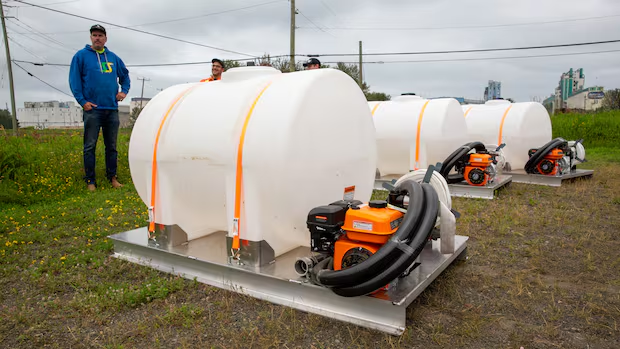
Members of the Canadian charity GlobalMedic, which provides disaster relief to various countries, distributed fire skids and coveralls to smaller fire departments surrounding Thunder Bay on Monday.
The skids consist of:
- 1,000-litre portable tanks that can turn pickup trucks into mini pumper trucks.
- 3,000-litre mobile pumping units.
 Leon Nayanookeesic is the fire chief of Whitesand First Nation and Armstrong, two closely linked communities about 250 kilometres north of Thunder Bay. He says he hopes wildfire evacuees can return home soon. (Marc Doucette/CBC)
These offer more flexibility for smaller fire departments to tackle bush fires in hard-to-reach areas, Nayanookeesic explained.
“We got lots of bush roads that the fire trucks can’t make it in, so it’d be a big asset to us.”
Devin Jackson, a captain with the Gillies Volunteer Fire Department just outside Thunder Bay, agrees.
“It could be a day of clearing trail going in to an access area before we can actively fight the fire. If we can clear the area quick enough and get a portable unit like this just to at least start suppression, it’s going to make a big difference.”
 Local fire crews gather in Thunder Bay to receive fire skids and coveralls from GlobalMedic on Monday. (Sarah Law/CBC)
GlobalMedic says it has distributed 700 fire skids across Ontario, Manitoba, Saskatchewan, Alberta, and Newfoundland and Labrador.
“What we’ve been doing is bringing in fire gear to unlock existing capacity,” said GlobalMedic’s executive director, Rahul Singh.
“When your community is threatened, the wind is your enemy. So the wind is blowing the embers in and starting spot fires — you gotta get out quickly, get the spot fires out or they’re going to grow, connect and destroy the community.
“You can’t really do that in a pumper truck. Solutions like this are better.”
As well, the coveralls — transported by Air Canada — offer more lightweight protection to fight fires in warmer weather.
“Especially like [the other] week when we had daytime temperatures over 40 degrees, you want to be protected as much as you can, but you need to be dressed up so that you’re not overheating.”
Smaller fire departments ‘strapped for finances’
Dave Tarini is the fire chief of Thunder Bay Fire Rescue, which is part of a mutual aid group with surrounding municipalities. The fire department has taken a lead role in tracking down what equipment communities need and how to get it to them.
“It’s really important for the smaller municipalities to get support from the larger municipalities,” Tarini said.
 Dave Tarini, fire chief of Thunder Bay Fire Rescue, says it’s important for larger municipalities to do what they can to support smaller fire departments, which often struggle with a lack of personnel and resources. (Marc Doucette/CBC)
“A lot of these smaller fire departments are a bit more strapped for finances, and these kind of donations are gonna go a long way to build out the capacity they have to respond to fires in their areas.”
At GlobalMedic, emergency programs officer Hannah Frazer said she’s learned a lot during her time in northwestern Ontario this summer.
“I’m learning a lot about the different funding gaps and how smaller communities are bridging these gaps — and truly what the word community means,” Frazer said.
“It is incredibly meaningful to see the impact of these fire skids for these small remote and volunteer fire departments.”