
Listen to this article
Estimated 4 minutes
The audio version of this article is generated by AI-based technology. Mispronunciations can occur. We are working with our partners to continually review and improve the results.
Farmers and livestock owners are once again at risk of running out of hay following a disastrous shortage last year, according to some farmers.
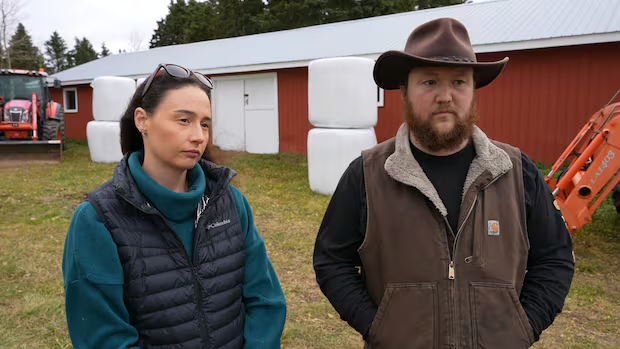
Demand for hay is growing each year and production can’t keep up, Stephen Cuff and Jessica Cuff, owners of 3C Farms in Comfort Cove-Newstead told CBC News.
3C Farms produces hay for sale to other farmers, mainly as feed for livestock including cows, sheep, goats, horses and Newfoundland ponies, Stephen said.
He said a wetter than usual summer this year meant farmers couldn’t get a three or four day stretch with good weather to dry hay, causing a delay in his first cut.
“You would cut later in the season, which then wouldn’t give you the time to get a good second cut in and it just creates a shortage right across the province,” he said.
WATCH | Farmers say hay surplus was wiped out:
Farmers concerned about hay supply call for government support
Farmers in N.L. say they’ll likely be short on hay again this year. A devastating shortage last year left them having to import more, and hopes for this season aren’t high. The CBC’s Sanuda Ranawake explains.
Last year, severe shortages in hay, caused by overly dry conditions, left the province having to import hay to cover the shortfall in supply — a short-term success but unsustainable in the long run, Stephen said.
He said last year’s shortages also left the province’s hay reserves dry.
“There was always a surplus of hay… Over the last few years, the extra hay was wiped out,” he said.
Jessica said the only feasible long-term solution for the province is to invest in new farms and expand existing hay farms.

Stephen Cuff and Jessica Cuff load hay bales onto a truck for delivery (Sanuda Ranawake/CBC News)
She said some government funding is available, but the pair’s applications were unsuccessful.
“The last couple years we have tried to get some funding but we have been declined, unfortunately. So hopefully this year we can turn that around,” she said.
She said 3C Farm can’t keep up with demand, even with expansion planned for the future — the two produce just enough hay to supply their existing customers.

Stephen Cuff says demand for their hay is about twice as high as what they are able to supply. (Sanuda Ranawake/CBC News)
“With such a shortage, we’re not able to take on anybody extra. So anybody trying to get into livestock or grow their herds or flocks, we’re not able to keep up with the growing demand that the province would like to see in the coming years,” she said.
“There is a shortage, we will run out. It’s guaranteed,” Stephen added, saying demand for their hay is about twice as high as what they are able to supply.
The provincial government is currently getting feedback from farmers to develop a 10-year agriculture strategy, said Sara Rideout, a spokesperson for the Department of Forestry, Agriculture and Lands.
“Hay and forage production, as well as feed availability and quality, can differ considerably from one region of the province to another due to weather variability,” she said in an email to CBC News.
“While some producers have raised concerns about forage supplies, we are not aware of widespread hay production challenges this season.”
She said the government also offers low-cost agricultural land leases, land development programs, machinery and equipment purchases, along with other initiatives to increase farm productivity.
“Producers also have access to Business Risk Management programs, including AgriStability, to help protect their farms from production losses, rising costs, and market challenges,” she said.
Rideout said the provincial and federal governments also helped subsidize some costs of purchasing and transporting feed last year caused by drought conditions.
Download our free CBC News app to sign up for push alerts for CBC Newfoundland and Labrador. Sign up for our daily headlines newsletter here. Click here to visit our landing page.