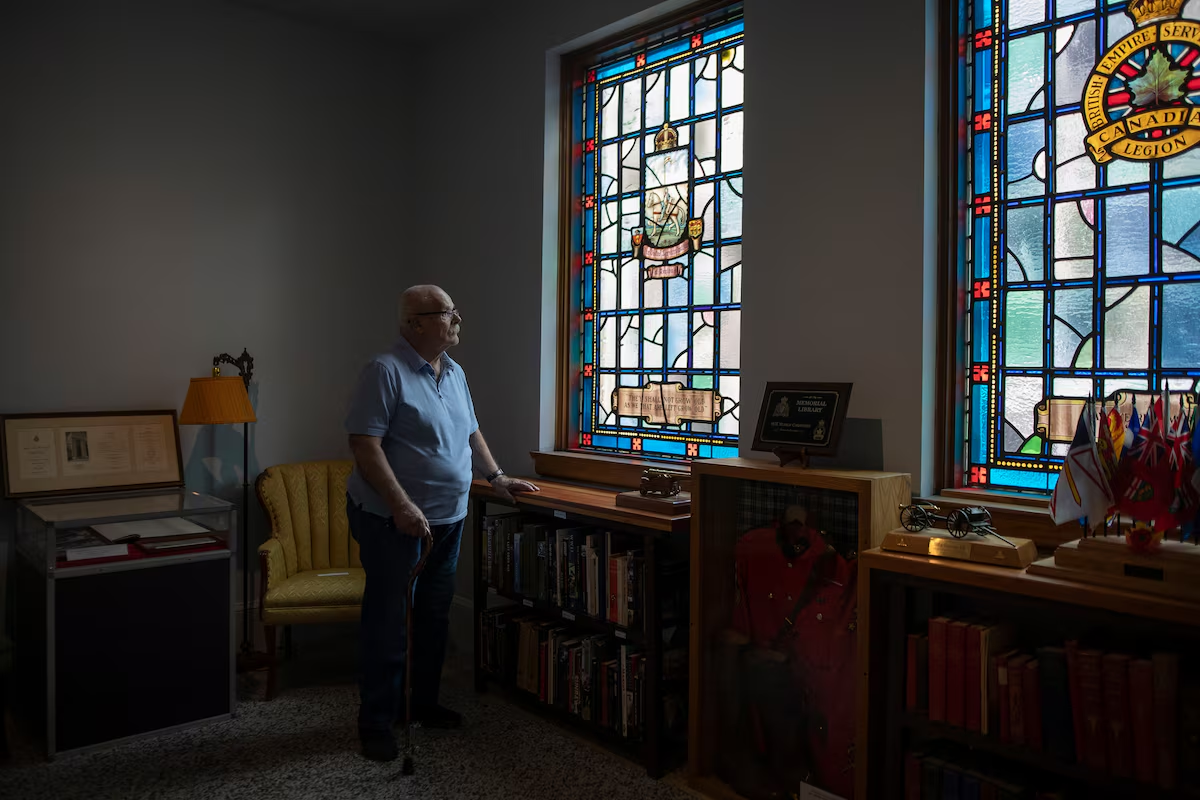

Juergen Knauert, who served with the Royal Canadian Army Medical Corps from 1965 to 1970, stepped into the Regina branch of the Royal Canadian Legion, one of the oldest in the country, looking for a place where he could be around fellow veterans.
When he first arrived in 2023 after moving from Ottawa, Mr. Knauert was overcome with emotion as he saw the vaulted ceiling and decades-old stained-glass windows depicting scenes of military life. In one of the rooms, a mural showed poppies and soldiers carrying a coffin draped with a Canadian flag.
For Mr. Knauert, the branch became an instant source of friendships.
“It’s a kind of a fellowship, if you will. Rank really doesn’t matter, although some people like to remind us of what rank they had, but here at the Legion, it really doesn’t matter because we’re all the same,” said the 77-year-old vice-president and museum director of Regina’s Branch 001.
Open this photo in gallery:
Canadian Legion Provincial Convention, Saskatoon, June, 1941.1009, Gibson Photo/RCL Branch 001 Museum & Archives
On Friday, this branch and hundreds of others like it are celebrating the Legion’s centenary. Since 1926, it has provided grassroots veteran support and advocacy, and, after 100 years, Legion halls are some of the few spaces left in Canada where civilians and veterans can sit side-by-side and share pints and stories.
Open this photo in gallery:
Regina Branch Canadian Legion BESL House Rules.RCL Branch 001 Museum & Archives
As the number of veterans from the two World Wars dwindles, the Legion is playing a vital role by preserving and educating the next generation about Canada’s military history.
To celebrate the centennial, the Regina branch’s museum put out a public call for help identifying soldiers in its digital archive of 3,000 photos. The museum houses artifacts donated by Legion members and their families, including medals and shrapnel brought back from the trenches of the First World War.
Family members have already contacted the museum after spotting a relative, collections manager Kelsey Lonie said.
“In Saskatchewan, almost everybody knows somebody who has served at some point in their family or in their community. These photographs remind us of the humanity of war and how these are just everyday people who answered the call and deserve to be remembered for it,” she said.
The Legion was born out a need to have a unified voice for veterans, said Eric Story, assistant history professor at Wilfrid Laurier University and co-director of the Laurier Centre for the Study of Canada.
After the end of the First World War in 1918, Canadians were optimistic that the world would change for the better, he said. But that hope was shattered after a postwar economic slump hit the country, crippling the job market for veterans returning home.
Open this photo in gallery:
Pilots looking at the Book of Remembrance.RCL Branch 001 Museum & Archives
“A recession took hold, and that was, for a lot of veterans, extremely frustrating and disillusioning, and a lot of them, especially those suffering from disabilities, really struggled with employment,” Prof. Story said.
As wounded and returning soldiers adjusted to domestic life, more than a dozen advocacy groups cropped up for different subsets of veterans, including the Great War Veterans Association and the Tuberculous Veterans’ Association.
In 1926, those groups unified to create the Royal Canadian Legion after Field Marshal Douglas Haig, who commanded the British Expeditionary Force in the First World War, urged Canada’s veterans’ groups to strengthen their voice for better pensions and improved rehabilitative policies for soldiers with disabilities.
In the Legion’s first year, more than 160 branches were created with thousands of members joining. Representatives of the Legion would routinely appear before committees in the House of Commons to speak about veterans’ issues.
Branch 001 in Regina first opened in 1926, months after the veterans’ associations unified, in a specially constructed building, which is now a designated heritage property.
Both at national and local levels, the Legion, which operates as a non-profit, is funded through private donations and annual memberships fees. The majority of money for programming comes from the national poppy campaign around Remembrance Day.
Open this photo in gallery:
Cy, Walo play rummy, Patio of house, West Hoathley, in January, 1943.RCL Branch 001 Museum & Archives
In its early years, the Legion was the main knowledge keeper of the history of the First World War and was “foundational to shaping its memory,” Prof. Story said.
After the Second World War ended in 1945, the Legion’s political influence grew. It was involved in advocating for federal legislation to codify veterans’ rights, which provided loans for new businesses and funding for postsecondary education.
Membership swelled from the 1960s to the 80s, reaching nearly 600,000 in 1984, according to the Legion’s website.
In 2000, the Legion was the main driver behind the repatriation of the body of an unidentified Canadian who fought at Vimy Ridge in France to create the Tomb of the Unknown Soldier in Ottawa.
The Legion’s 100-year anniversary shows its cultural “staying power” in terms of how people view the country’s military history and its veterans, Prof. Story said.
He pointed to the Remembrance Day poppy drives, a fixture every fall, as an example of the Legion’s lasting impact.
The perpetuation of the memory of the First World War has been extremely potent through the poppy.
Open this photo in gallery:
Mildred (left).RCL Branch 001 Museum & Archives
“It has become an enduring symbol of not just the First World War, but war and conflict around the world,” Prof. Story said.
“It may seem small, but these symbols hold a lot of power in communicating ideas of what we believe are valuable and what are invaluable.”
Nujma Bond, spokesperson for the Legion’s national headquarters, said the centennial anniversary marks a new “exciting chapter.”
“This is really an amazing time, a time for everyone who is connected to the Legion, who works with the Legion volunteers, to be very proud of such a long and strong history,” she said.
Much of the Legion’s work has evolved to offer more emergency financial help, as well as assistance navigating social supports and mental-health programming for veterans, Ms. Bond said.
Open this photo in gallery:
Historical items are displayed inside the Regina branch’s museum on Wednesday.Kayle Neis/The Globe and Mail
Contrary to the perception that branches are closing, the Legion has seen a surge in memberships, she said. That’s thanks, in part, to a streamlined application process and a membership expansion to the RCMP. Since the start of 2026, 100,000 new members have joined, totalling 300,000 nationally across 1,350 branches.
Ms. Bond also said there’s been a wider acknowledgment of Legion branches as community centres, places to hold weddings or socials.
She often hears stories of young adults visiting Legions, even if it’s for a beer or a bit of food – and this helps build connections and educate people about Canadian veterans.
“If you’re in a position to meet a veteran, then you’re able to have some conversations you might not otherwise have in an environment that’s also comfortable for them,” she said.
Open this photo in gallery:
The museum houses artifacts donated by Legion members and their families, including medals and shrapnel brought back from the trenches of the First World War.Kayle Neis/The Globe and Mail
Despite branches being scattered from coast-to-coast-to-coast, there are familiar signs when entering a Legion hall: Walls covered in military memorabilia. A framed picture of the British monarch. Bingo nights and meat-draw fundraisers.
As more youth get involved, whether by taking part in Remembrance Day writing contests or showing up at branches for events, Ms. Bond is optimistic the next generation can maintain and further the Legion’s legacy.
“It’s amazing to know how much [young people] do know, and it bodes well for the future because these are the individuals who will be carrying remembrance forward,” she said.
More from The Globe
Cyber bootcamp aims to match tech-savvy veterans with their next employer
First Person: Dad never talked about the war, but a vet who served with him helped me fill in the blanks
Opinion: We must preserve the stories of our veterans before it’s too late