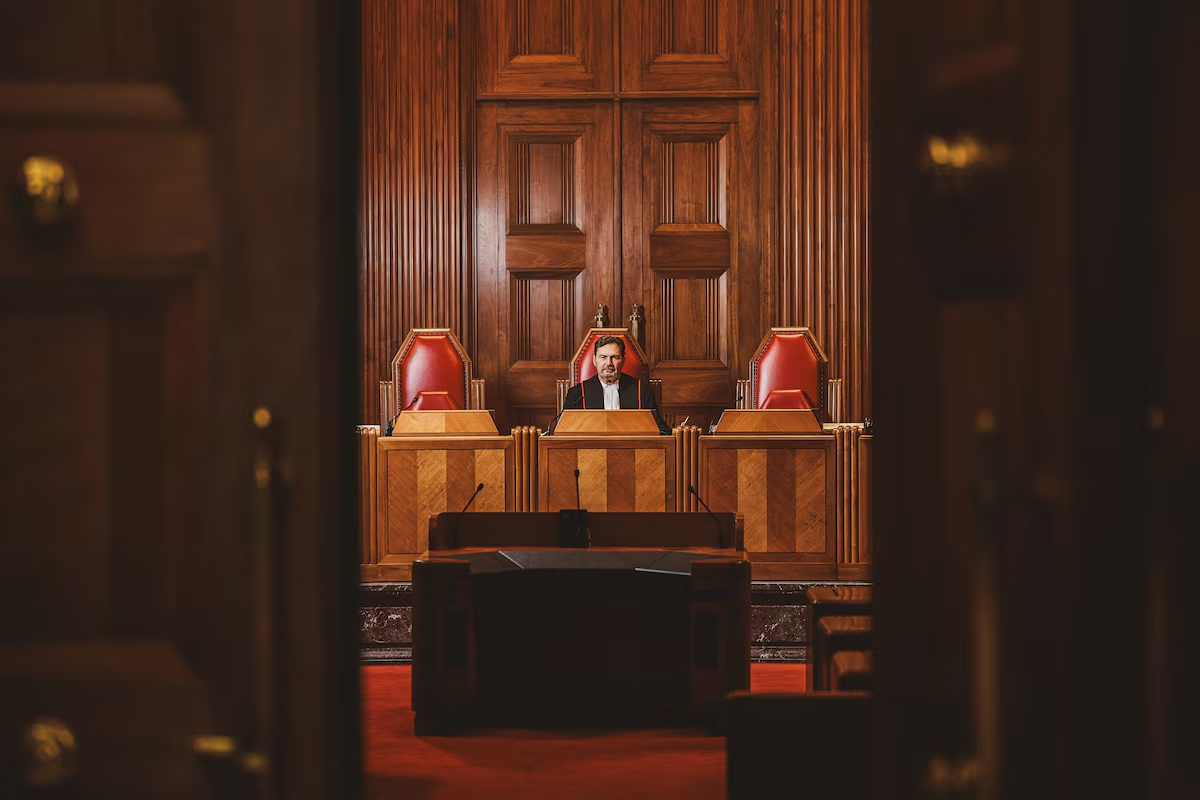

Good morning. Richard Wagner is the man leading Canada’s highest court in its deliberations on a country-shaping case, the landmark judgment on Quebec’s Bill 21. More on him and the case below, along with updates on the wildfire crisis.
Open this photo in gallery:
Richard Wagner, Chief Justice of Canada, poses for a portrait at the Supreme Court in Ottawa.Nicolai Gregory/The Globe and Mail
TOP STORIES
Richard Wagner’s career-defining judgment
The Chief Justice of Canada’s Supreme Court has as many admirers as detractors. Today, The Globe’s Justice reporter David Ebner has a revelatory feature, with sources across the highest levels of our justice system, examining the Chief Justice Richard Wagner’s past and present to illuminate the inner workings of the Supreme Court at a pivotal moment in its history, with the pending Bill 21 ruling that will affect the rights of all Canadians.
The profile: Chief Justice Wagner followed his dad’s path in public life, but swore off electoral politics after watching Claude Wagner almost win the federal Progressive Conservative leadership in 1976. Richard Wagner had a respected career as a lawyer and judge in Montreal before he was named to the Supreme Court in 2012. He became Chief Justice in 2017.
Bill 21: The case started in Quebec in 2019, when the province limited people’s religious rights. Chief Justice Wagner, who understands Quebec as well as anyone, immediately saw a political and legal tinderbox. David’s feature delivers surprising and new behind-the-scenes revelations including from when the court was deciding whether to hear a final appeal of the Bill 21 case.
Up next: Chief Justice Wagner and his fellow Supreme Court judges must now weigh the Constitution, the Charter of Rights and Freedoms, political power and minority rights. It’s one of the biggest judgments since the Charter was enacted 44 years ago. The court heard the Bill 21 case in March. Such landmark rulings often take a year to write. This one might come much quicker. Provisionally, circle Friday, Nov. 27 on your calendars.
Ontario seeks federal help with wildfires
As the Assembly of First Nations called on Ottawa to rebuild a First Nation in northern Ontario devastated by wildfire, the province also appealed for federal help with a worsening crisis that is threatening several more communities and spewing acrid smoke across parts of eastern Canada and the U.S.
The details: AFN chiefs harshly criticized both levels of government, saying residents of Namaygoosisagagun First Nation received no support as they fled a blaze on Monday. “If this community had waited for an official response, we would be recovering the bodies of children, of elders and the men and women of this community,” said Linda Debassige, Grand Council Chief of Anishinabek Nation, which also represents Namaygoosisagagun.
The take: Why did Namaygoosisagagun First Nation members have to be “their own heroes?” In part, because Indigenous people on the land bear the brunt of climate change, writes Tanya Talaga.
Down wind: Some U.S. lawmakers threatened to sanction Canada as they raged about wildfire smoke blanketing many parts of Canada and swaths of the United States. Back home, fires prompted evacuations, blocked rail traffic and halted forestry operations as smoke continues to blanket much of the province.
Elsewhere: A wildfire that has been threatening the community of Boston Bar, B.C., this month grew more aggressive triggering an evacuation order for residents.
Open this photo in gallery:
People in Kyiv protest against Ukrainian President Volodymyr Zelensky’s decision to replace Mykhailo Fedorov as defence minister.Thomas Peter/Reuters
Ukrainians protest dismissal of defence minister
President Volodymyr Zelensky’s decision to dismiss Ukraine’s defence minister has prompted a public outcry and raised doubts even among his supporters. Yesterday, hundreds of demonstrators gathered in central Kyiv to protest carrying signs that said “Hands off Fedorov” and “Reforms must go on.”
The details: Mykhailo Fedorov, 35, was only in the post for six months and was considered to have several battlefield successes, but also caused a stir among senior officers by pursuing aggressive reforms. Zelensky confirmed that he acted because of growing tension. Whoever replaces him will be Ukraine’s third defence minister in a year.
Open this photo in gallery:
Juergen Knauert, Regina Royal Canadian Legion Branch 001’s vice president and museum director, inside the museum in Regina, July 15.Kayle Neis/The Globe and Mail
Royal Canadian Legion turns 100
Today marks The Royal Canadian Legion’s 100-year anniversary. Since 1926, it has provided grassroots veteran support and advocacy, and Legion halls are some of the few spaces left in Canada where civilians and veterans can sit side-by-side and share pints and stories.
The work: As the number of veterans from the world wars dwindles, the Legion serves to preserve and educate the next generation about Canada’s military history. It has evolved to offer more emergency financial help, as well as assistance navigating social supports and mental-health programming for veterans.
The Take
Instead of using cannabis as a cash cow, governments need to lighten the tax and regulatory load to let the legal industry fully take root, and finally overshadow the black market.
— The Editorial Board
Ottawa’s high taxes are stunting the growth of legal cannabis, writes our Editorial board.
The Shot
Open this photo in gallery:
Max Dean invited the public to take home a piece of Martha Fleury’s art work.Alejandro Gomez Garcia/The Globe and Mail
This artist is sharing his late wife’s legacy by giving away her life’s work, asking only that patrons “live with and care for the art.”
The Wrap
What else we’re following
At home: Canada’s Drug Agency is now recommending that public drug plans cover a disease-modifying medication for Alzheimer’s disease – but with conditions.
Abroad: The United States expanded its air strike campaign against Iran early Friday by hitting more bridges, energy sites and collapsing a tower at a key Iranian port.
Hand-off: A proposal for a potential pipeline terminus and expansion of the Roberts Bank Terminal 2 in Delta, B.C., is being referred to the Major Projects Office.
Tune-in: Donald Trump used a primetime address to claim China stole voter data during the 2020 election cycle. But documents released by the U.S. President to back his claims contain direct rebuttals of his allegations.
Tune-up: The World Cup has been a boon for Bell Media, the exclusive Canadian rights-holder for the tournament.