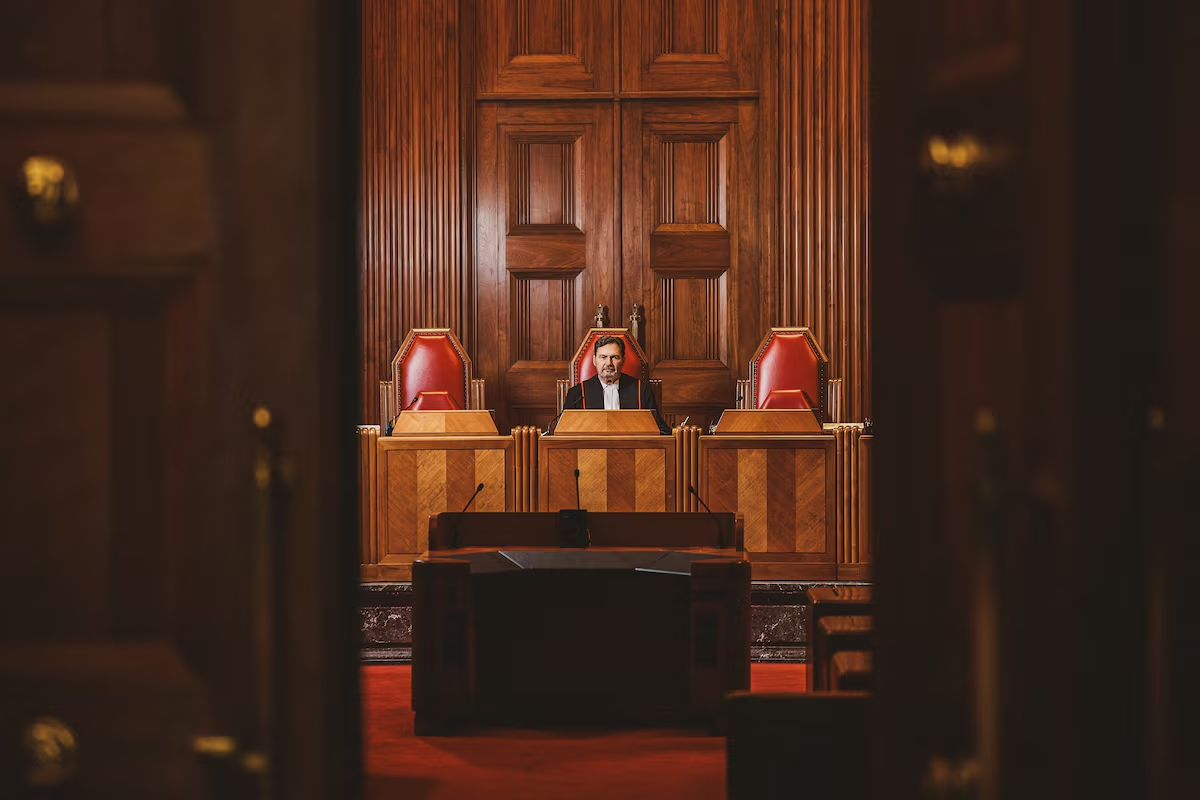
Richard Wagner was 18 when he watched his father’s dreams collapse in defeat.
In 1976, Claude Wagner arrived in Ottawa at the federal Progressive Conservative convention as the front-runner to become the party’s new leader, the one to unseat Pierre Trudeau as prime minister.
Voting started at noon on a winter Sunday. After the first ballot, victory felt within grasp. Mr. Wagner, a veteran of Quebec politics, was comfortably ahead of two younger upstarts, a Quebec rival, Brian Mulroney, and an Albertan, Joe Clark.
To Richard Wagner, soon to start his law studies at the University of Ottawa, this was his father’s destiny. From boyhood, Claude was Richard’s lodestar. A kaleidoscope of memories resonated: the ever-present milieu of politics at the dinner table in Montreal; Claude’s rise from lawyer to judge to politics amid Quebec’s Quiet Revolution in the 1960s; visits to the stately courthouse downtown where Claude, serving as the province’s first justice minister, had an office.
At the convention, Richard was one of his father’s political organizers. The lead narrowed on the second and third ballots. On the fourth round, Mr. Wagner lost to Mr. Clark by 65 votes. Many on Mr. Wagner’s team wept.
Open this photo in gallery:
Claude Wagner, with wife Gisèle in 1976, was the front-runner in that year’s race to succeed Robert Stanfield as Progressive Conservative leader.Dennis Robinson/The Globe and Mail
A half-century later, in his son’s corner office at the Supreme Court of Canada on a bluff above the Ottawa River, Parliament Hill stands in the near distance outside the window. Long-ago memories remain present. “It was painful,” said Chief Justice Richard Wagner in an interview. “Because I could see that for him it was very painful. I felt the same pain. It was a very difficult period.”
The Chief Justice keeps a striking black-and-white image of his father at the convention near his desk. Claude died of cancer three years later, as his son graduated from law school.
Richard Wagner followed his father into the law but swore off politics. Yet the calling of the path Claude had blazed was powerful. The duty of public service, the mission – and desire – to lead. His father’s unfinished business propelled Chief Justice Wagner throughout his life.
He was appointed to the Supreme Court in 2012 after a respected career in Montreal as a litigator and judge. When he swore his oath of office, he evoked his father’s public service at a ceremony in the courtroom. “His generosity and noble spirit always inspired me to follow in his steps,” he said.
Five years later, when Richard Wagner was named the 18th Chief Justice of Canada, the son ascended a mountaintop that had eluded his father.

Chief Justice Richard Wagner keeps a photo of his father at his Supreme Court office.
Nicolai Gregory/The Globe and Mail
The Globe and Mail spoke with the Chief Justice in two interviews, each an hour long, and interviewed more than three dozen people across the highest levels of Canada’s justice system, a range of lawyers, academics and judges. The Globe is not naming all of them because they were not authorized to speak publicly about private discussions.
What emerged is a portrait of a leader who has asserted a strong public voice far beyond the bench. But more than eight years into the job, at age 69 and with six years until mandatory retirement, Chief Justice Wagner’s leadership garners as many detractors as admirers.
He is praised for his work to open the doors of the Supreme Court to Canadians. At press conferences and elsewhere, he extols the institution as a pillar of the country’s democracy and warns of attacks on the rule of law. He has written a series of key judgments that shaped Canada in distinct ways, on everything from bail to carbon pricing.
But his apparent penchant for attention – in a break from tradition, his bust is already on display at the Supreme Court – colours views of his work. As he prioritizes a public voice, the primary criticism of Chief Justice Wagner is that his record at the court does not live up to the standard of his predecessors.
There are open questions about a fractured bench riven by dissent among the judges.
Some critics say it is a weak court compared with its forebears. Chief Justice Wagner, in a role that is supposed to be first among equals, can wield an imperiousness and on some internal decisions rules by fiat. The court has become at times an unhappy workplace. And the Wagner court hears significantly fewer cases than those in years past.
Open this photo in gallery:Open this photo in gallery:
The flag outside the courthouse can be mistaken for a Canadian flag at a distance, but look closer and you’ll see nine maple leaves, one for each of the justices.Sean Kilpatrick/The Canadian Press
Now, he faces his most difficult test: a country-shaping landmark ruling, bigger than any he has presided over before. It is among the most important decisions the court has weighed in the era of the Charter of Rights and Freedoms and one that will shape his legacy as Chief Justice.
In March, the court held one of the longest hearings in its history, four days, to weigh Quebec’s Bill 21 and whether to limit politicians’ use of the Charter’s notwithstanding clause.
Bill 21 prohibits public sector workers in Quebec, including teachers and police officers, from wearing religious symbols such as a hijab or a cross on the job.
The goal is secularism but many people believe the law flagrantly violates freedom of religion and, worse, is a state attack on minorities.
But the notwithstanding clause allows governments to ignore large parts of the Charter, as Quebec did with Bill 21.
It is a clash that revolves around fundamental questions about how Canada operates as a federation. It is a political tinderbox.
Open this photo in gallery:
Bill 21 has been in force in Quebec since 2019, raising debates about religious freedom within the province and beyond.Graham Hughes/The Canadian Press
Quebec insists its political soul is at stake. Ontario and Alberta urged the judges to keep their hands off. The three conservative-led provinces demand that the political power of the notwithstanding clause stand unchanged. But the federal Liberal government, and an array of civil rights and other groups, insist the top court must impose new limits on the clause.
As Bill 21 made its way through the lower courts in Quebec, Chief Justice Wagner spoke with colleagues about the political risks of the case. Sources said he was reluctant to hear it at all.
At the March hearing, however, he was the central presence. His deep Quebec roots – and his father’s experiences – gave him a clear vantage on the myriad political and legal nuances.
It is his job to guide the court out of this crucible and shepherd its deliberations. The pressure to deliver a decisive judgment, with a minimum of dissent, is immense.
Earlier benches at the top court were more divided than the Wagner era. The 1990s was one such time. Powerful personalities did not get along. But when it counted most – the 1998 Quebec Secession reference case – the nine spoke as one. They delivered Canadians a judgment signed “The Court.”
“This will be Wagner’s test,” said David Schneiderman, a longtime law professor at the University of Toronto. “To see whether he can bring unity to the Supreme Court.”
The climb
Richard Wagner was born April 2, 1957, in Montreal.
His mother, Gisèle Normandeau, worked in an office and came from a Québécois family. His father’s side was new to the province and as with many who left Europe a century ago, details are sparse. “I was never able to find out,” the Chief Justice said. “Somehow, it was like a blank part of history.”
His grandfather, Benjamin Wagner, was a Jewish immigrant from central Europe who played violin at movie theatres in the silent film days. After the talkies emerged, he worked in a textile factory. His son Claude’s professional rise was swift. He became a judge at 38, and soon after was elected to the province’s National Assembly. As justice minister, he battled organized crime. A 1966 headline dubbed him Quebec’s gangbuster.
Richard’s boyhood was heady with change, the Quiet Revolution, when the provincial government wrested power away from the Catholic Church. “Every day brought new things,” he said of the 1960s in Montreal. In grade school, two visits with his dad to the old courthouse, designed by local architect Ernest Cormier – who also designed the Supreme Court of Canada – imprinted a lasting impression. “There was some kind of peace,” he said. “That was the feeling I had when I entered.”
Open this photo in gallery:
The Montreal courthouse of Richard Wagner’s youth is today the Quebec Court of Appeal, down the street from the present-day courthouse. He would work in both buildings as a judge.Christinne Muschi/The Canadian Press
He attended Collège Jean-de-Brébeuf, the elite private school that educated the Trudeaus and the Péladeaus. Richard excelled there and thrived in football and lacrosse.
In 1978, two years after Claude Wagner lost the Conservative leadership, Pierre Trudeau appointed him to the Senate. Cancer killed him the next year. He was 54.
When Claude was dying, Mr. Trudeau brought Richard, as he finished law school, to his office across from Parliament Hill. “He tried to give me some comfort,” said the Chief Justice. “Very generous, very gracious. I’ll never forget that.”
Open this photo in gallery:
Pierre Trudeau plays with son Justin in 1979, the year the elder Trudeau comforted Richard Wagner as his father was dying.Peter Bregg/The Canadian Press
In 1980, Richard Wagner returned to Montreal and started at a prominent firm, Lavery de Billy. He focused on commercial litigation and specialized in construction law. He liked to show up at the office before anyone else and in court he got to the point with direct arguments. “He wanted to win all the time,” said Michel Yergeau, a former partner at Lavery, retired judge, and a friend of the Chief Justice.
He eschewed divisive politics, staying away from the separatism debates, but took on leadership in the law. In 2001, he became president of the Montreal bar association. Paul Martin’s Liberals named him to the bench in 2004.
As a new trial judge on the Quebec Superior Court, he immersed himself in criminal law and gained a reputation for being tough on crime, not unlike his gangbuster father.
Among his biggest judgments was the 13-year jail sentence he imposed in 2009 on Vincent Lacroix, who had orchestrated the Norbourg mutual fund fraud and stole more than $100-million from thousands of investors. It was billed as the harshest-ever sentence for a white-collar criminal in Canada. Justice Wagner, in his ruling, wrote of the “moral violence towards the victims and their families.”
Open this photo in gallery:
Justice Wagner delivered a 13-year sentence to Vincent Lacroix, ex-president of the Norbourg investment company.Ryan Remiorz/The Canadian Press
In early 2011, the federal Conservatives elevated Justice Wagner to the Quebec Court of Appeal. A year later, he considered the case of Jacques Delisle, a former judge who had been convicted of first-degree murder for killing his wheelchair-bound wife. He shot her in the head.
Mr. Delisle sought bail pending appeal. Justice Wagner forcefully rejected it. The ruling caught the eye of then-prime minister Stephen Harper.
That spring, Supreme Court Justice Marie Deschamps, one of three Quebec judges, had announced her retirement. In October, 2012, Mr. Harper appointed Justice Wagner, at age 55, to the Supreme Court of Canada.
Richard Wagner joined the Supreme Court when it was led by Beverley McLachlin, an Albertan who kept a painting of her hometown, Pincher Creek, in her office. By the court’s conventions, her retirement left the job open to a Quebecker.
Fred Lum/The Globe and Mail
The cusp
In late November, 2017, with Chief Justice Beverley McLachlin’s retirement two weeks away and a new chief not yet named, the Supreme Court convened for a highly anticipated hearing on freedom of religion and equality rights at Trinity Western University.
Justice Wagner was the senior judge from Quebec. It meant he was set to become, by convention, the next chief justice. Since 1944, the job had alternated, eight out of nine times, between English Canada and Quebec.
A rival contender loomed, Ontario’s Rosalie Abella. The decision belonged to Prime Minister Justin Trudeau. Justice Abella, although close to mandatory retirement, was the court’s leading liberal.
People lobbied for her, according to a source with direct knowledge of the process who wasn’t authorized to speak publicly. A mid-November story in The Globe about Justice Abella’s potential promotion was headlined: “PM may skirt tradition in top-court choice.”
Open this photo in gallery:
Rosalie Abella’s appointment to the top job would have bucked tradition, but The Globe reported in late 2017 that it was a possibility.Dave Chan/The Globe and Mail
Like his father Claude four decades before, Justice Wagner was the front-runner for the top job. But what felt like certain victory was suddenly no longer assured.
Four months earlier, Justice Wagner ignited a blaze of political heat in the Trinity Western case. The evangelical Christian university east of Vancouver wanted to open a law school but required students to sign a pledge of celibacy outside of heterosexual marriage. Two provincial law societies refused to accredit the law school because the pledge was discriminatory.
About two dozen groups applied to the Supreme Court to present brief arguments as interveners. Justice Wagner, on behalf of his colleagues, said yes to nine and no to the rest. He granted standing to several religious groups but not to any LGBTQ groups.
The decision became public on a Friday in late July. Outrage ensued online. The following Monday, in a rare move, Chief Justice McLachlin varied Justice Wagner’s order. She added a second hearing day and granted standing to all interveners.
In another rare move, the court put out a news release several days later to explain itself. It cited the time constraints behind Justice Wagner’s order. Scheduling is the job of the chief justice. With an extra day, the Chief Justice and Justice Wagner agreed there was time for everyone.
The explanations continued in an interview Justice Wagner did with The Globe at the time. “There was no intent to exclude,” he said.
Open this photo in gallery:
Trinity Western University’s campus in Langley, B.C., was a hub of controversy when it planned to open a law school – and have students pledge to abstain from sex outside of heterosexual marriage.Ben Nelms/The Globe and Mail
At the end of November, when the nine judges entered Canada’s apex legal arena – a regal courtroom with vaulted ceilings, plush red carpet and walls of warm black walnut – the venue was at capacity. They walked in as always in order of seniority. Justice Abella sat to the Chief Justice’s right. Justice Wagner took his usual seat one chair over from the chief’s left.
Trinity Western’s lawyer, Kevin Boonstra, faced the elevated bench as the hearing began. He had spoken for one minute when Justice Wagner cut in. It was to ask a question but, to many people in the courtroom, it sounded like a speech – one directed at a wider audience, including the Prime Minister’s Office up the street.
Justice Wagner spoke for 90 seconds. He talked of how a LGBTQ student at a Trinity Western law school would have to hide their identity – “which will bring some pain and suffering and could attack the human dignity” – and called Trinity Western’s student pledge “obvious discrimination.”
The exchange between lawyer and judge extended through the first 10 minutes of the hearing. It was more like a debate. Such a back-and-forth, on another day, wouldn’t be out of place. But this felt different. “He was campaigning for the job of Chief Justice,” said one lawyer who was in the courtroom that day.
When presented with how people remember the hearing, Chief Justice Wagner expressed surprise. “This is the first time I heard that,” he said in a recent interview at his office.
“There was no strategy behind that. Sometimes I will ask the first question. Sometimes I will ask the last question.”
Open this photo in gallery:
Prime Minister Justin Trudeau had the final say on whether Richard Wagner would become chief justice in 2017.Blair Gable/The Globe and Mail
Regardless of motivation, any fears that a father’s fate would befall the son were unnecessary. The Prime Minister’s Office in the summer took note of the interveners controversy but by late November a consensus had formed in the office, according to another source with direct knowledge of the process.
The government announced the decision Dec. 12, 2017.
The telephone call came the night before, at around 8 p.m. Justice Wagner and his partner, Justice Catherine Mandeville of the Quebec Superior Court, were driving in her old Subaru to get pizza at a favourite Ottawa spot, Tennessy Willems, to celebrate her birthday. On the line, the Prime Minister asked Justice Wagner if he would take the job.
“It was,” Justice Mandeville said in an interview, “quite an emotional moment.”
The summit
Judges’ work, most days, is rooted at the courthouse. In 2012, when Justice Wagner was first named to the Supreme Court, he declared his broader ambitions.
He immediately did an interview with The Globe. A week after he was sworn in, a story ran on the front page. The rookie Supreme Court judge proposed a national summit of political leaders and judges to grapple with a slow, costly and opaque justice system. “It can create serious problems for democracy,” Justice Wagner told The Globe.
His idea didn’t get much farther than the newspaper, but it affirmed his expansive view of a top judge’s role. After he became Chief Justice, he made the ambassadorial mission a pillar of his work. It draws plaudits – and criticisms.
“It’s important that judges take the opportunities that are given to them to speak about the justice system,” Chief Justice Wagner said in a recent interview at his office, the old photograph of his father nearby.
In a new tradition, he conducts annual press conferences each June, broaching a range of issues and always warning of risks that could threaten Canadians’ faith in the courts. Last year, to mark the court’s 150th anniversary, Justice Wagner led a publicity tour to five cities across the country.
The goal is for people to better understand “what we do, why we do it, and how we do it,” he said. His desire to showcase the court’s work is almost plaintive: “I wish people would know more about it.”
Open this photo in gallery:
The Supreme Court justices were guests of honour in Winnipeg in 2019. They came to this ceremony where Indigenous leaders gave the Manitoba courts eagle feathers, sacred items that can be used for oaths.John Woods/The Canadian Press
University of Ottawa president Marie-Eve Sylvestre, who has worked with the Chief Justice on events at the school, said senior judges need to speak out.
“He’s proud of judges across the country,” said Ms. Sylvestre. “I understand why some people may be criticizing but, for me, it’s really a risk that the court has to take to make sure people understand why this institution is so important for our democracy.”
These efforts have partly overshadowed his work at the court. Chief Justice Wagner’s legal legacy exists in the long shadow of his predecessors, such as former chief justice Brian Dickson in the 1980s, who led the court in the early years of the Charter of Rights, and especially Ms. McLachlin, the longest-serving chief justice, who served in the role for almost 18 years.
But Chief Justice Wagner has been at the helm on numerous key rulings. While the pending Bill 21 is the big one, his work on the bench is already influential.
Open this photo in gallery:
Bail and sentencing have been the central issues in several of Chief Justice Wagner’s precedent-setting cases.Peter Power/The Globe and Mail
He wrote three defining rulings on how judges in the lower courts apply the law of bail, one of which reverberated politically for years after. In mid-2017, a few months before his promotion, his Antic ruling leaned liberal. It stated bail should be granted, if justified, to an accused but still innocent person at the earliest opportunity on the least onerous grounds. This was, he wrote, essential to an “enlightened criminal justice system.”
The federal government codified the Antic ruling in the Criminal Code in 2019. Yet a steady increase in violent crime that started in the mid-2010s fuelled political pressure from the left and right that demanded a reversal. Last fall, Ottawa backed away from its 2019 revisions and made bail less lenient. The bill became law in mid-June.
The Chief Justice in other cases has taken a conservative tough-on-crime approach. His 2019 Friesen ruling, a sentencing precedent, pushed judges to levy longer punishments on perpetrators of sexual crimes against children.
Chief Justice Wagner has also written major decisions on the division of federal and provincial powers. In 2021, the court favoured Ottawa on carbon pricing in the Greenhouse Gas Pollution Pricing Act reference case. Two years later, the court handed a win to the provinces on industrial projects in the Impact Assessment Act reference case.
“It was highly political,” said Prof. Schneiderman.
The University of Toronto professor doesn’t mean ideological. He sees a judge who considers the political landscape beyond the courtroom, such as provincial-federal power dynamics and frayed relations.
“That speaks to Wagner’s leadership. He’s a political guy. He’s his father’s son.”
Open this photo in gallery:
Carbon pricing and environmental regulation are hot-button issues in Western Canada, and the Supreme Court plays a big role in adjudicating ground rules for Ottawa and the provinces.Jeff McIntosh/The Canadian Press
The Chief Justice’s most important ruling will sound a bit boring: a 2019 judgment called Vavilov that resolved a legal debate in administrative law. This is a mostly unseen but omnipresent part of the legal system, where the courts assess government decision-making and citizens can seek review of rulings from tribunals such as the Immigration and Refugee Board of Canada.
Until the Vavilov ruling, how judges reviewed such decisions was a mess. There was little coherence and a lot of wasted court time.
Chief Justice Wagner sought to solve the problem. The Supreme Court took on three similar appeals, invited interveners to join in and, unusually, solicited outside legal help.
The central case was that of Alexander Vavilov, born in Toronto in 1994. His parents were Russian spies, the inspiration for the television show The Americans. After the FBI arrested the spies in 2010 near Boston, Mr. Vavilov applied to renew his Canadian passport. In 2014, the federal Registrar of Canadian Citizenship cancelled his certificate of citizenship.
The registrar’s reading of federal regulations, and the Citizenship Act, determined Mr. Vavilov should not have been granted Canadian citizenship at birth because his parents had been employees of a foreign government.
Open this photo in gallery:
Alexander Vavilov’s parents lived in the United States as Tracey Ann Foley and Donald Howard Heathfield, before they were revealed to be Russian spies. That set off a legal debate about their son’s Canadian citizenship.U.S. Marshals via AP
Mr. Vavilov won at the Supreme Court in a 7-2 decision. Chief Justice Wagner, the lead author, ruled that the registrar’s conclusion was unreasonable. The larger legal breakthrough: the judgment clarified how courts should review administrative decisions writ large.
“I’m very proud of that decision,” said Chief Justice Wagner. “It was a group decision. It was a big majority.”
Legal experts view Vavilov as one of the most impactful judgments from the top court this century. It is repeatedly cited in administrative law rulings on a vast array of government decisions. This year, in mid-January, the Federal Court of Appeal leaned on Vavilov extensively when it found that the federal government’s 2022 decision to invoke the Emergencies Act to end the pandemic trucker protests was not legally justified.
The Chief Justice made it to the Supreme Court on appointment by a Conservative. A Liberal elevated him to the top job. Then and now, while his political instincts are evident, he is part of the court’s wide middle.
“He’s proved very effective as a chief justice,” said veteran Montreal lawyer Julius Grey, “perhaps because of the absence of a strong political ideology.”
The exposure
To his critics, who prefer monastic judges, the Chief Justice is a flâneur.
He’s not the first judge to court public attention. Former chief justice McLachlin gave many speeches and, over her long tenure, became an exception among those behind the bench – a judge whom Canadians knew relatively well. Yet Chief Justice Wagner’s style provokes rumbling discontent.
The outward symbol that draws heated negative attention is his bronze bust. It stands in the courthouse entrance hall. Busts of chief justices are typically installed there after they retire and a plaque notes who paid for them. Chief Justice Wagner’s bust does not. “I don’t know who paid for that,” he said at last year’s press conference when pushed on its provenance.
The secrecy rankles detractors. But Howard Anglin, a Conservative political strategist and former top adviser to Stephen Harper, is not among the incensed. “It’s gauche and embarrassing,” he said, “but it doesn’t make me angry.”
Still, Mr. Anglin, who described the Chief Justice as a “workmanlike, capable jurist,” questioned his seeking of a spotlight.
“I don’t think he’s inclined to humility,” Mr. Anglin said. “That worries me because I do think a proper judicial temperament would be a little more self-effacing.”
In Chief Justice Wagner’s eight-plus years leading the court, he’s put his visual stamp on the institution. The most obvious debuted last fall: new ceremonial robes for the judges, black with red stripes and intricately embroidered with new heraldic emblems. He called the robes distinctly Canadian. They replaced the heavy red robes trimmed with white fur whose style dated back centuries to England.
Open this photo in gallery:
Chief Justice Wagner’s ceremonial robes were red when he first joined the Supreme Court. Under his watch, the judges switched to black.Nicolai Gregory/The Globe and Mail
Choices that some label as attention-seeking have had a cumulative effect on the Chief Justice’s reputation.
It is worsened by the fact the current Supreme Court looks less productive than those of the past. The Wagner court in its first eight years produced an annual average of 53 judgments, lower than the McLachlin court’s annual average of 72 over the previous eight years.
The powers of a chief justice are not like those of a prime minister or a chief executive. In former chief justice McLachlin’s memoir, she remembered what a retired California chief justice told her when she got the job: “Don’t get too excited. They hand you the reins of power. It takes about three days to discover they aren’t connected to anything.”
The court’s work inherently involves disagreement among people with sharp intellects and strong opinions. All nine judges do a lot of their work independently. Early in his tenure, to promote a stronger sense of team, Chief Justice Wagner initiated morning meetings before hearings, so the judges can talk about a case before they enter the courtroom.
“I try my best to make sure that we are collegial,” he said. “Not to agree on everything but to do it in a collegial way.”
A chief justice cannot order their colleagues how to decide a case, but they can exert themselves when it comes to the operations of the court. Among Chief Justice Wagner’s significant internal management decisions is his effort to limit interveners.
Not every judge agrees.
During the pandemic, the court operated on Zoom. In 2022, when in-person hearings resumed, Chief Justice Wagner kept the interveners on Zoom and out of the courtroom. The decision stoked the umbrage of many lawyers. It was his call, according to a person with direct knowledge of the decision-making who wasn’t authorized to comment publicly.
Open this photo in gallery:Open this photo in gallery:
COVID-19, which closed businesses across Canada, also slowed the Supreme Court, which began to operate over Zoom.Adrian Wyld/The Canadian Press
Chief Justice Wagner is not the first headstrong boss at the Supreme Court. Former chief justices such as Antonio Lamer had similar reputations. But there are strains within the current group, according to multiple sources with knowledge of the workings of the court. There are personality clashes. Two people said it is not a happy workplace. Another said some judges will sometimes work from home or not join their colleagues for lunch, though they also described the level of discord as medium, compared with tough times on past courts.
Tension spiked three years ago.
In the Supreme Court annals back to 1875, a judge getting into a fight at a fancy hotel is an incongruous chapter. Such a situation presented Chief Justice Wagner with a decision to make in early 2023.
It had been a celebratory evening at the Omni Scottsdale Resort in the Phoenix suburbs. Former Supreme Court justice Louise Arbour received an award for her career’s work and Justice Russell Brown introduced her.
Justice Brown had been on the court since 2015. In several ways, he was the opposite of Chief Justice Wagner. He grew up in a village in northern British Columbia where his family ran the local hardware store. On the bench, he was a favourite among conservatives.
At the Omni hotel, after the gala, Justice Brown visited the hotel bar and a group invited him to join their table. According to a police report whose details he later disputed, he flirted with two women. One woman said there was no sexual touching but called his behaviour creepy, as did a second woman who also described Justice Brown as very intoxicated.
The Paradise Valley Police Department report stated Justice Brown followed the group after they left the bar. One of them, a former U.S. marine, punched Justice Brown in the face near the hotel pool. No one was charged.
Open this photo in gallery:
Russell Brown’s dust-up in Phoenix left Chief Justice Wagner with a decision to make about how to address a complaint against the judge.Adrian Wyld/The Canadian Press
The next day, a Sunday, the Canadian Judicial Council received a written complaint from the marine. The council oversees judges’ conduct and reported it on Tuesday to Justice Brown and Chief Justice Wagner. The next day, the Chief Justice put Justice Brown on a paid leave of absence while the council assessed the complaint.
To the Chief Justice’s mind, the court’s reputation was at stake. The determining factor was the public interest. The decision, he said in an interview at his office, “was made by me, but after consultation with my colleagues.”
It remains unclear whether Chief Justice Wagner was empowered to do that. Chief justices choose the judges who sit at a hearing – most times all nine – yet power beyond that is uncertain in federal law.
“I am skeptical he had the power to put him on leave as it is defined in the Judges Act,” said University of Alberta associate law dean Gerard Kennedy.
In June, as the judicial council readied a public hearing on the allegations, Mr. Brown retired. It ended the saga.
The legal community is divided on the Chief Justice’s initial decision. Some, including his critics, say he made the right call in a difficult situation, as a judge of the Supreme Court faced unproven but serious allegations. Others insist Justice Brown was unjustly pushed off the bench.
Yet there’s been no open debate. Prof. Kennedy suggested there’s hesitance to question it. “Do people want to offend the Chief Justice of Canada?”
When asked about his conversation with Justice Brown after the hotel fight, Chief Justice Wagner made it plain he wants to leave the story in the past. “I would prefer not to deal with that situation,” he said. “There was an incident, there was an investigation, and he decided to retire.”
When the debate about ‘laïcité,’ or secularism, came to the Supreme Court this past March, protesters showed up outside the building to have their say. The hearings were livestreamed in the entrance hall.
Sean Kilpatrick/The Canadian Press
The crux
Outside the Supreme Court building, on an early spring morning with sharp gusts of winter wind, protesters hoisted signs decrying Quebec’s Bill 21. It was the first day of the landmark hearing. “Don’t erase our identity,” read one. Another heralded: “Diversité.”
Lawyers packed the courtroom. Six groups of appellants vied against the government of Quebec. One group calling on the court to strike down Bill 21 invoked the dangers to Canada if a “mini-Trump” were ever elected.
Chief Justice Wagner, however, expressed a steady skepticism of such fears from the bench.
That first Monday morning in March, he repeatedly brought arguments over secularism back to Quebec’s Quiet Revolution. “Religion was everywhere,” he said of Quebec’s past. It was his boyhood, under the tutelage of his political father, when he watched the Church’s influence diminish.
On the final hearing day, Chief Justice Wagner suggested the judges had not been swayed by arguments of future abuses of the notwithstanding clause. “I don’t think that this case will be disposed of by extremist or catastrophic scenarios,” he said of the thinking behind an eventual judgment.
Open this photo in gallery:
The Mount Royal Cross had already been standing for decades when Chief Justice Wagner was a child in Montreal, an era he brought up at the Bill 21 hearing to note the role religion has played in Quebec history.Bibliothèque et Archives nationales du Québec
The hearing moved a years-long legal process towards a culmination.
In April, 2021, after a 33-day trial, the Quebec Superior Court upheld Bill 21 because of the notwithstanding clause. The Quebec Court of Appeal unanimously upheld the law, for the same reason, in February, 2024.
Applications to appeal to the Supreme Court landed two months later. The Supreme Court Act outlines criteria the judges consider when they decide on hearing a case. These include issues of national importance and legal disagreements in the lower courts. Bill 21 was big – but the Quebec courts had been clear. There were good reasons for the Supreme Court to take the case and likewise valid reasons to decline.
The court accepts cases if at least four judges are in favour.
The deliberations extended into early 2025, twice as long as average. According to several sources with knowledge of the decision-making who were not authorized to speak publicly, Chief Justice Wagner voted no.
Daniel Byma, the Chief Justice’s executive legal officer, said decisions on whether to take cases are “made by the judges together” in a confidential process.
On Jan. 23 last year, the court announced it would hear the appeal.
The judgment – which might be issued as early as the end of November – is a legal and political crux. The Supreme Court must weigh political power, provincial autonomy, the Constitution and the Charter, all of it considered against the increase in government incursions on minority rights. It could spark a political conflagration.
Eugene Meehan, an Ottawa lawyer who was an executive legal officer to former chief justice Lamer, described Chief Justice Wagner as a pragmatic jurist, a centrist who favours an incremental approach to the law.
“The stakes of Bill 21 are the future of the Canadian federation,” Mr. Meehan said. “The Supreme Court has a key opportunity to strike a balance for the country. To send a clear message about the limits of provincial autonomy and the scope of government powers.”
Open this photo in gallery:Open this photo in gallery:
Canada’s Constitution, signed by Queen Elizabeth II in 1982, included the notwithstanding clause as a compromise with provinces. The Bill 21 case tests that consensus.Erik Christensen/The Globe and Mail; Andy Clark/UPC
Unanimity, or something close to it, remains the toughest hurdle. Chief Justice Wagner has always welcomed dissent, more so than former chief justice McLachlin, and Justices Suzanne Côté and Malcolm Rowe are two of the most prolific dissenters in the last half-century.
But in major cases of the past, judges strived to find common ground, said former Supreme Court justice Marshall Rothstein.
He recalled the unanimous 2015 Carter decision that led to medical assistance in dying, where he and his colleague, Justice Wagner, were among the nine who came to consensus. The Carter decision was signed by “The Court,” the same as the 1998 Secession reference. To get there, a chief justice’s leadership – and collective compromise among all the judges – is essential.
“It may mean that you put a little water in your wine but it was important that the court come out with a unified unanimous judgment,” Mr. Rothstein said.
Mr. Anglin, the Conservative strategist, urged Chief Justice Wagner and the top court for a cautious ruling on Bill 21.
“I want to say this carefully. He has a chance to make a grave error that could have deep constitutional repercussions for years to come,” Mr. Anglin said, referring to the imposition of restrictions on political leaders’ use of the notwithstanding clause.
To Mr. Anglin, the right decision is to reaffirm the Supreme Court’s 1988 Ford precedent, when it endorsed governments’ mostly unfettered right to use the power as they like.
Should a majority of judges, led by Chief Justice Wagner, choose this path, Mr. Anglin said: “Then, perhaps paradoxically, he’ll have done the right thing – but not the memorable thing.”
Open this photo in gallery:
A ruling on Bill 21 from the Wagner court could land as early as the end of November.Nicolai Gregory/The Globe and Mail
A half-century ago, when a teenage Richard Wagner watched his father Claude lose the biggest vote of his life, an inch away from victory, the young man swore off the political arena. In the law, he followed his father’s path of public leadership. Work on the country’s top bench brought back into the maw of politics.
Back in 2012, ahead of the Chief Justice’s appointment to the Supreme Court, labour lawyer and NDP MP Françoise Boivin sat on the committee that advised Stephen Harper on the candidates. Ms. Boivin and the group endorsed Justice Wagner.
His passion for the justice system, his sound judgments, and his open ear to listen to arguments impressed Ms. Boivin. She feels he has fared well through his tenure. He’s poised for this moment.
On Bill 21, Ms. Boivin hopes he delivers a ruling that is “clear, straightforward, not wishy-washy.”
“I’m sure they feel the weight,” Ms. Boivin said of the Chief Justice and his colleagues working on the landmark ruling. “They don’t live in a monastery. They’re well aware of the politically charged atmosphere.”
Chief Justice Wagner is a man who leans to a formal bearing. His handshake is firmer than most. And he knows the weight of history. At 18, he watched it unfold. At 69, he’s at the helm. Outside work, he reads biographies and ponders how others shouldered such moments.
“How they lived through history,” he said. “How they think, when dealing with specific challenges. I always like to see the behaviour of people and, even in difficult circumstances, how they deal with the issues. You learn a lot about human beings.”
Bill 21 and beyond: More from The Globe
Open this photo in gallery:
Graham Hughes/The Canadian Press
The politics at play
A constitutional clash pits Canadians’ rights against government powers
For two Muslim teachers, the Bill 21 saga is personal
With fall election looming, Quebec’s new Premier tries to make her mark
Commentary
Sheema Khan: In Quebec, laïcité has become its own kind of religious orthodoxy
Michael W. Higgins: Will Bill 21 complete Quebec’s unfinished revolution against Catholic culture?
The Decibel podcast
How did the notwithstanding clause end up in Canada’s Constitution, and how have provinces used it? Justice reporter David Ebner spoke with The Decibel about that ahead of March’s Supreme Court hearings on Bill 21. Subscribe for more episodes.