
Open this photo in gallery:
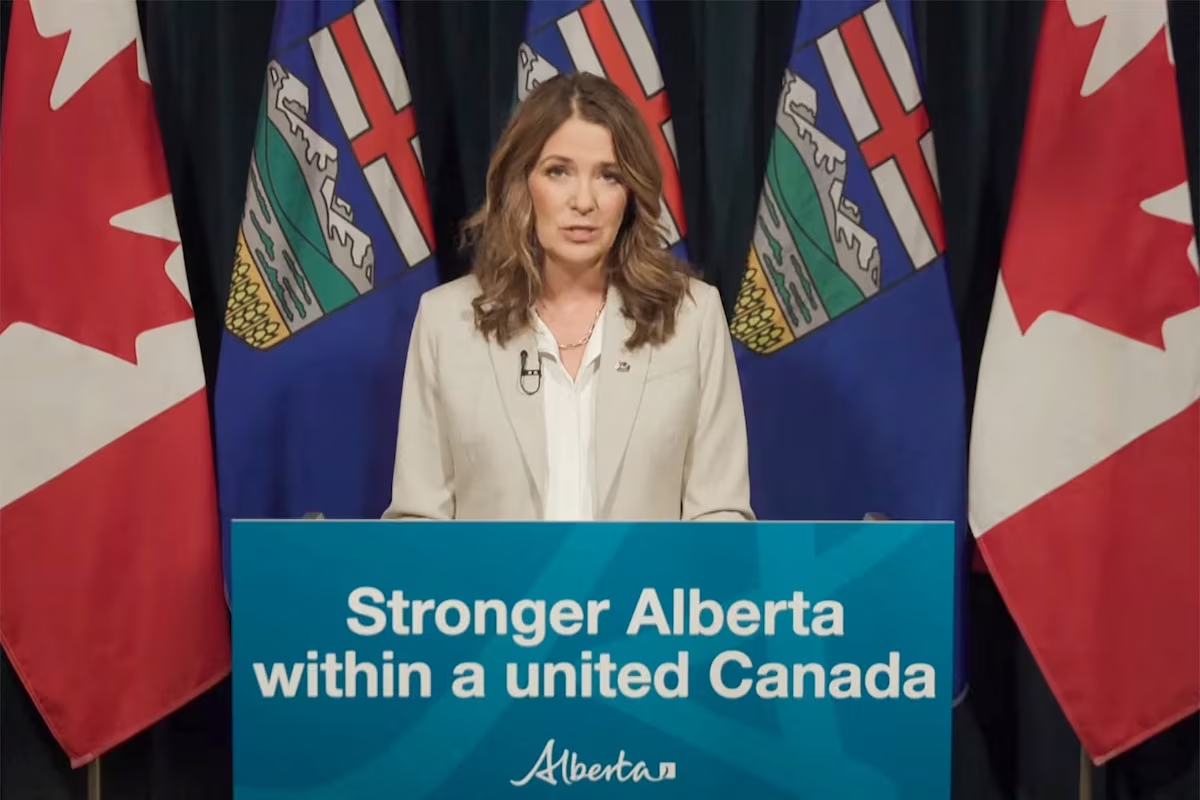
Alberta Premier Danielle Smith makes a televised address a day after Alberta’s referendum.Alberta Government/Reuters
A day after Albertans voted overwhelmingly to remain a part of Canada, Premier Danielle Smith heralded progress with Ottawa but remained defiant in her plan to extract more autonomy from the federal government, even as she pledged not to hold another separation referendum while in office.
Ms. Smith said she will work co-operatively with her federal counterparts, but also issued a warning to Prime Minister Mark Carney.
“We will use every legal and political tool at our disposal to protect and advance the interests of Albertans,” she said in a televised address on Tuesday night.
“And when Ottawa interferes with those rights, we will be unrelenting in our response.”
Ms. Smith encouraged Albertans to turn the page on separatism and said that, under her watch, the province wouldn’t hold another referendum on the issue.
“Yesterday, Albertans made their choice. Today, we begin the next chapter,” she said.
Opinion: Alberta’s separatists lost badly. Danielle Smith might have lost even worse
On Monday, roughly 75 per cent of voters in the province endorsed remaining in Canada without moving toward holding a future separation referendum.
The result mirrored more than a year of public-opinion polling on the issue and was met with relief from federalists and business leaders, many of whom had issued grave warnings about the dangers of a binding separation vote.
Alberta’s referendum – the first time the province has put a secession question to voters – emerged over the past year as one of the greatest stress tests of national unity in decades. It added to two active threats to Canadian sovereignty: the recent election of a minority separatist government in Quebec, and U.S. President Donald Trump’s tariff war and musings about annexation.
The separation debate has roiled Alberta’s political arena. It started to emerge as the province’s dominant issue in March, 2025, after Ms. Smith threatened an “unprecedented national unity crisis” if Mr. Carney didn’t repeal a list of environmental laws she believed were stifling Alberta’s energy sector. A month later, she lowered the threshold needed for citizens to put questions to the electorate in a referendum.
After two separatist petitions hit roadblocks in the courts, Ms. Smith announced this spring that Albertans would be asked to pick between two options: remain in Canada or start the process toward a binding separation referendum.
The Alberta referendum by the numbers
Tension between Alberta and Ottawa is not new. The relationship grew particularly strained during former prime minister Justin Trudeau’s decade in office.
Addressing the quarter of the electorate who voted to hold a binding separation referendum, Ms. Smith said on Tuesday that those Albertans hold “legitimate frustrations.”
“You need to know that your voices have been heard. Not just by our government, but also by your fellow Albertans and your fellow Canadians,” she said.
Opinion: We don’t need an independent Alberta. We need to keep AIMCo independent
Relations between Alberta and Ottawa have thawed under Mr. Carney. Together, he and Ms. Smith have pursued building a bitumen pipeline to the West Coast, holding it up as proof Canada can work. The two campaigned side by side for the remain camp last week in Red Deer.
Ms. Smith’s support for remaining in Canada has not satisfied many of her critics, who’ve accused her of catering to separatists that public-opinion polls say make up a large chunk of her United Conservative Party base.
Political strategists say the referendum has weighed down her popularity, underlined in September by a shocking by-election loss to the Alberta NDP in one of the safest conservative seats in Calgary.
Mr. Carney said on Tuesday on Parliament Hill that he was “thrilled” with the referendum result: “They’ve chosen to continue to take care of each other, to move forward together with purpose, high ambition.”
Conservative Leader Pierre Poilievre celebrated the outcome as well, telling reporters in Calgary that it’s time to “focus on unity for everyone.”
Separatists, meanwhile, were left licking their wounds after failing to muster support for their cause. Mitch Sylvestre, chief executive of the Alberta Prosperity Project, said in an interview on Tuesday that he’s now focusing on getting more separatist allies on the UCP board and as party nominees for the next provincial election, scheduled for October, 2027, at the latest.
“We need some of our people to become MLAs,” he said.
Now, attention is likely to shift toward the nine other proposals on Albertans’ referendum ballots on issues of immigration policy and constitutional changes.
Five takeaways from Alberta’s separation referendum
Carving out greater autonomy for Alberta has been Ms. Smith’s governing thesis since she became Premier in September, 2022, and motivated her decision to put the other nine questions to the electorate.
Elections Alberta was still counting those ballots on Tuesday and few questions appeared to receive an overwhelming mandate from Albertans.
With 90 per cent of polls reporting, 54 per cent of voters had endorsed Alberta taking increased control over immigration. Meanwhile, a slim majority – roughly 51 per cent – had rejected a proposal to let provinces opt out of federal programs without losing the associated funding.
In her TV address, Ms. Smith declared victory on the immigration proposals and said she’ll wait for the results on the constitutional questions before making a decision on how to proceed.
Some corners in Alberta’s business community have voiced concern over the immigration questions, saying the province’s proposals would increase the cost of labour and make it harder to attract talent.
While the results of those questions were unsettled on Tuesday, Mr. Carney signalled that he is willing to work with provinces on immigration, which is already a shared priority between the two levels of government.
“Where we go from here needs to be established in co-operation with the provinces, and that’s very much the spirit of at least one of the questions,” he told reporters.
Prime Minister Mark Carney thanked Albertans for taking part in the ‘democratic process,’ saying on Tuesday the vote to reject the referendum question on separation is a ‘great result’ for the country.
The Canadian Press
He was less absolute about reopening the Constitution. Ms. Smith’s constitutional proposals, besides needing federal co-operation, would require support from seven of the 10 provinces, comprising half the national population.
“Constitutional change is difficult. It’s long … where we can find solutions that work for Canadians, we should find those solutions,” Mr. Carney said.
Ms. Smith’s government has not provided concrete details around how it would implement its immigration proposals. On Tuesday, she said her government will pursue those changes “in the coming months and years ahead.”
Leaders from across the country voiced their support for Alberta and were happy about voters’ choice to remain in Canada.
“I’m thrilled by the decisive support Albertans have shown for the country we all love,” Ontario Premier Doug Ford said.
In Quebec, newly elected premier-designate Paul St-Pierre Plamondon of the separatist Parti Québécois pointed to the early results on the nine questions as evidence that Albertans believe Canadian federation is a “straitjacket that prevents them from placing their priorities at the heart of their own public policies.”
“Prime Minister Mark Carney will therefore have to take note that Alberta residents are now questioning, just as Quebeckers did before them, the Canadian constitutional order and the abuses of power by the federal regime in areas of jurisdiction.”