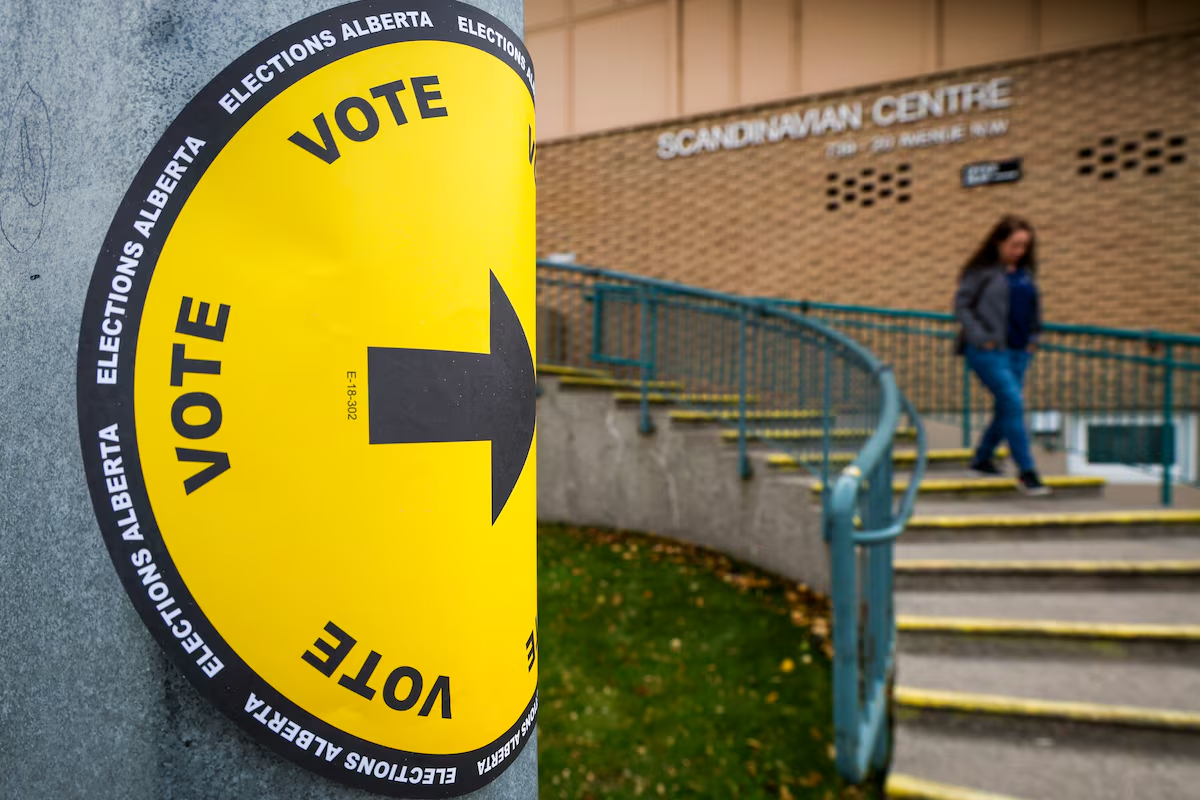

Open this photo in gallery:
A voter leaves a polling station after casting their vote in the Alberta referendum in Calgary on Monday.Jeff McIntosh/The Canadian Press
Five months after Alberta Premier Danielle Smith announced her government would call a vote on whether the province should pursue secession from Canada, Albertans at last know the results of its historic referendum.
The separation question, as well as nine other ballot questions on issues such as immigration, social services and judicial appointments, led to intense rhetoric and fierce campaigning. In the end, roughly a quarter of ballots cast supported a new, separate vote that could begin the legal process allowing the Prairie province to secede from Canadian federation.
While final results are still pending – Elections Alberta has said a full count is expected to take several days – preliminary tallies already reveal how voters have responded to the questions posed by the government.
Here’s a look at Alberta’s referendum by the numbers.
Turnout on separation
Preliminary results show that roughly 62 per cent of the province’s 3.1 million eligible voters cast a ballot on Question 10, which asked whether the province should hold a separate vote that could commence the legal process to separate. Turnout on that question was similar to the 2023 general election, when around 60 per cent of eligible voters cast a ballot.
Many voters chose to vote in advance or through a mail-in ballot. Roughly 43 per cent of eligible voters – 1.4-million people – cast a ballot this way during the referendum, according to Elections Alberta. This is far in excess of the 28 per cent of eligible voters who did so in 2023.
But an analysis also found that this turnout wasn’t uniform across the province.
While Elections Alberta has not yet published a breakdown of eligible voters in 2026 for each of the province’s 87 electoral divisions, it has done so for 2025. The Globe tallied up votes on the separation question for each district and compared that to the 2025 eligible-voter figures.
That analysis shows that turnout in divisions won by the United Conservative Party in 2023 was five percentage points higher than in areas that went to the New Democrats.
Separation strongholds
Preliminary results show that only two of Alberta’s 87 electoral divisions voted in favour of a separation referendum – and, in both cases, it was a slim majority.
Rimbey-Rocky Mountain House-Sundre, represented by United Conservative Party Finance Minister Jason Nixon, saw the strongest support for a separation question, with 51 per cent voting in favour of a referendum. The only other division to vote in favour of a separation question was Central Peace-Notley, represented by Forestry and Parks Minister Todd Loewen, also with 51-per-cent support.
In fact, the next 42 divisions with the most support for a separation referendum were all won by the United Conservative Party in 2023, the data show. On average, areas won by the UCP in 2023 voted for separation 33 per cent of the time, while divisions won by the Alberta New Democratic Party voted for separation roughly 15 per cent of the time.
The NDP district with the strongest support for separation was Banff-Kananaskis, a district located in the Rocky Mountains in southwest Alberta, at 20 per cent. The NDP division most staunchly in support of remaining in Canada was Edmonton-Strathcona, where 10 per cent of valid votes supported a separation referendum.
Urban-rural divide
At a glance, a map of the votes for and against separation falls along familiar Albertan lines: The big-city NDP strongholds of Calgary and Edmonton were strongly in favour of remaining in Canada, while rural areas, which have traditionally gone to the UCP, were more likely to vote to separate.
The Globe analyzed Alberta’s 87 electoral divisions and divided them into four buckets: districts representing Edmonton, those representing Calgary, those representing other major cities and those representing the rest of the province, much of which is rural.
Edmonton and Calgary saw the strongest support for federalism, at roughly 86 and 83 per cent, respectively. Other cities hewed more closely to the provincial average, with 73 per cent of districts voting to remain.
The rest of the province, meanwhile, was more supportive of a separation referendum. Those districts, which represent lesser-populated areas like Camrose, Peace River and Lacombe, saw 60 per cent support for remaining in Canada – a 26-point difference compared to Edmonton.
How Indigenous communities voted
Indigenous leaders in Alberta have been vocal opponents of Alberta’s separation movement, arguing that a break from Canada would infringe on their negotiated treaty rights.
While Elections Alberta’s data does not identify which votes came from Indigenous people, an analysis of polling stations located within Indigenous communities shows that voters in those areas overwhelmingly want Alberta to continue being a part of the Canadian federation.
The Globe identified 50 voting locations that sit primarily on First Nations land or Métis settlements and were reporting votes as of publication time. Of the 13,602 ballots cast at those locations, 95 per cent were in favour of Alberta remaining in Canada.
Some locations were even more vigorously opposed to separation. At a polling station located on the Tsuut’ina Nation southwest of Calgary, 98 per cent of 342 ballots cast were in favour of Alberta remaining a part of Canada. A polling location on Siksika Nation land that received 512 ballots was 99 per cent in favour of staying in Canada, and a voting location in the Tallcree First Nation, which had counted 102 votes as of publication time, did not see a single ballot cast in favour of separation.
The nine other questions
Votes are still being counted on the nine other questions put to people in Alberta. Elections Alberta said it was giving priority to tallying votes on Question 10, which concerns separation.
Preliminary results for most of the other nine other measures – including questions about Senate and judicial appointments, immigration and self-determination – are still close.
Question 5, which asks whether the government should implement stricter voter ID requirements, has the strongest support so far at 64 per cent. Seven other questions have support between 49 and 58 per cent.
As of publication time, only Question 8 – which asks whether voters support amending the Canadian Constitution to “allow provinces to opt out of federal programs that intrude on provincial jurisdiction such as health care, education, and social services” – has a majority “no” vote, at 51 per cent. Elections Alberta has said it expects its count to take two days.