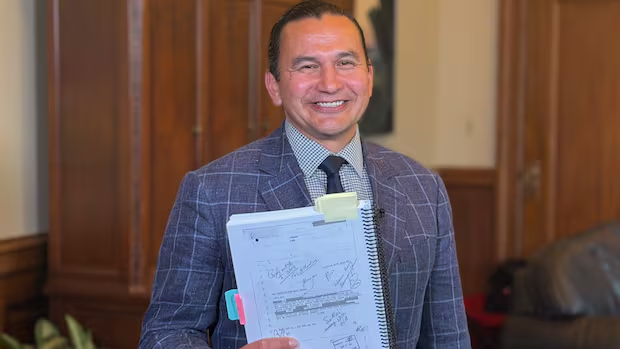
Inside the Manitoba premier’s office, Wab Kinew unravels a state secret.
With a mix of wry amusement and serious concern, he flips through censored copies of the RCMP’s historic surveillance dossiers, each one marked in pen as “racial intelligence,” compiled on Indigenous organizations from the 1960s to the 1980s.
What he learns he calls damning and alarming: the Canadian government spied on his father, the late Anishinaabe leader Tobasonakwut Kinew, in a countrywide infiltration initiative later dubbed the “Native extremism program.”
“Finding out that there was surveillance by law enforcement, by national security, for what today we would consider very routine political organizing and activism, it shows you, I would say, the racism of the time,” the premier told CBC News in October.
At home in Orillia, Ont., Wab Kinew’s uncle Fred Kelly untangles the same tale of espionage and deceit. He too was spied on for lawful democratic activism in the ’60s, though it’s hardly a surprise. He strongly suspected it.
“I had no actual proof that I was being spied upon, but I knew it,” said Kelly, also known as Kiizhebowse Makwa, a distinguished Anishinaabe elder, spiritual leader and former grand chief of Grand Council Treaty #3 in northwestern Ontario.
WATCH | Fred Kelly reacts to being spied on by the RCMP:
Anishinaabe elder gets proof of long-suspected RCMP spying
Fred Kelly, who spent his life fighting for justice, peaceful coexistence and human rights, reacts to proof the RCMP placed him under surveillance and labelled him an “agitator” because of his peaceful political work.
CBC News provided these documents to the family for the first time during a years-long investigation into Canada’s Cold War-era program to spy on Indigenous leaders and activists, which the RCMP created and which CSIS revived in the late 1980s.
The story of this one famous family reveals how many RCMP surveillance targets were residential school survivors who went on to lead legitimate political movements to reclaim their identity. To them, it’s no shock the government that openly suppressed First Nations culture in residential schools also tried to suppress their newfound political voice.
As former national chief Georges Erasmus put it in an interview earlier this year, “It is just the next chapter of oppression.”
From residential school to resistance
Tobasonakwut Kinew was about seven years old when he was taken to St. Mary’s Indian Residential School in Kenora in northwestern Ontario in the 1940s, where he experienced almost a decade of horrors.
Catholic priests and nuns tried to strip him of his culture by cutting his hair short, changing his name from Tobasonakwut to Peter Kelly and giving him a number, 54. He suffered psychological, physical and sexual abuse.

Eight-year-old Tobasonakwut standing with his grandfather, Kaagagewannakweb, who came to visit him at St Mary’s Residential School in Kenora, Ont., circa 1944-45. (Submitted by Diane Kelly)
Both as a CBC reporter and in his 2015 memoir, Wab Kinew candidly explored his father’s residential school experience and how the resulting trauma nearly severed the ties that bind a family together.
“Look at my dad, he had the Indian agent deciding everything about his life in his early years, until he went to residential school when it was a boys’ keeper and a priest … Then he left and it was back to the Indian Agent. And then this surveillance,” Wab Kinew told CBC News.
“There’s a longer history of government and corporate entities monitoring Indigenous families, assigning numbers, assigning qualitative evaluations of them, but seemingly not engaging with them as people.”
Fred Kelly’s experience was similar. He said he suffered physical and sexual abuse as well, and he too got the Irish surname Kelly at St. Mary’s, where he was taken at five years old.
“My impression of the residential school system was very much a system of incarceration to teach me and to force me to believe that my system, my original system of spirituality, was wrong,” he said.

Fred Kelly (left) and Tobasonakwut Kinew (Peter Kelly) in their 20s in an undated photo taken in their community, Ojibways of Onigaming First Nation. (Submitted by Diane Kelly)
The 6,000 pages of formerly secret intelligence files gathered on First Nations leaders by the RCMP Security Service and obtained by CBC News under access to information law reveal another chapter in this story.
As the brothers joined a generation of Indigenous leaders getting organized politically, it was no longer priests and nuns giving them numbers but Mounties — giving them file numbers as perceived subversives.
Fred Kelly entered the national political spotlight in November 1965, when he organized a pivotal protest in Kenora against racial injustice, now hailed as the country’s first civil rights march.
Newspapers called Kenora Canada’s Alabama and compared the racial tensions to “Bloody Sunday” in Selma, where Alabama state troopers attacked peaceful Black civil rights marchers earlier in 1965.
“Our people did not do these kinds of things. Our people are rather stoic: If that’s the way it is, that’s what we’ve got to live with,” Kelly recalled.
WATCH | The 1965 Kenora march:
Indigenous people demand a better deal in Kenora, Ont. in 1965
As 400 residents march on the streets, CBC Newsmagazine examines the lives of indigenous people in the northern Ontario town. Aired Dec. 7, 1965.
Town council mocked him, saying he’d be lucky if four people showed up. Instead between 400 and 500 Anishinaabeg filled Kenora’s streets, marching in a silent and peaceful but proud show of dignity that still inspires First Nations leaders 60 years later.
“We were not looking for love,” Kelly said.
“We were looking for justice and equality.”
‘Known agitators’
The premier’s father and uncle, or the “Kelly brothers,” soon gained celebrity and notoriety.
The Globe and Mail ran the headline “Indian brothers predict Kenora race riots” after a group of white men attacked them in 1967, and CBC flew them to Toronto to discuss the incident on national television.
The RCMP Security Service, a domestic intelligence agency that became CSIS in 1984, took notice, too. Amid the paranoia of the Cold War, Mounties feared radicals and communists could infiltrate and exploit the First Nations rights movement.
By 1969, Mounties had Winnipeg-based human sources informing on the brothers. One informer meticulously tracked Fred Kelly’s movements and politics, depicting him as a potentially violent subversive.
“The source considers him to be a radical and somewhat dangerous person,” an intelligence investigator reported.
WATCH | RCMP spied on Manitoba premier’s dad:
Why the RCMP spied on Wab Kinew’s dad
Manitoba Premier Wab Kinew wants to know who spied on his father for the RCMP, and why. Documents obtained by CBC News reveal the late Anishinaabe leader Tobasonakwut Kinew and his brother were under surveillance in the 1960s, early targets in a countrywide infiltration initiative later dubbed the “Native extremism program.”
In a separate report, a Mountie in Winnipeg reported both brothers “have been connected with the ‘Red Power’ movement.” The RCMP labelled them as “known agitators” and tracked their movements across Canada.
Fred Kelly is unsurprised, but he still denounces these reports as “the wrong interpretation of what I was seeking.” He draws parallels between how residential school officials carried out their mission and how Mounties did theirs.
“That was probably an order. How they carried that out is something that they have to live with,” he said.
“But they did it in much the same way as those Catholic priests believed in what they were doing.”
Diane Kelly, Wab Kinew’s sister, was stunned and disappointed to see these references to her father and uncle.
“These are the things that we’ve always suspected, not just as a family, but as Indigenous people,” said Diane Kelly, a former grand chief of Grand Council Treaty #3.

Diane Kelly says it’s shocking and disappointing but not really surprising to see the contents of the declassified surveillance files. (Brett Forester/CBC)
In the 1970s, her father was helping bring back that grand council, laying the foundation for the resurgence of the very political body she later led, she said.
“How was that terrorism? How was that being an agitator? It’s about having pride in who you are and knowing who you are,” she said.
By 1971, the Security Service explicitly targeted the legitimate Indigenous movement, writing in a secret, urgent-marked report that “the activities of the National Indian Brotherhood,” now the Assembly of First Nations, were “of special interest to us.”
“As stressed in previous correspondence forwarded to all divisions, the organized activity of our Canadian Indians are of interest,” the report said, calling it “most desirable” if the brotherhood’s annual spring conference was infiltrated with “human source coverage.”
Singled out as top targets were Fred Kelly and Tobasonakwut Kinew, or Peter Kelly. Their movement, in other words, was compromised.
Jeffrey Copenace, chief of Ojibways of Onigaming First Nation, where the brothers and premier are from, is outraged.

Chief of the Ojibways of Onigaming Jeff Copenace speaks to reporters following the First Nations Summit at the Canadian Museum of History in Gatineau, Que., in July 2025. (Spencer Colby/The Canadian Press)
“These two men should be celebrated along with all of the other Treaty 3 and First Nation leaders that have been trying to attain human rights in Canada,” he said.
“To think that these two men had their privacy infiltrated, that there’s all kinds of documentation about them that they’re not aware of that’s just coming to light now, it’s a bit sad. It’s just a little bit heartbreaking.”
In response to the rise of the American Indian Movement and arrival of Red Power activism, the RCMP Security Service intensified the surveillance and expanded the dragnet by formally establishing a full-time “Red Power desk” in Ottawa in 1973.
Here, intelligence officers tapped phones and paid informers to infiltrate groups like the National Indian Brotherhood and Dene Nation. The RCMP files name 150 Mounties involved, dozens of organizations monitored, and hundreds of individuals targeted.
“When you hear these actions, it’s hard to believe that reconciliation is really a tangible thing in Canada,” said Copenace.
What now?
At the Manitoba legislature, Wab Kinew has questions. First, naturally, is “who were these informants?” But that evolves into a call for all-around clarity.
“Was the RCMP paying people? Were people giving this information under duress?” he said.
“Does the way that this information enters the permanent record speak to whether it is credible or not? Were people being induced? Bribed?”
Using informers to infiltrate legitimate movements is far from harmless, said John Carlson, who is Anishinaabe from Red Rock Indian Band in northwestern Ontario and an associate professor of criminology at the University of Ottawa. He argues this countersubversion program had a chilling effect on political activism and free expression.

Associate professor John Carlson teaches his students at the University of Ottawa about the significance of the silent march in Kenora led by Fred Kelly in 1965. (Brett Forester/CBC News)
“That’s the legacy. It’s purging the movement of what the RCMP, I’m sure, would call subversive ideology and organizational practices,” Carlson said.
“But I would call [those practices] relevant to fighting for a society where Indigenous dignity, self-determination and relations, responsibilities and values could also shape this society.”
Ultimately Tobasonakwut Kinew and Fred Kelly became political and community leaders, leaving an indelible mark on Canadian history.
Fred Kelly was part of the team that negotiated the Indian Residential Schools Settlement Agreement that led to the Truth and Reconciliation Commission. Tobasonakwut Kinew personally reconciled with Pope Benedict in 2009, presenting him with an eagle feather and ceremonial pipe. Both brothers were on Parliament Hill in 2008 to witness prime minister Stephen Harper’s historic apology for the residential school system.

Tobasonakwut Kinew (Peter Kelly) holds the Assembly of First Nations ceremonial staff on his way to a news conference after Pope Benedict’s general audience in St. Peter’s Square at the Vatican, April 29, 2009. (Pier Paolo Cito/The Associated Press)
As for the spying, RCMP Commissioner Mike Duheme issued a statement of regret after CBC News revealed the program’s existence in May 2026, but the Assembly of First Nations continues to seek a full apology, access to uncensored files and answers.
Public Safety Minister Gary’s Anandasangaree office said in September that he is working with relevant federal departments to support the release of those documents.
For Wab Kinew, the files confirm Canada’s intelligence service of the 1960s “was racist,” but he believes those organizations today have a more progressive and egalitarian view. On that front, Manitoba’s first Anishinaabe premier finds a silver lining in his relationship with the RCMP today.
Mounties still follow him around the country, as they did his father. It’s just no longer the secret spy branch. It’s the executive protection unit.