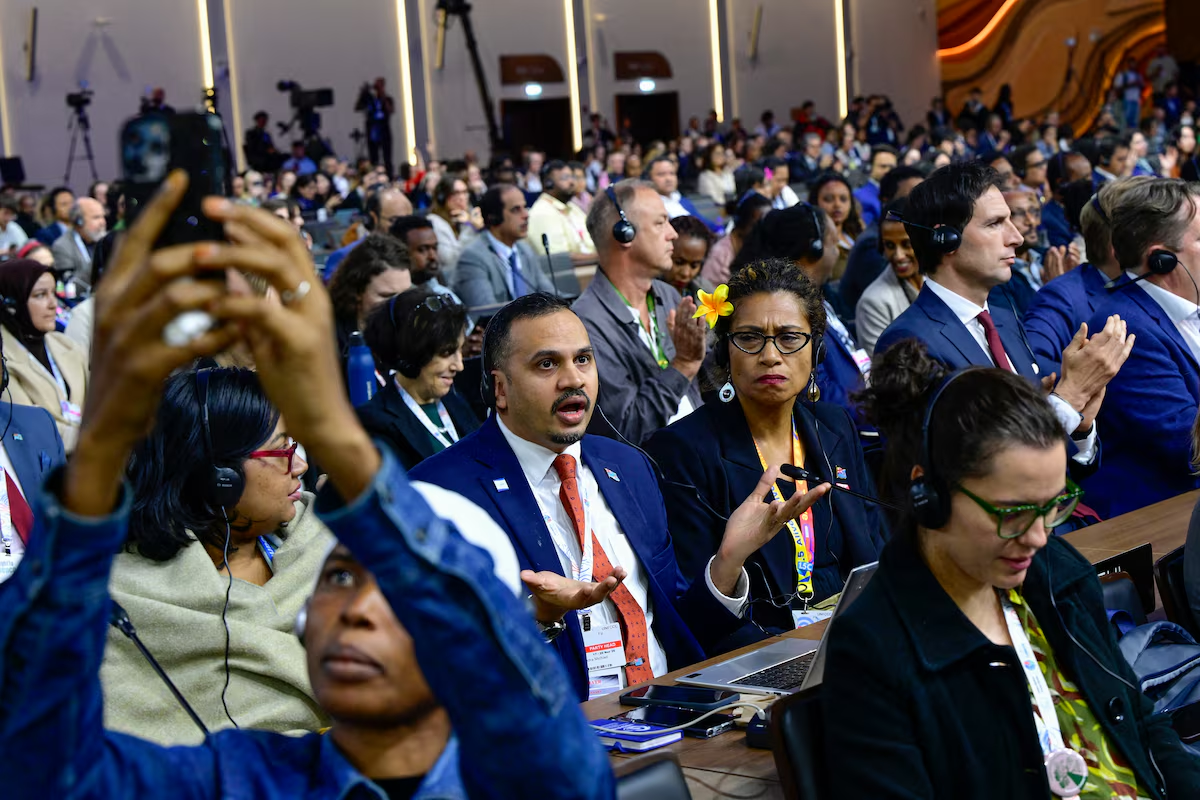

Good morning. The annual United Nations climate talks ended in more disappointment than usual. More on that below, along with new research on cannabis and mortgages.
Open this photo in gallery:
Delegations react during COP31 on Sunday.YASIN AKGUL/AFP/Getty Images
TOP STORIES
UN climate summit fails to reach agreement
COP31 failed to reach a main agreement known as a cover decision after impasses over whether to mention the fossil fuels that cause global warming. Other issues, including money, proved irreconcilable.
The countries: Russia and Saudi Arabia sought to keep fossil fuels out of the document. Several countries and the 27-nation European Union said they could not accept the final proposal from the joint Turkish-Australian leadership.
From home: Tzeporah Berman, Vancouver-based climate activist and chair of the global Fossil Fuel Treaty initiative, said Canada was largely missing in action, and criticized efforts by the Carney government to help expand fossil fuel production. Meanwhile, Ottawa remains unlikely to meet its 2030 emissions target despite official statements.
Open this photo in gallery:
Cannabis products are displayed at Cosmic Charlies on Queen Street West in Toronto.Arlyn McAdorey/The Canadian Press
Daily cannabis use is now more common than drinking
A Canadian Medical Association Journal study has found that daily cannabis use is more common than alcohol among Canadian adults, and it is equal to or exceeds daily cigarette use among those younger than 35. It has been eight years since the country became the first major industrialized nation to legalize the substance.
A joint problem: Selling legal Canadian cannabis to the rest of the world has grown into a billion-dollar business, one that’s expected to double in 2027. But criminal smuggling of our cannabis overseas is booming too, just as Canada tries to build closer ties with Europe.
Open this photo in gallery:
Rescuers extinguish the Russian cargo ship Sparta II on Sunday.Finnish Border Guard/Reuters
Russia tows cargo ship after strike
A Russian rescue vessel began towing a cargo ship that was struck by drones in the Baltic Sea out of Finnish waters after two days of firefighting. The Finnish military has said the strike was likely carried out by Ukraine and that the Russian vessel later drifted into Finnish waters.
The effort: It was a rare instance of cross-border collaboration where Russian, Estonian and Finnish vessels were helping to fight the fire. Finland shut all of its land border crossings with Russia in 2023. Estonia will shut its own from Dec. 1, for six months.
Mortgage arrears in Ontario on the rise
A recent report from TD Bank economist Maria Solovieva found the number of homeowners in Ontario unable to pay their mortgages due to high balances and rising interest rates is growing, even as delinquency rates ease in much of the rest of the country.
The numbers: The rate of homeowners in arrears has nearly tripled from prepandemic norms of 0.12 per cent to 0.34 per cent in Ontario. The rate is approaching levels not seen since the 2008 financial crisis, when mortgage arrears in Ontario peaked at 0.43 per cent.
Open this photo in gallery:
Daycare teachers and students go for a walk in Seoul.Tina Hsu/The Globe and Mail
South Korea is paying families to have kids
Seoul was ground zero for global birth decline. It’s the capital of the country with the lowest fertility rate on the planet. There are many factors influencing the decisions around kids, from economic pressures and social values to deep-rooted cultural beliefs.
The effort: National identity, culture and way of life is at risk. The South Korean government’s response has been to pour the equivalent of about $360-billion into trying to turn things around. They have offered cash bonuses and tax incentives for new parents. They’ve helped cover family medical costs and housing costs and invested in daycares.
The Take
Certainly, Mr. Carney has had no difficulty turning his back on the policies of his predecessor Justin Trudeau, although it still should be a little embarrassing for Mr. Champagne to sit beside the Prime Minister if he’s going to tell Canadians that the added competition of a fourth carrier wasn’t, in fact, a victory for the people.
— Campbell Clark, Chief Political Writer
Carney is going to have to need more than vague words about sovereignty and reassurance about the good side of oligopolies if he’s going to approve a Telus takeover, writes Campbell Clark.
The Shot
Open this photo in gallery:
Montreal river surfers Alexis Roy and Phil Charest head out to surf at Lawrencetown Beach Provincial Park in Nova Scotia.Carolina Andrade/The Globe and Mail
Nova Scotia’s surfing scene is a year-round delight – for those who are willing to put in the work.
The Wrap
What else we’re following
At home: The Ontario Liberals have chosen Navdeep Bains, the former Trudeau-era federal cabinet minister, as new leader. But without a seat in the chamber, he won’t yet be able to face Doug Ford.
Abroad: The U.S. Army will detonate a toxic lead azide in Iowa under emergency powers that bypass a court order blocking the controversial plan.
At home and abroad: Canada is committing approximately $100-million to joining the NATO Innovation Fund.
In the ground: A study found that toxic forever chemicals are still turning up more than two decades after firefighters last sprayed flame-dousing foam at a Newfoundland practice facility.
Breaking ground: The majority of the $8.2-million public funds raised for the renovation of 24 Sussex Dr. has come from a wealthy class of donors. The foundation is trying to reach $50-million.
Cool: Meet the Canadian actors who played a secret role in Grand Theft Auto VI.
Cold: Here’s some expert advice about where to ski during an El Niño winter.
More Globe on the go
Visit the Morning News Playlist on The Globe’s app. Every day an editor curates the top stories of the morning for you to listen to on your commute. Download the app on iOS or Google Play and click the Listen tab with the headphones icon.