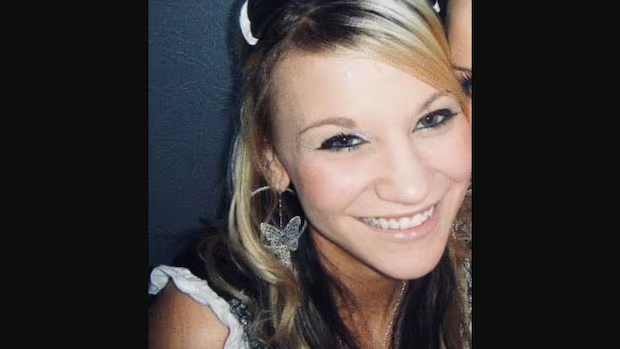
WARNING: This story contains distressing and graphic details.
The family of an Edmonton woman who was brutally beaten and left to drown by her boyfriend want her to be remembered beyond the horrific circumstances of her death.
Collin Boucher-Gionet, convicted of manslaughter in the 2024 death of Aylissa Rovere, was expected to be sentenced in the Court of King’s Bench of Alberta Friday.
A decision on his sentence has been delayed as the prosecution and defence wrestle over how he will be held culpable in the killing. But Friday’s hearing in Edmonton revealed horrific details of Rovere’s final hours and shed light on the anguish her death has wrought on her closest friends and family.
According to an agreed statement of facts, Boucher-Gionet prepared to burn and then bury Rovere before ultimately disposing of her inside a septic tank in 2024, believing she was already dead.
An autopsy showed she was still alive and died of drowning hours later, court heard Friday.
Boucher-Gionet, 36, pleaded guilty to manslaughter and attempting to improperly interfere with or offer indignity to human remains in the domestic violence homicide.
He was initially charged with second-degree murder but later pleaded to the reduced charge of manslaughter in 2025.
Rovere, a 32-year-old mother of two, was last seen alive on Sept. 6, 2024.
Her body was found the following week when police searched a home in Parkland County, about 40 kilometres west of downtown Edmonton.
Court heard that the pair, who had shared a long relationship already marred by domestic violence, had met on the rural property in Parkland County that night to share a firepit with friends that night.
People who saw them there described them as “lovey-dovey,” Crown prosecutor Anders Quist told the court. But as the night progressed, violence erupted.
When Boucher-Gionet awoke from a drunken blackout, all their friends were gone and Rovere was unconscious and motionless on the ground.
Court heard that Boucher-Gionet found her cold to the touch and that he could not see her breathing.
Quist said there is “no doubt” that Boucher-Gionet caused Rovere’s injuries, including the head trauma that left her unconscious.
An autopsy showed that she had suffered severe injuries, including blunt force trauma to her head, bleeding on the brain and a broken neck.
Her nose was broken, a laceration traced across the back of her skull, cuts and bruises covered her face, hands and body. Boucher-Gionet had admitted to harming her in the past, and had demonstrated “a pattern of interpersonal violence,” Quist said.
“She had numerous injuries inconsistent with an accident,” Quist said, describing the “brutal nature” of her death as an aggravating factor.
“To be abused, concealed and abandoned” makes the crime a horrifying one, Quist told the court, noting that the tragedy was made worse by the fact that Rovere died at the hands of an intimate partner whom she cared for.
Court heard that Boucher-Gionet — after coming to believe Rovere had died — began to dig a shallow grave in the woods nearby and also prepared to burn her body using liquid fuel. Hours passed before he ultimately dropped her inside the tank and closed the lid.
According to the agreed statement of facts, he also burned her clothes and her phone before going to bed. He later deleted photos of her from his phone and posted on social media that his relationship with Rovere was over.
She was formally reported missing by her family two days later.
Quist said Boucher-Gionet then went on to lie about what he had done and Rovere’s whereabouts, concealing the truth from police and Rovere’s family as they continued to search for the missing mother.
“He did not cause her death with blunt force trauma, he caused her death by drowning,” Quist said. “The tragedy is higher because Aylissa Rovere was not dead and he made no effort to get her help.”
Quist characterized the case as profoundly disturbing.
“His efforts took time,” he said. “This was not spontaneous.”
Sentencing dispute
During Friday’s hearing, the Crown asked Justice Melanie Hayes-Richards to sentence Boucher-Gionet to 12 years in prison.
Defence lawyer Stacey Purser did not indicate what sentence she will seek but instead raised concerns about what unlawful act will be considered during his sentencing, resulting in the case being adjourned.
While both sides agree Boucher-Gionet is responsible for beating Rovere unconscious and concealing her injured body in the septic tank, Purser contested how the crime had been characterized by the Crown, raising concerns about how Boucher-Gionet would be held culpable during sentencing decisions.
Purser said the criminal act that led to Rovere’s death occurred when she suffered blunt force trauma, not when Boucher-Gionet placed her in the septic tank and believed she was dead.
According to sentencing guidelines, Purser said, if the unlawful act is contested, the court should consider the lesser crime when determining a sentence.
“The conduct that caused Aylissa Rovere’s death was blunt force trauma,” Purser told the court.
“[Boucher-Gionet] didn’t believe she was breathing.”
Purser said when the case returns to court, Boucher-Gionet’s defence team will either seek to strike his guilty pleas from the record or submit a joint sentencing submission with the Crown.
The case returns to court Dec. 11.
Justice Hayes-Richards characterized the case as a challenging one, noting that she had never heard a case where the act of disposing of a body ultimately became the homicide itself.
“This is something I have been grappling with for a long time,” she said of the case.
Victim impact statements from Rovere’s friends and relatives were shared in the court Friday and many detailed how those closest to Rovere remain haunted by the circumstances of her death.
‘So much more than the circumstances of her death’
Seven of Rovere’s loved ones, including her son and daughter and sisters, provided victim impact statements which were shared with the court. In them, she was remembered as a kind and devoted mother who loved fiercely, had a passion for singing and loved to laugh.
Rovere’s mother Jodi Dunn took the stand Friday, describing the “permanent and painful” void the death of her youngest daughter has left in the family.
She recalled how she had begged her daughter to leave Boucher-Gionet many times and how she was haunted by the cruel circumstances of her daughter’s death, and the knowledge that she will never hold her again.
“I suffer vivid nightmares about how she suffered in her final moments,” Dunn said.
“Because of you this is the reality I have to face,” she said as she turned to Boucher-Gionet, who sobbed several times throughout the proceedings, bending over to hide his face from view.
Nicole Strong, one of Rovere’s six siblings, said she would never offer Boucher-Gionet forgiveness for the pain he’s caused.
The indignity he wrought on Rovere has left her family broken, she said.
Strong said because of the horrific actions Boucher-Gionet took, the family was denied the chance to view Rovere’s remains.
Strong said the good memories of her sister, as someone who loved to sing and dreamed of owning a farm, are overshadowed by the horror of her final moments.
“She is so much more than the circumstances of her death,” she said. “Her life was so much greater than how it ended.”
A statement from Rovere’s son, who was just 14 when he saw his mother for the last time, was also read out in court.
In it, he described how his mother’s absence changed his young life forever.
“She just wanted to be loved even if that hurt her,” he wrote. “She always saw the good in people even when it wasn’t there.”
If you’re in immediate danger or fear for your safety or that of others around you, please call 911. If you’re affected by family or intimate partner violence, you can look for help through crisis lines and local support services.