
Open this photo in gallery:
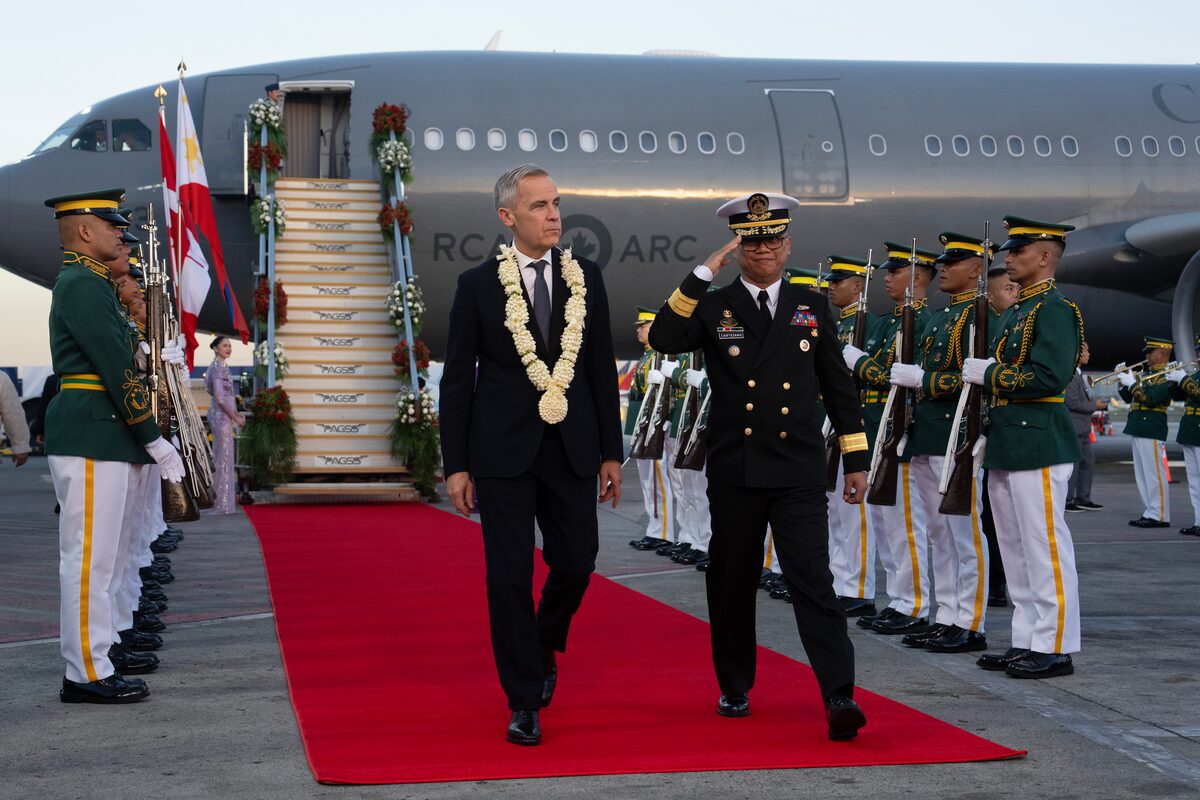
Prime Minister Mark Carney arrives in Manila on Saturday. Mr. Carney met with Philippines President Ferdinand Jr. on the sidelines of ASEAN summit.Adrian Wyld/The Canadian Press
Prime Minister Mark Carney says Canada has wrapped negotiations on a free trade agreement with the Philippines, the fourth such deal he’s concluded since taking office on a pledge to reduce economic dependance on the United States.
He made the announcement Saturday during his first visit as prime minister to Philippines, a country that is playing an outsized role in Canada’s four-year-old Indo-Pacific strategy.
Mr. Carney met with Philippines President Ferdinand Jr. on the sidelines of Association of Southeast Asian Nations (ASEAN) taking place in Manila.
Both countries committed to signing the new trade agreement in 2027.
The other deals Canada has concluded since last year include those with Indonesia, the United Arab Emirates and Ecuador.
While Mr. Carney has issued many declarations of “strategic partnerships” and memorandums of understanding to deepen ties with countries around the globe, those documents do not carry binding obligations on both partners like free trade deals do.
Free trade deal, backed up by implementing legislation in Parliament, set rules for the ways in which trading partners remove restrictions to two-way trade and investment.
There’s no word yet on whether as part of this deal Canada will be given an exemption from temporary barriers to foreign pork imports being erected by Manila this month.
Ottawa hopes to triple two-way trade between the Philippines and Canada to $10-billion a year by 2035.
Mr. Carney, meeting with Mr. Marcos, compared leadership in today’s world to navigating a ship in troubled times. He said ships aren’t meant to remain in safe harbours. “That’s not what a ship is for and it takes a leader to take the ship out of the harbour into choppy waters.”
The Prime Minister said by negotiating a deal to lower trade barriers, Canada and the Philippines are setting an example “for other countries around the world of what is possible when like-minded countries come together.”
Major powers will join a summit next week of Southeast Asian nations hosted by the Philippines against one of the most complex backdrops for the regional bloc, from the Iran war that has batter…Full Caption
The Ottawa-Manila deal caps a remarkable expansion of relations between Canada and the Philippines.
In recent years, Canada’s diplomatic mission in Manila has quietly grown into one of this country’s biggest. It’s now No. 2 globally when measured by the number of people, according to Global Affairs Canada.
The Philippines sits at the edge of some of Asia’s most contested waters, and it has clashed repeatedly with Beijing over competing claims to reefs and shoals in the South China Sea. Its northernmost islands border a vital gateway between those waters and the open Pacific.
Today, Canada’s diplomatic footprint in the Philippines has grown to about 300 positions. This includes locally hired staff and officials from various federal departments, as well as provincial governments and Crown corporations such as Export Development Canada, which opened an office there in 2024.
Only Canada’s diplomatic mission in Washington is bigger than Manila when it comes to the number of people, figures from Global Affairs show. Canada’s next three largest missions are London, Mexico City and Delhi.
One of the earliest examples of growing Canada-Philippines co-operation under this strategy has been Ottawa sharing satellite data from its Dark Vessel Detection program to help Manila identify illegal fishing craft plying its waters. The data also gives Manila a helping hand in territorial disputes with China.
Canada’s Manila embassy has become a hub for Canadian government outreach and operations in the Indo-Pacific region. In 2024, the government opened the Indo-Pacific Agriculture and Agri-Food Office at the embassy to promote Canada’s food exports.
The Department of Citizenship and Immigration’s operations in Manila handles immigration and visa matters not only for the Philippines but also for other nations. The Philippines is among Canada’s largest source of immigrants to Canada, with close to one million people in Canada claiming Filipino ancestry.
Canada and the Philippines have grown closer on the security and defence front too. This year, Canada appointed a general to represent Ottawa’s security interests in the region: Lieutenant-General Derek Macaulay, the country’s first senior military representative for the Indo-Pacific.
The new post makes him the Chief of the Defence Staff’s envoy to the region’s military leaders. His job is to build relationships from Tokyo to Hanoi to Kuala Lumpur, and to make sure the Canadian Armed Forces’ activities line up with Ottawa’s priorities in the region.
Despite Mr. Carney’s efforts, it will be difficult to substitute trade with other countries for exports to the U.S., which totalled more than $560-billion in merchandise goods in 2025. That’s more than 70 per cent of Canada’s goods exports.
Canadian merchandise exports to the Philippines in 2025 amounted to $1.1 billion.