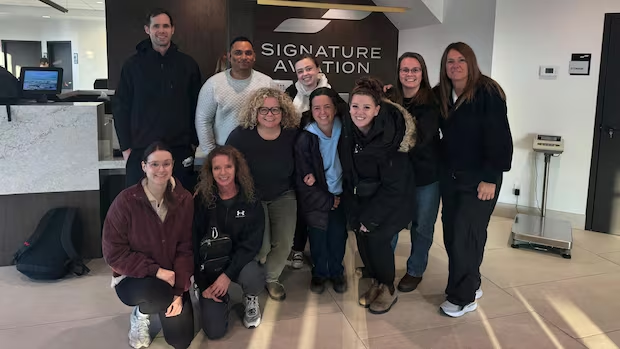
Nine burn-care specialists from Hamilton Health Sciences (HHS) have travelled to Edmonton to help treat military personnel severely injured in the deadly fire at a Canadian Forces base in Wainwright, Alta.
The team includes specialized burn nurses and other health-care professionals who volunteered to support hospitals treating soldiers injured when a fire swept across a live-fire training exercise at CFB Wainwright on Oct. 17.
The fire killed four people and injured dozens of others. It was reported that 39 service members were taken to hospitals across Alberta, including 19 who were initially reported to be in critical condition.
Dr. Marc Jeschke, director of the burn centre at HHS, said the request for assistance came through the province as hospitals faced an urgent need for specialized staff and medical supplies.
He said the response from Hamilton’s burn-care team was immediate.
“Our team responded within minutes and almost everybody volunteered to go to help the patients in Edmonton, which is just remarkable,” Jeschke told CBC Hamilton in an interview on Oct. 23.
The request was organized within 24 hours, he said, with nine staff members ultimately selected to travel. The team flew out Oct. 22.
“They just left their lives, left their families, left their loved ones, left their partners [to] care for patients in Edmonton,” he said.
Jeschke said he remains in contact with the staff but could not discuss the specific care being provided, citing patient privacy.
Spencer Beach has some understanding of what the injured soldiers may be going through. He survived a workplace explosion that resulted in burns to 87% per cent of his body in 2003. He says the road to recovery is a long one, and it takes a toll on you.
“The fire is not just a physical injury, it’s a mental injury. It takes your identity away in many ways,” he said in an interview with Edmonton AM host Tara McCarthy on Oct. 26.
Beach, who’s now become a motivational speaker, says his message to the injured soldiers is that recovery takes time.
“There is not a problem in life where time is not a part of the solution.”
WATCH | The road to recovery for burn survivors at CFB Wainwright:
Burn survivor discusses recovery for injured soldiers from CFB Wainwright
In 2003, a workplace explosion burned 87 per cent of Spencer Beach’s body. So, he knows the long recovery facing 27 Canadian Armed Forces service members who were injured in a deadly fire at CFB Wainwright on Oct. 17.
Canada has just 46 specialized burn beds, doctor says
The deployment has also drawn attention to the limited number of specialized burn-care beds available across Canada.
Jeschke said a recent census conducted through the Canadian Burn Association found there are approximately 46 specialized burn beds nationwide.
Hamilton Health Sciences has 10 of those beds, while Toronto’s Sunnybrook Health Sciences Centre has 14, he said.
That means over half of the country’s specialized burn beds are concentrated in southern Ontario, which Jeschke says highlights the need to assess the country’s capacity and identify gaps before another major incident occurs.
“This will not be the last devastating event,” he said.
Burn injuries are particularly complex because their effects extend well beyond the damaged skin, Jeschke said.
Patients with burns covering more than 20 per cent of their bodies can experience a prolonged hypermetabolic response — an intense stress reaction that can affect the heart, lungs, brain and other organs.
The loss of the skin’s protective barrier also leaves patients vulnerable to infection. Without access to specialized burn care, patients with significant burns face much greater challenges surviving their injuries, Jeschke said.
Research aims to improve recovery beyond survival
Jeschke said advances in burn treatment have shifted the focus from simply keeping patients alive to helping them regain their quality of life.
That includes reducing pain and scarring, restoring function and addressing the psychological effects of severe injuries.
At HHS, researchers are working toward what Jeschke describes as a vision of “no death, no pain, no scars.”
The hospital’s Centre for Burn Research is studying new treatments, including the use of exosomes, tiny particles released by cells that help coordinate tissue repair and healing.
In June, Hamilton doctors announced a world-first use of experimental exosome therapy on a Western University student who suffered severe facial and neck burns in a December 2025 fraternity house fire.
The treatment helped the patient avoid skin graft surgery to her face and neck.

Dr. Marc Jeschke (left) standing beside Kaitlin Jeffrey, a Western University student who suffered serious burns to her face in a London fraternity house fire in December 2025. She became the first burn patient in the world to receive an experimental treatment that helped heal her burns. (Hamilton Health Sciences)
Jeschke said the hospital is also working on three-dimensional skin printing, with hopes of moving the technology into clinical trials within the next three to five years.
The treatments remain experimental, but he said the research could eventually change how severe burns are treated.
“Survival used to be the main outcome for burn patients, but there is a life afterwards, so to restore the quality of life is a very important goal,” Jeschke said.
He said minimizing scarring is also important because severe burns can affect how people see themselves after an injury.
“We need patients to regain the entire spectrum of their lives,” he said.