
Listen to this article
Estimated 3 minutes
The audio version of this article is generated by AI-based technology. Mispronunciations can occur. We are working with our partners to continually review and improve the results.
The lack of time change this fall is prompting some schools, police and government agencies across B.C. to prepare families for increasingly dark mornings, hoping to keep children safe as they make their way to school before the sun comes up.
This weekend, residents of some provinces like Ontario and Quebec are turning back their clocks. But earlier this year B.C. moved to permanent daylight time.
The change means people in some parts the South Coast, like Vancouver, won’t see the sun rise until as late as 9:08 this winter.
“That’s definitely a concern,” said mother Kim Robinson, picking her child up from Aspen Elementary in Comox.
“When I look at our wardrobe and stuff I think of colours, and how are we going to be more visible.”
Some parts of the province, like Fort St. John, are used to dealing with dark mornings because they haven’t observed Daylight Saving Time for decades now. But early commutes with no sunlight at all will be a first for many other British Columbians, after the province passed the Daylight Saving Act in 1919.

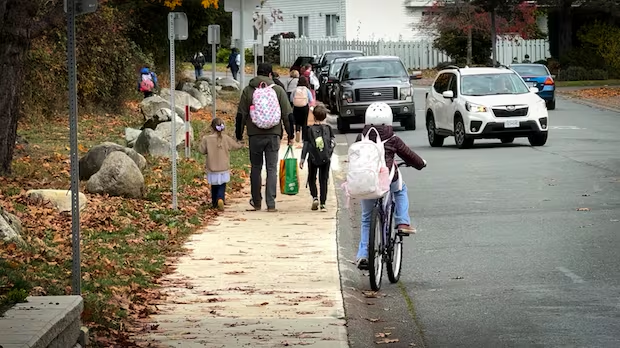
ICBC says its data shows that children are most at risk during their commutes to and from school. (Maryse Zeidler/CBC)
Building awareness about visibility
In Sooke, Victoria and Saanich, schools are partnering with the Capital Regional District on a new campaign. Lets Get Visible encourages families to wear bright clothing and reflective gear.
Some schools on Vancouver Island say they have been or will be giving students reflective gear.

The Victoria School District says it has been handing out reflectors to students to help keep them more visible during their commute to school. (Submitted by the Victoria School District)
Paul Block, superintendent and CEO with the Sooke School District, says the switch to permanent daylight time is a good time to remind the community about early morning safety around schools.
“What we’re trying to get is a sense of awareness for our families that do walk, ride or wheel to school to really be thinking a little bit more about being visible on their routes to school,” Block said.
“We also want to extend that to the greater community because drivers as well need to be aware of that to avoid those accidents.”
Crashes more likely during school commutes: ICBC
According to ICBC, for many children, getting to and from school is the riskiest part of their day.
ICBC says its data shows minors are more than twice as likely to be involved in a crash during their school commute than other times of the day.

Sooke School District superintendent Paul Block says educating drivers about the change in morning daylight is important as well. (Maryse Zeidler/CBC)
In Victoria, police are amplifying the early morning safety message as well.
“On [Nov. 1], our clocks don’t change. Our routines stay the same but road conditions transition,” said media relations officer Sgt. Kristin Greffard in a recent Facebook post.
“As the days get shorter, visibility becomes more challenging.”
- What does the move to permanent daylight time mean for your routine? Click “Join the Conversation” below. On the app? Tap here.