
Open this photo in gallery:
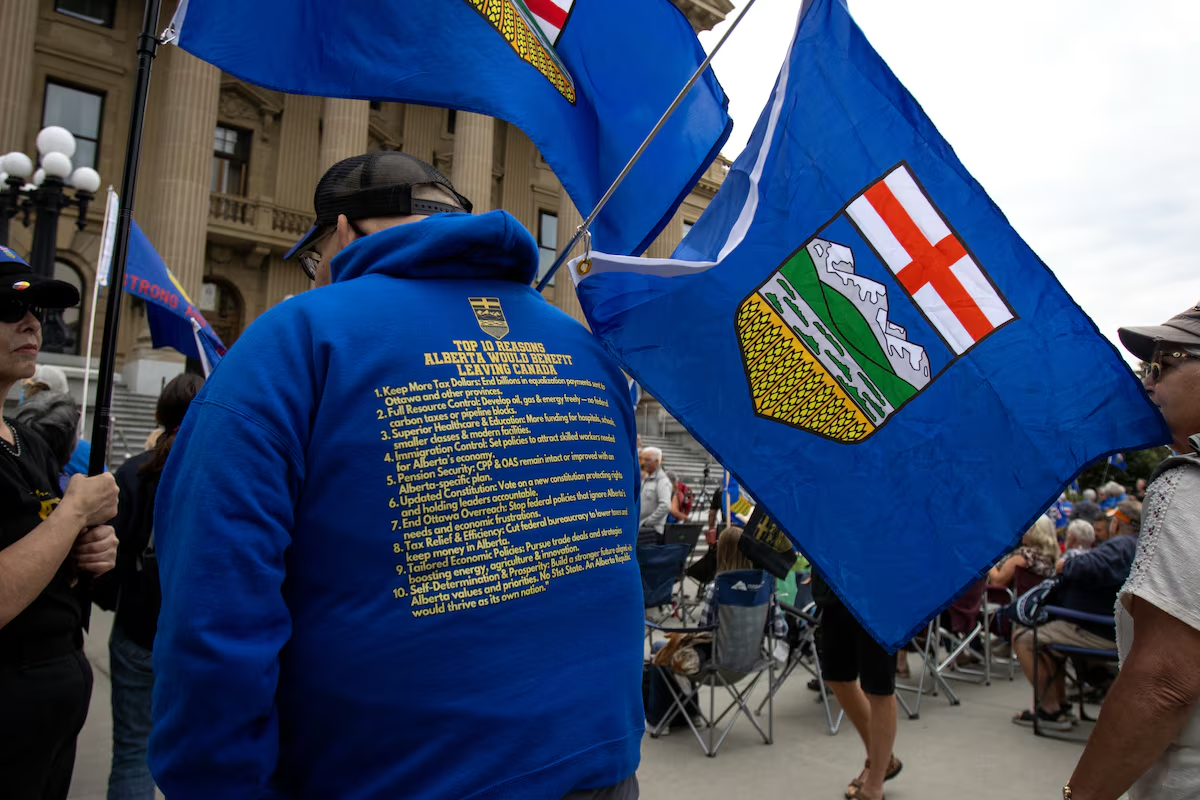
Alberta separatists gather at the provincial legislature in Edmonton in August for a protest organized by the Alberta Prosperity Project.Amanda May Erickson/The Canadian Press
More than two decades ago, Gurnam Dodd ran as a Progressive Conservative candidate in southeast Edmonton. He narrowly lost, but spent the ensuing years as a loyal conservative and devoted supporter of Danielle Smith, even before she became Alberta’s Premier.
A few weeks ago, he decided he had enough. He sent a letter to Patrick Malkin, vice-president of membership for the United Conservative Party of Alberta.
“I ask that my membership be cancelled, that no renewal be processed, and that written confirmation be provided,” he wrote. “This is not an impulsive decision.”
Over nearly a thousand words, he sketched out his reasons. The political decisions that enabled last week’s provincial referendum, in which Albertans overwhelmingly voted to remain in Canada, risked “normalizing separation as an ordinary instrument of provincial bargaining,” he wrote.
Tony Keller: Separatism’s crushing referendum loss is all upside for the Canadian economy
And, he added, a series of immigration-related questions brought to the referendum vote by Ms. Smith’s government were “deeply concerning.” Decisions about who is eligible for provincial services or preferential employment should be made carefully, he said, not reduced to “slogans that divide established Albertans from newcomers.”
Those slogans prevailed. Albertans voted for the province to assert more control over immigration and restrict access to public services to some new arrivals. One measure said Albertans should be given “first priority on new employment opportunities.”
In the aftermath of the bruising referendum, separatists seeking to entrench themselves as a political force have pledged to remove her from leadership of the United Conservative Party. Ms. Smith has sought to bolster her internal support, and her party said this week it did not expect any success from attempts to unseat her.
Some former backers are nonetheless abandoning the Premier.
“People are upset,” said Gursharan Buttar, whose family owns My Radio 580, an Edmonton AM station that broadcasts largely in Punjabi. An immigrant from India, Mr. Buttar has been on the air in Alberta since 1995. He hosts three hours of weekday morning radio, a mix of political discussion and call-in talk shows.
Ms. Smith’s actions, he said, are “putting insecurity into the minority communities.”
Alberta Premier fends off leadership challenge and looks to squelch separatist discord
Over the past few weeks, a half-dozen people have called in to describe taking steps similar to Mr. Dodd’s.
“Immigrants are submitting their resignation,” Mr. Buttar said. Any future UCP candidate that reaches out to minority groups in the province, he said, “will face harsh questioning when the next election comes.”
His listeners, he said, want to know why members of Ms. Smith’s party did not publicly decry anti-immigrant sentiment that arose around the referendum.
“When immigrants were on the receiving end, why did they not speak?” he asked.
Nearly a quarter of Albertans said they wanted to pursue separation through a binding referendum, including some who said last week their vote was driven in part by immigration concern.
“We’ve had 600,000 people come into Alberta in the last year, and a lot of them shouldn’t be here,” said George Hartford, a retiree in the southern Alberta village of Carmangay. According to Statistics Canada, 76,500 people arrived in Alberta in the past year. Mr. Hartford himself is a recent arrival. He moved to Alberta from B.C. four years ago to be in a province governed by the UCP and Ms. Smith.
In the wake of the referendum, Ms. Smith said she will “proceed with caution” on the referendum questions.
Open this photo in gallery:
Alberta Premier Danielle Smith in Calgary earlier this month.Jeff McIntosh/The Canadian Press
But Alberta has been one of the fastest growing parts of the country and those now seeking to take command of the UCP have said changing immigration is a primary objective.
“Alberta is working on taking control of our sovereignty so we can, among other things, stop the insane immigration that’s threatening western civilization,” podcaster Chris Scott, who has said he intends to compete for the UCP board, wrote last year on X.
Mr. Scott later said his concern lies with mass migration, not legal immigration.
The prospect of Alberta turning against immigration has, however, already raised the alarm for business groups. A recent survey by the Calgary Chamber of Commerce found that more than two-thirds of large businesses said immigrant employees are important to their business.
The Alberta referendum by the numbers
The need to bring in foreign workers will only grow if the province succeeds in expanding its industrial base as Prime Minister Mark Carney seeks to speed construction of major new projects, said Deborah Yedlin, president of the Calgary Chamber.
“We need to be competitive for global and Canadian talent. That is just absolutely critical if we’re going to meet the labour needs of the projects that we want to build,” she said.
The province has already forecast shortfalls over the next decade of more than 100,000 workers across different sectors.
In the referendum, Albertans said they want the province to create a separate class of services for non-permanent immigrants and their families, charging for access to health care and education. Referendum voters also supported a measure to bar those without citizenship, permanent residency or “Alberta-approved immigration status” from provincially funded programs.
The Editorial Board: Immigration is not a provincial fiefdom
Such change, if enacted by Ms. Smith’s government, could create additional financial burdens for employers that cover those expenses for employees.
“If there is a world where it’s more expensive to bring labour here because businesses have to bear the extra cost to enable access to health care and education – then, all of a sudden, how competitive are we as a jurisdiction for investment?” Ms. Yedlin said.
Others are preparing to fight Ms. Smith if she pursues the issues passed in the referendum. Avnish Nanda, an Edmonton lawyer, created Our Alberta Advantage as a pro-federalist third-party advertiser prior to the referendum. He is now pivoting that group to advocate on other issues, including immigration.
The possibility of Alberta growing more hostile to immigrants, he said, has galvanized political opposition to what even some conservatives see as “an existential threat,” one overseen by Ms. Smith.
“There’s a real shift in tone that’s openly partisan against her,” Mr. Nanda said.