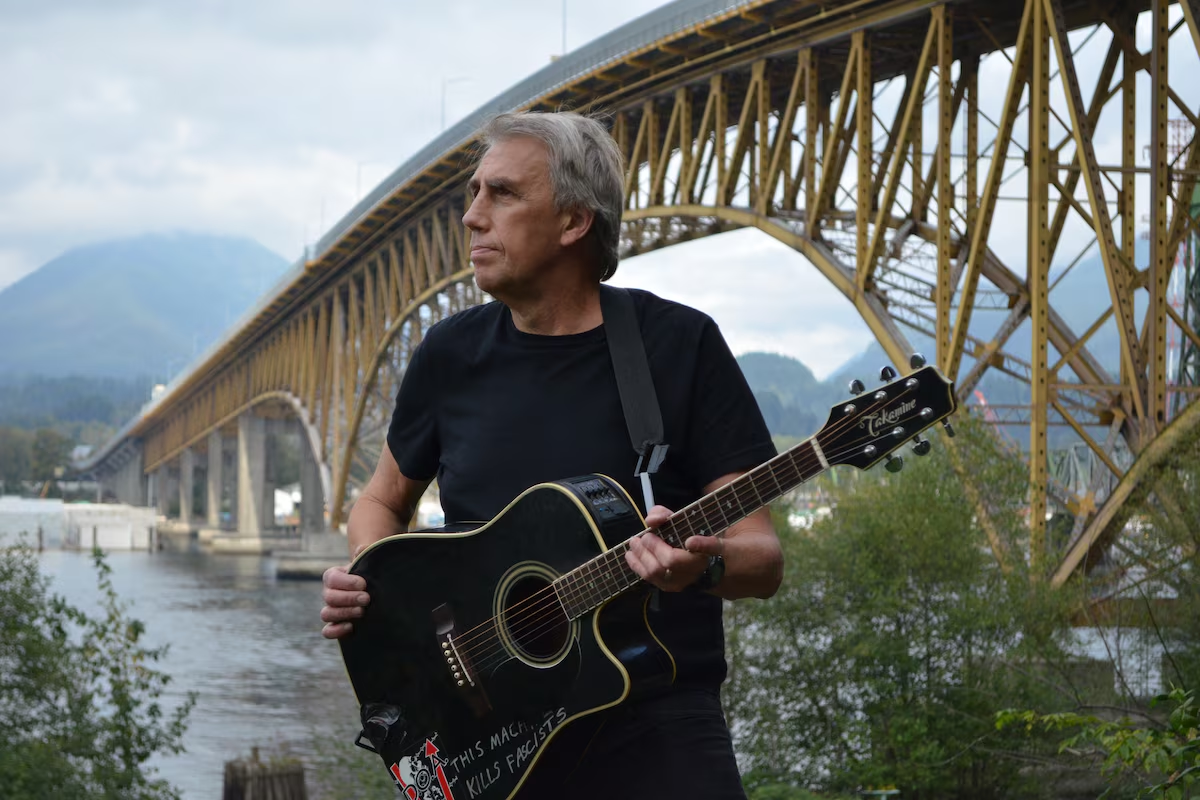

Open this photo in gallery:
D.O.A.’s Joe Keithley won the most votes of any aspiring Burnaby councillor during the municipal election on Oct. 17.Clayton Keithley/Supplied
Joe Keithley has lived most of his life by a simple slogan: Talk Minus Action Equals Zero. He’s never much cared for rhetoric; making the world a better place requires work. The philosophy has coloured his nearly 50-year career as the front man of D.O.A., the trailblazing, innovative and deeply progressive B.C. punk band that has played and organized hundreds of benefit concerts for anti-racist, anti-war, environmental and many other causes.
So when Keithley was first elected to Burnaby, B.C.’s city council as a member of the local Green Party in 2018 by a margin of just a couple hundred votes, he was happy to see that voters understood his ethos. “At first, they were like, ‘Oh, it’s a punk rock guy,’” he says, “but then were like, ‘No, no, he actually takes these issues seriously.’”
The 70-year-old has since helped push the city to affirm housing as a human right and to boost its supply of affordable units, including when old buildings are knocked down for new development. During B.C.’s municipal elections earlier this month, Keithley’s reputation as a councillor took him even further than his reputation as a musician. Running this time as a member of the social-democratic Burnaby Citizens Association, he won the most votes of any aspiring councillor.
Open this photo in gallery:
Keithley, pictured in 2014, formed D.O.A. in the late seventies.Clayton Keithley/Supplied
He wasn’t, remarkably, even the only punk-rock front man in the Lower Mainland to pull off that feat. Sean Orr, vocalist of the hardcore-punk band NEEDS – and a longtime civic-affairs writer, housing activist and artist – took home the most votes of any Vancouver council candidate on Oct. 17 as a member of the Coalition of Progressive Electors, or COPE, party.
Punk rock and progressive politics have been intertwined since the Ramones and Sex Pistols first brought the genre to the masses in the seventies. The connection only deepened at the turn of the eighties, when the genre’s rougher, tougher second wave more openly and deeply wrapped inclusivity into its scenes. It may have taken a few decades since D.O.A. helped christen that more aggressive wave and its descendants as hardcore punk, but the progressive politics of the genre are now firmly entrenched in two of the biggest municipal governments in B.C. (The provincial government is another matter, however, with the B.C. Conservatives winning a majority in last weekend’s vote.)
Vancouver elects Canada’s first Green mayor
“I really like the metaphor of the mosh pit – if somebody falls down, you pick them up,” Orr says. “Extrapolating that out to politics, into the world in general, it’s like the spirit of looking out for each other and protecting each other.”
His band NEEDS, which is now dormant, made both its politics and its sense of humour quite clear with several releases last decade. Its song titles include The Only Good Condo Is a Dead Condo and Eat the Rich… People’s Leftovers, but also We Don’t Know Why We Are Protesting Is Why We Are Protesting.
“I’ve written songs about limitations around punk rock and change, in terms of how it kind of gets co-opted by the big machine,” Orr says, acknowledging that there are “limitations to being a city councillor as well.”
Orr, 48, felt limited in his ability to push an agenda after first being elected to Vancouver council in a 2025 by-election. Not only was he COPE’s only councillor for that truncated term, he had a terse-at-best relationship with now-outgoing mayor Ken Sim after Sim falsely accused Orr, a supporter of harm-reduction approaches for drug users, of distributing illegal drugs. While Sim later apologized, Orr has since launched a defamation suit against him.
Despite being on the outside, Orr made serious efforts to get his voice heard in his brief first year-and-change on council. He co-introduced a successful motion for landlords to be fined for preventing tenants from running air conditioners; fought for more library funding and seven-day-a-week service; and, like Keithley in Burnaby, pressed to recognize housing as a human right.
He said that being part of COPE, now part of a largely progressive Vancouver council, keeps him grounded. “We’re a party that is connected to a lot of movements on the ground, and we are super aware of the limitations of we can do at City Hall – and that we have to kind of have that door open to those movements.”
Keithley ran for politics a half-dozen times before winning a Burnaby council seat. Before that, he was mostly known by a stage name that does not adhere to The Globe and Mail’s editorial style guide. And while he still performs with the band between council sessions, often in sleeveless shirts, these days you might catch him walking around Burnaby City Hall in a suit jacket – or at least a T-shirt with sleeves.
It’s only a slight lifestyle change for a man whose band once issued a record with a famed photo of Ojibwa warrior Brad Larocque staring down a soldier during the Oka Crisis on its cover, and which has also put out albums titled Something Better Change and, yes, Talk – Action = 0. (D.O.A. also released a song about American assimilation called 51st State – in 1987.)
From the archive: What happens when an old punk rocker enters politics
Keithley’s political career has caught the attention of everyone from documentarian Scott Crawford – whose film, also titled Something Better Change, chronicles the musician’s 2022 council campaign – to Beto O’Rourke, the Texas Democrat who came up in the same music scene as members of At the Drive-In and The Mars Volta. Punk didn’t exist when Keithley first got into music; he made it his own. “These people stood up and said something,” he said of his contemporaries. So did he.
Though both their past and present careers overlapped thematically, Orr and Keithley have only met briefly in passing. But the geographic coincidence of both winning the most votes among council candidates in their respective cities nonetheless highlights the way progressive politics emerges organically in the Vancouver area.
“If you look at Vancouver, we’re kind of isolated from the rest of the country, and we’ve prided ourselves on this long history of activism,” Orr says. “Look at Greenpeace, look at Adbusters, look at all these organizations that are now international – that started in Vancouver, because of that spirit of fighting back against institutions and power.”