
Open this photo in gallery:
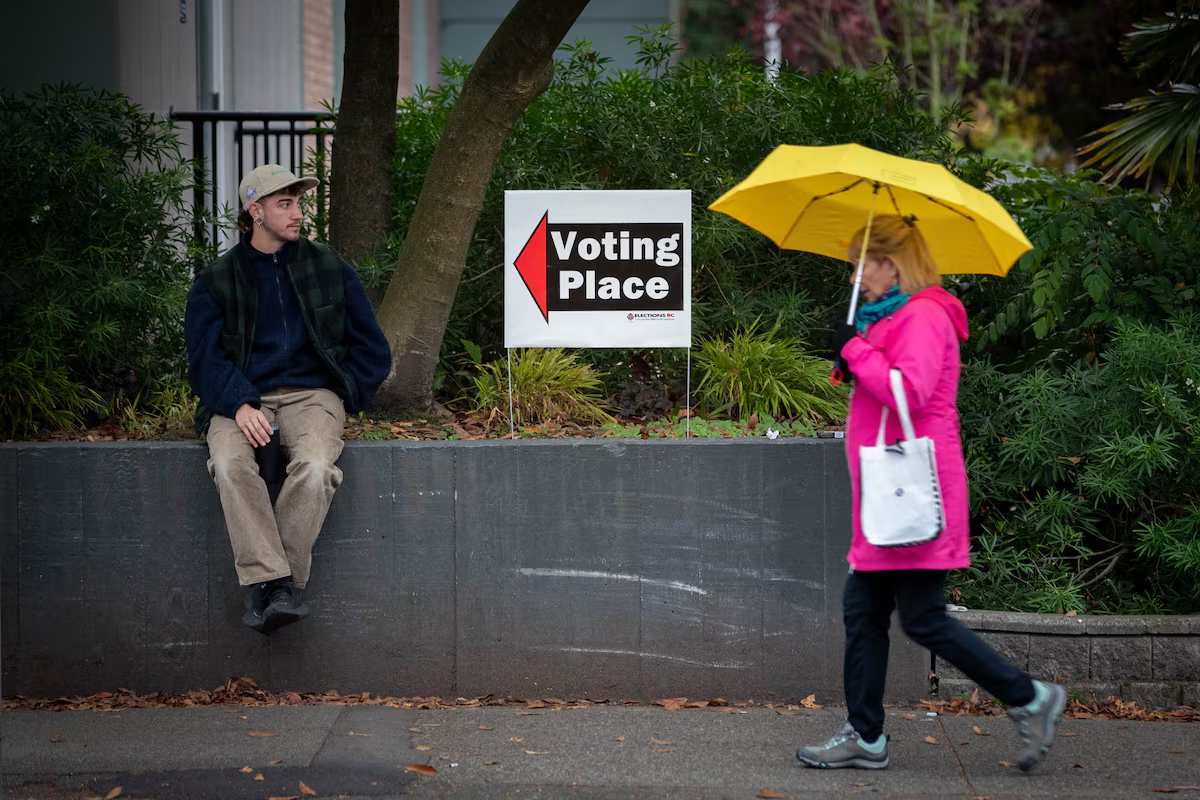
Voters arrive at a polling place in Vancouver on Saturday. Turnout for B.C.’s provincial election was about 48 per cent, according to preliminary results.Justine Beaulieu-Poudrier/The Globe and Mail
Voter turnout in B.C. hit a new low in Saturday’s provincial election as fewer than half of registered voters cast a ballot, an indication, observers say, that many voters rejected the rationale for the snap vote.
According to preliminary results from Elections BC, about 48 per cent of voters cast a ballot, which would be the lowest level recorded going back as far as 1928. In 2024, voter turnout was about 58.5 per cent, and in 2020, it was about 53.9 per cent.
The stunning electoral turnaround that saw the Conservatives, led by interim party leader and now premier-designate Lorne Doerkson, sweep the incumbent NDP government from office was a remarkable rebuke for outgoing Premier David Eby.
With two years left in his mandate and with an opposition party that was without a permanent leader and in disarray, Mr. Eby called the vote on Sept. 22 with his party leading in the polls. Voters, however, did not seem persuaded that an election was necessary, despite Mr. Eby’s efforts to make it about winning a new mandate to tackle the U.S. trade war.
On Saturday, they punished the government, electing a sizable Conservative majority and ending a nine-year run in charge for the NDP that began in 2017 under premier John Horgan, who died in 2024.
Geoff Meggs, who was chief of staff to Mr. Horgan, said it appears that many of the party’s voters simply stayed home.
“Dave Eby’s campaign angered them. They were never persuaded by his arguments in favour of an election,” Mr. Meggs said.
He said in some ways it’s not surprising that the party’s support took a hit. The NDP campaign, when it eventually pivoted away from the trade argument for the election, proposed complex policies focused on affordability, such as one to regulate grocery prices, that didn’t capture the imagination of voters.
And while Mr. Eby raised fears about what the Conservatives would do if they won power, he didn’t clearly underline what his government had accomplished, according to some political observers.
“He didn’t campaign on the very real achievements of the NDP over the years since 2017 and proposed things that didn’t resonate with British Columbians,” Mr. Meggs said.
The NDP received about 274,000 fewer votes than in the previous election, while the Conservatives got about 49,000 fewer. The Green Party increased its tally by about 23,000.
Five takeaways from B.C.’s election
Gary Mason: Political hubris claims another victim
The low turnout for the provincial election is in contrast with relatively strong turnout during the recent municipal elections. In Vancouver, municipal voter turnout was up seven percentage points for the Oct. 17 vote at 43.4 per cent, compared with 36.3 per cent in 2022. Across the province, municipal-election turnout was 32.8 per cent, according to the Union of B.C. Municipalities, up by about three percentage points from four years ago.
Allan Tupper, a professor emeritus of political science at the University of British Columbia, said the timing of the two elections, just one week apart, was odd and may have had an impact on how many votes were cast. With two sets of signs on local lawns and campaigns competing for often overlapping pools of volunteers, citizens may have experienced some election fatigue.
“It just seemed there was no energy for this thing,” Prof. Tupper said. “I think Eby didn’t size it up right. The opposition organized itself very quickly.”
In the Quebec provincial election of Oct. 5, turnout was a relatively high 67 per cent, while the Alberta referendum of Oct. 19, which asked whether to hold a vote on separation, had preliminary turnout of more than 62 per cent.
Duff Conacher, co-founder of Democracy Watch, a non-profit that works on democratic reform, said studies show that voter turnout is high when voters believe something important is at stake, when the leaders appear viable and competent and the race appears close.
Turnout was above 70 per cent in B.C. in all the elections held from 1983 to 2001 and hasn’t been higher than about 62 per cent since.
Mr. Conacher said it’s a worrying sign that voter participation appears to have dipped below 50 per cent this time, but it’s not surprising given recent trends.