
Open this photo in gallery:
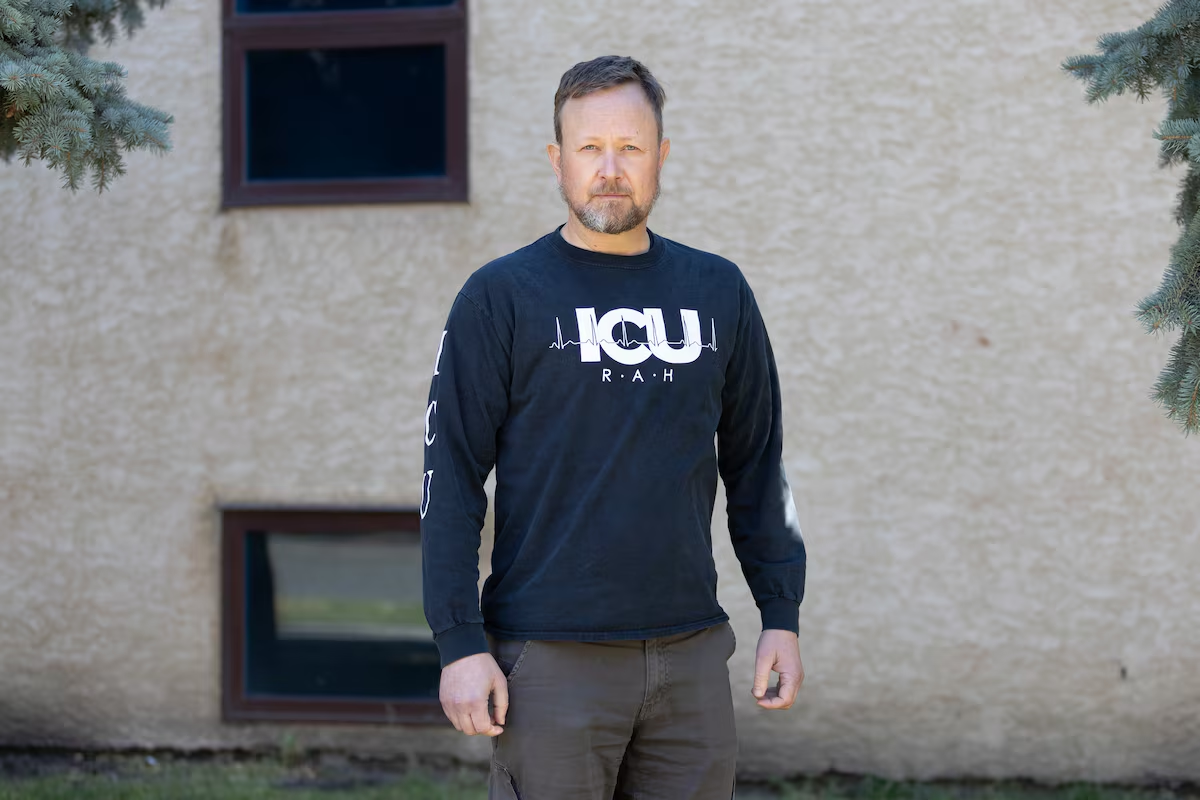
Dr. Damian Paton-Gay assessed the injured arriving at Wainwright Health Centre after the fire. He says many of his waking hours this week, as well as those of his colleagues, have been spent caring for the burn patients.Megan Albu/The Globe and Mail
Dr. Damian Paton-Gay raced through the halls of the Wainwright Health Centre on Saturday night as chaos swirled around him. Nearly every corner of the 100-bed Alberta hospital was crammed with gurneys holding patients suffering from severely scorched skin and in need of intensive care.
His job was to take stock of the condition of the 39 injured soldiers arriving from the nearby military base where they had been engulfed by flames during a training exercise. Calmly but swiftly, he determined which needed to go elsewhere for specialized treatment, and how soon first responders could get them there.
For Dr. Paton-Gay, this was a first – a scene of mayhem that he said would prompt someone watching a medical drama to say, “Well, this TV show is taking a bit of artistic license.”
But this scenario is precisely the type of mass casualty event that senior leadership in both the civilian and military health care systems in Canada have been simulating – and warning that the country is woefully unprepared for.
For two years now, this group of experts have run war games involving the repatriation of hundreds of war zone casualties arriving from overseas for a sustained period to determine how Canadian health care systems would fare. Burns have featured heavily in the exercises.
In just minutes, tiny Wainwright hospital became scene of horrors and heroism
What played out on Saturday night in Wainwright, a town about 200 kilometres east of Edmonton, is just a glimpse of how the capacity of Canada’s health care system can be challenged in an instant, said Adalsteinn Brown, dean at the University of Toronto’s Dalla Lana School of Public Health, and one of the experts involved in these planning simulations.
If the Wainwright fire and another tragedy elsewhere in Canada occurred around the same time, the system would falter, Dr. Brown said.
“If we continually run the systems as close as we can to the bone, we don’t focus on resilience, we don’t build in that capacity, and we don’t practice being ready to deal with not just one but many. Then we’ll find ourselves in real fundamental existential difficulties with the health system,” Dr. Brown said.
The Canadian Armed Forces relies on the country’s civilian, public health care system, which is often operating at maximum capacity, for specialized care. Canada also depends heavily upon imports for critical supplies such as skin and blood bags, leaving its supply chains vulnerable in the event of war or another large-scale mass casualty event. Those involved in the simulations are campaigning for better co-ordination of health care preparedness at a national level, especially between the civilian and military systems, to ensure Canada emerges resilient in the face of a crisis much larger than Wainwright.
Open this photo in gallery:
Military personnel arrive at the Wainwright Health Centre, Oct. 19.Amanda Erickson/The Globe and Mail
In December, NATO Secretary-General Mark Rutte warned in a speech in Berlin that, “Conflict is at our door.” He added, “Russia has brought war back to Europe, and we must be prepared for the scale of war our grandparents or great-grandparents endured.”
For Canada, this call to action doesn’t mean only investing into arms and soldiers, but also, health care: “You really can’t talk about the defence of Canada without investing in a resilient civilian health care system,” Major-General Scott Malcolm, surgeon-general of the Canadian Armed Forces and a participant in the Canadian war games, said.
Similar disasters in the past have done little to spark change, said Gen. Malcolm. He referenced Quebec’s Lac-Mégantic disaster in 2013, during which a fiery explosion killed 47 people. That prompted calls to be better equipped for burn care in Canada, he said. But little changed.
Being prepared for an influx of burn patients is top of mind for Gen. Malcolm because of the types of injuries being documented in Ukraine, which are different than wars past.
“We’re seeing burns and a greater volume of patients in general,” he said. This has raised flags at home for the surgeon-general, where the Armed Forces often rely on the civilian health care system and lack burn surgeons among their ranks.
Modelling shows that capacity, supplies and specialized personnel in the civilian system are limited in terms of surge capacity.
When Dr. Paton-Gay was making calls from the Wainwright Health Centre on Saturday night, one of the things he asked was how much space hospitals could open up for the incoming burn victims. Were there existing patients who could be moved around to open up room in intensive and emergency care? How many?
Seven of the injured soldiers landed in his own intensive care unit at the Royal Alexandra Hospital in Edmonton where he works full-time as a physician.
A Toronto hospital’s mass-casualty war game puts Canada’s health care system to the test
Dr. Paton-Gay walked into his Edmonton home on Sunday morning roughly 12 hours after receiving the call for aid in Wainwright. By Monday morning at 7 a.m., he was back at work in the ICU to begin his first shift of a seven-day stretch.
“There is some fatigue,” he said. “But no one’s going to shy away from caring for people who volunteered their service to protect our country.”
Many of his waking hours this week, as well as those of his colleagues, have been spent caring for the burn patients.
“It’s minute by minute for the nurses at the bedside,” he said.
The care includes painful dressing changes that often require painkillers or sedation, ensuring the patients’ airways remain open, frequent surgical procedures, and keeping their bodies free of infection and at the right temperature. It’s precise work and critical, until they are ready for the intensive surgeries necessary to replace their damaged skin.
This aspect of their recovery underscores another feature of the Canadian health care system that mass casualty experts say is deficient – a steady supply of tissues, such as skin, cornea and tendon. In the U.S., there are more than 100 establishments accredited by the Association for Advancing Tissue and Biologics whose members’ work includes tissue recovery, distribution and storage. In Canada, there are 15 organizations dedicated to supplying tissue to those in need.
Canada imports the majority of its tissues from the U.S., said Dr. Graham Sher, chief executive of Canadian Blood Services. The country has long been self-sufficient in blood, but tissues have been left behind owing to a lack of federal investment, he said.
That vulnerability is why, more than a year ago, Gen. Malcolm approached the national organization to increase the country’s sovereign supply of skin. This request was backed in June by Industry Minister Mélanie Joly, who announced a $75-million investment into Canadian Blood Services to support its work with the Armed Forces.
“If we ran into a circumstance, where needs arose at the same time in our neighbours to the south or in Europe, we would be challenged,” Gen. Malcolm said.
“We simply don’t produce enough tissue in Canada, right now, in peacetime, to meet our demands.”
The Globe and Mail asked the provincial health agency Acute Care Alberta about how much skin will be required to treat victims of the Wainwright fire, and where it will be sourced from.
Opinion: Tragedy at CFB Wainwright will be a blow to the Canadian Armed Forces
Acute Care Alberta declined to provide specifics about individual patients’ treatment requirements. Spokesperson Jennifer Vanderlaan wrote in an e-mail: “When donor skin is required, Give Life Alberta tissue banks in Edmonton and Calgary maintain supplies from deceased donors. If local demand exceeds supply, hospitals can also request donor skin from tissue banks in other provinces.”
It’s difficult to say how much skin Canada needs to be better prepared. With the caveat that there’s “not a lot of science to it,” Gen. Malcolm said he’s calling for an expansion of tissue banks across the country, with each location housing about 1.5-million square centimetres, roughly the area of 11 standard parking spaces.
“You never know truly how many casualties you’re going to have,” he said.
For now, planning to bolster Canada’s national skin supply chain is still in early stages, said Jody Faught, vice-president of supply chain at Canadian Blood Services.
In Quebec, where the province operates its own blood and tissue supply separate from the rest of the country, Héma-Québec spokesperson Josée Larivée confirmed the organization has been co-ordinating with the armed forces and Ottawa.
Quebec has previously been reliant on the U.S. for tissues. Today, it’s closing in on an agreement with the federal government, Ms. Larivée wrote in an e-mail, to have 1.5-million square centimetres of skin, or enough to “simultaneously treat approximately 75 to 150 severely burned patients.”
Wainwright is proof for Dr. Paton-Gay that the system and supplies supporting a country’s health care workers matter. “We can trust that people will do remarkable things, if they’re provided a system that supports them,” he said.