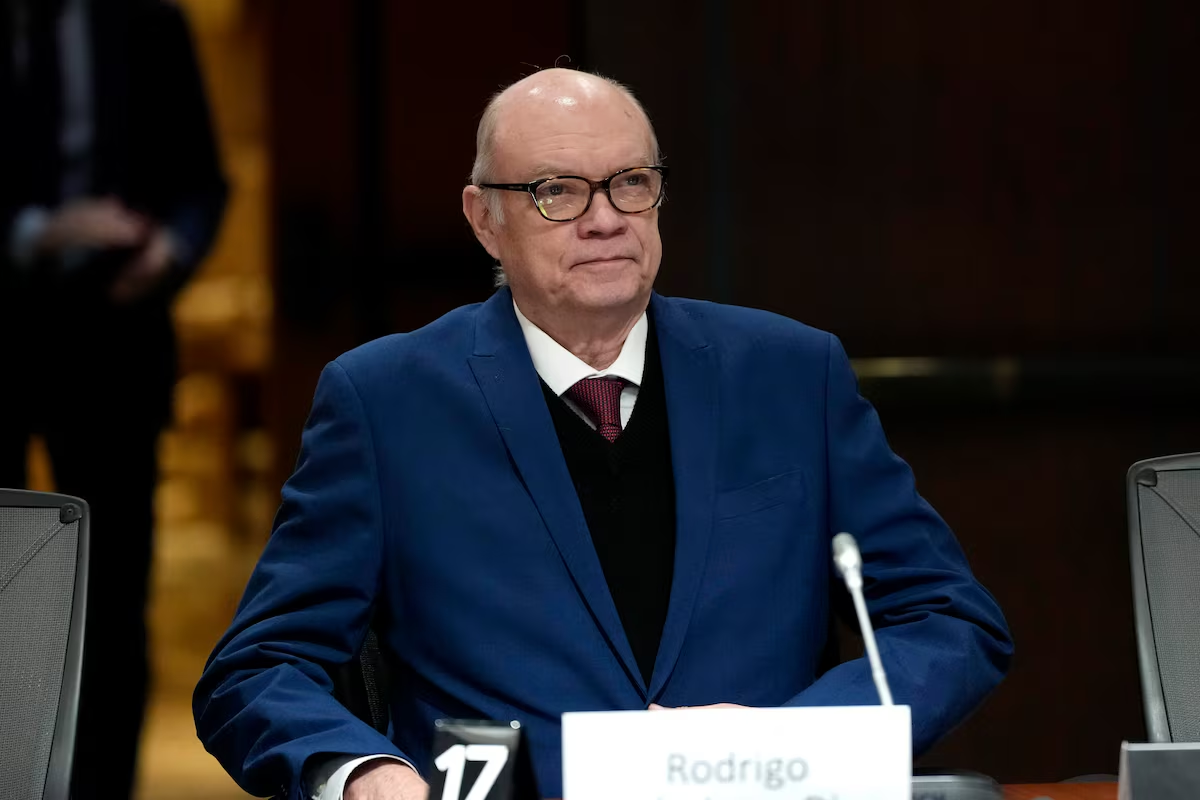

Open this photo in gallery:
Ambassador of Cuba to Canada Rodrigo Malmierca Diaz prepares to appear before the Standing Committee on Foreign Affairs and International Development, in Ottawa on Feb. 24.Justin Tang/The Canadian Press
Havana is urging Ottawa not to drop its public opposition to the decades-long U.S. embargo as Washington ramps up pressure on countries supporting Cuba.
“We are confident that Canada will stay with us, as they have done in the past,” Cuban Ambassador to Canada Rodrigo Malmierca Diaz told The Canadian Press.
“The blockade and this intensification is, in practice, killing people.”
The United Nations is set to vote next week on a motion Cuba has put forward nearly every year since 1992. It calls for the termination of “the economic, commercial and financial embargo imposed by the United States of America against Cuba.”
Canada has voted in favour of this motion multiple times.
Canada to send $8-million in food aid for Cuba as fuel crisis continues
U.S. President Donald Trump’s administration has been trying to overthrow Cuba’s Communist government through a de facto oil blockade. Washington cut off Venezuelan shipments in January and has threatened to impose tariffs on countries that sell oil to the island nation.
Washington claims Cuba poses a national security threat to the United States. Malmierca said the Caribbean nation is being collectively punished by an American pressure campaign that is harming the health and education of Cubans.
An economic crisis has gripped Cuba since 2020, triggering critical shortages and severe blackouts that peaked after January’s fuel blockade.
Havana insists its economic struggles stem from six decades of American sanctions, but critics point to the inefficiency of its Communist regime. Human Rights Watch and Amnesty International say Cuba’s government engages in arbitrary arrests, tortures political prisoners and limits media and political parties.
Cuba produces only 40 per cent of the fuel it needs. Shortages have led to frequent blackouts that have threatened health care systems and crippled the island’s economy. Air Canada and other airlines cancelled flights to Cuba in February because of shortages of aviation fuel.
Ottawa has pledged to distribute $13 million in humanitarian aid for Cubans through international organizations — not the Cuban government. Past Canadian development funding has gone to things like solar panels aimed at making the island less reliant on foreign fuel.
“The people are resisting because we are convinced that the most valuable thing we have is the independence, the sovereignty of Cuba. And we are not going to surrender that,” Malmierca said.
“We would like to have a normal relationship with the U.S. We are ready for dialogue.”
Ottawa says it’s open to mediation with Canadian diplomats allegedly suffering from Havana Syndrome
Malmierca said countries that have supported Cuba have told Havana they’re being warned by Washington their access to American trade or aid could be curbed if they continue supporting UN motions to end the blockade.
He said Cuba is “not naive” and knows Canada is facing its own economic pressure from the Trump administration.
“This year is a particular moment because of all this aggressivity of the U.S. government against Cuba,” he said. “They are in a kind of offensive with other countries, trying to exercise influence for them to change their votes. We know they are using threats.”
The Canadian Press asked the U.S. State Department for comment but didn’t receive a response.
U.S. Ambassador to the UN Mike Waltz this week urged countries to vote against the motion, dismissing it as a product of “70 years of propaganda” meant to distract from corruption in Havana. He said Washington has been lobbying European countries to vote against the motion.
“Do not let them abuse your vote for their oppression,” he said at a Monday event he hosted. “Do not give in to this lie.”
In a statement, Global Affairs Canada said it is still pondering how it will vote on the UN motion next week.
“As with all UN resolutions, Canada’s voting position is being considered in advance of the vote,” wrote spokesperson Thida Ith.
“Canada continues to call for the Cuban government to implement needed reforms to respect the political and economic rights of the Cuban people, and to release all political prisoners.”
In July, Havana called for a UN debate on the American embargo in the context of the island’s fuel crisis. Washington suggested it was a waste of resources to debate a motion that had already been debated nine months prior, and insisted that the decision to hold a debate be put to a recorded vote.
The vote passed and a debate was held. Canada was among 30 countries that abstained from the motion on holding a debate.
Civil society groups such as the Canadian Network on Cuba said they fear Ottawa may be pulling back from Cuba.
A document The Canadian Press obtained through a freedom-of-information request shows Ottawa had frank exchanges with Cuba about its liquidity crisis before Trump ramped up pressure on the Communist government.
The document — a briefing book prepared by Global Affairs for its deputy minister — shows the deputy minister met with three Canadian firms during a visit to Havana in February 2023 to discuss their Cuban clients’ unpaid bills.
The document says the aim of the meeting was to reassure the three firms that Ottawa “has their back … without unduly encouraging new investors and traders who risk not being paid for their goods/services.”
The companies mentioned in the document are the National Bank, mining firm Sherritt and hotel chain Blue Diamond, now called Royalton. None of the companies responded to The Canadian Press when asked whether they still have accounts in arrears in Cuba.
Sherritt and Royalton have both ceased operations in Cuba. Havana has blamed their withdrawal on American pressure tactics.
The briefing book for the deputy minister reveals some of the nature of Canada’s discussions with Cuba, with Ottawa pushing for details on small and medium-sized enterprises and Havana requesting more aid.
“Canadian firms are facing mounting payment arrears with Cuban buyers. Many Canadian firms in Cuba are SMEs and the situation is threatening their sustainability,” reads the February 2023 document for the deputy minister.
“We sought bilateral meetings for you, that would allow you, for example, to engage on human rights and new economic actors (private sector SMEs and entrepreneurs). The Cuban side wanted rather to talk to you about new tourism initiatives and more Canadian international development projects.”
The briefing book proposed that Canada “leverage Cuba’s desire for increased assistance in our dialogue on other priorities (e.g. human rights)” — but added that the cheapest and most effective things Canada could offer would be technical help with reforming the agriculture sector and rules for smaller businesses.
Malmierca said Cuba is implementing 176 reform measures which came out of parliamentary and public consultations. He said these measures will allow a larger role for the private sector, foreign investment incentives and municipal autonomy.
“In Cuba, we work according to the rule of law,” he said. “Cuba is a society that is continuously trying to improve.”
He said a trade fair in Havana next month is going largely virtual due to the current electricity shortages, and Cuba will hold an event in Toronto ahead of time to drum up interest from Canadian entrepreneurs.
“We can maintain not only the economic relationship, but we can increase it in better conditions in the near future.”