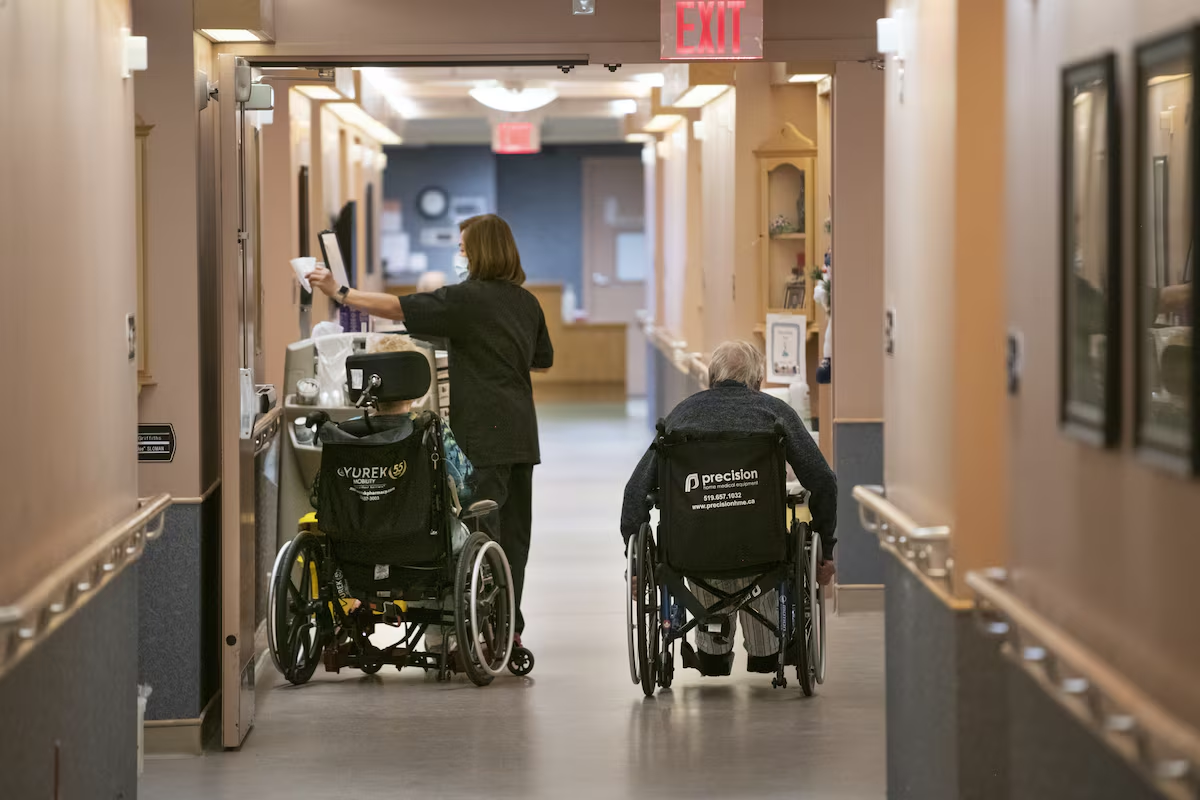

Open this photo in gallery:
Changes to federal immigration policy have made ‘a difficult staffing situation in healthcare even worse,’ Lisa Levin, the CEO of AdvantAge Ontario, says.Fred Lum/the Globe and Mail
Tighter federal immigration rules are putting nursing homes at risk of losing significant numbers of temporary foreign workers, long-term care providers in several provinces say.
The elder-care sector often struggles to find local labour. Nursing homes have to recruit personnel from abroad to supplement the staff looking after seniors who have cognitive problems or dementia and need help for dressing, bathing or feeding.
“There have been changes that the federal government has made to immigration policy that have made a difficult staffing situation in healthcare even worse,” said Lisa Levin, the chief executive officer of AdvantAge Ontario, which represents the province’s municipal and non-profit long-term care homes.
“This is one of those examples of unintended consequences from government decisions,” said Mary Polak, chief executive of the BC Care Providers Association. “They were not maybe aware of the whole scale of impacts that would result from their decisions.”
Ottawa announces immigration rule changes that will give highly paid foreign workers an edge
Ottawa has moved since 2024 to curb the number of international students and temporary foreign workers, following criticisms that their influx created housing problems and made it harder for Canadians to find jobs.
Two measures have had major impacts for long-term care providers, Ms. Levin said.
The first change involved the Labour Market Impact Assessment (LMIA), a document the employer must complete to confirm that no Canadian is available to fill a job. The LMIA enables foreign personnel to apply for a work permit.
LMIAs, which cost a $1,000 processing fee per application, are now only valid for six months, down from a year previously.
The second change Ms. Levin mentioned was the duration of work permits, which was shortened from two years to one.
Gavin McIntosh, operations and finance vice-president for The Care Group, which runs nine facilities in British Columbia, said homes have to pay overtime to compensate for their staffing shortages. “It’s not sustainable,” he said.
Others have turned to temporary staffing agencies, a costly alternative that is also detrimental because vulnerable residents need stable care personnel, Ms. Levin said.
“They’re working with people who have cognitive issues, and then you have to bring someone else in, you have to train them all over again on what the needs are of the residents. Each individual resident has their own care plan and their own needs, and in many cases they can’t communicate it themselves.”
The federal government, however, said that the Temporary Foreign Worker (TFW) Program should only be a last-resort solution for short-term problems. “It is not a substitute for Canadian talent and is conditional on ensuring that measures have been taken to recruit Canadian workers,” Samuelle Carbonneau, a spokesperson for Employment and Social Development Canada, said in an e-mail.
LMIAs are not based on job titles but assessed individually, Ms. Carbonneau said. She noted that there are additional pathways to hire foreign workers.
Quebec employers, for example, have a priority process called “traitement simplifié” that extends to foreign applicants for Personal Support Workers (PSWs), who provide basic care in nursing homes.
However, Jean-François Blanchard, executive director of two long-term care homes west of Montreal, said some of his foreign candidates have been stumped because the Quebec priority stream does not recognize the training they acquired in private establishments.
This person-centred approach to dementia could revolutionize long-term care in Canada
Mr. Blanchard, who is president of a group representing Quebec private nursing homes, said his members could potentially lose 650 of their 6,000 workers because of immigration issues.
Another option mentioned by Ms. Carbonneau was a temporary extension allowing rural employers to retain their number of foreign workers until next March. However, the measure requires applying for new LMIAs, and two provinces, Ontario and Alberta, aren’t participating in that temporary measure.
Ashley Hoffmeister, the human resources director for the District of Kenora Homes for the Aged, said 28 of the 400 employees in her three facilities in northwest Ontario are facing expiring papers.
She tried to hire foreign staff through another route, the Significant Benefit to Canada permit, commonly known as the LMIA exemption C10.
The C10 work permit only costs $230, but the employer has to explain how the foreign workers will make a contribution so significant that they can be exempted from requiring an LMIA.
Ms. Hoffmeister said some C10 applications have been turned down because bureaucrats didn’t recognize the foreign workers as health care personnel. One rejection letter shared by Ms. Hoffmeister said the PSWs “appear to be highly/mainly specific to individual’s personal care and not health care.”
PSWs, also known in some provinces as healthcare aides, handle the majority of the daily support for elderly residents.
“We literally wouldn’t be able to function without them. They monitor all the health care needs for our residents. If there’s any changes in their cognitive abilities or their physical abilities, they’re the first ones to see it and report it to our nursing staff,” Ms. Hoffmeister said.
Opinion: Can our health ministers ever focus on reform, not just money?
The lack of appreciation for PSWs might stem from the fact that nursing homes provide medical care but are also living environments for seniors. “There’s a poor understanding of our sector,” Ms. Polak said. “They think of it as completely aligned with an acute-care setting, a hospital setting, and it absolutely is not. There are so many other things you need to operate.”
Even in areas with high unemployment rates, it is hard to find local labour because of the arduous work required to care for dependent seniors. “It’s a job that’s rather demanding,” Mr. Blanchard said.
Long-term care homes aren’t looking for applicants who “are in it just for the paycheque,” Mr. McIntosh said. “You have to be a fairly well-rounded individual and be willing to help, sometimes in more ways than just doing your job. You have to make people feel loved and supported and cared for and safe.”
Ms. Levin said she hoped Ottawa will enable employers to apply for a single LMIA for each nursing home, rather than for each individual.