
Open this photo in gallery:
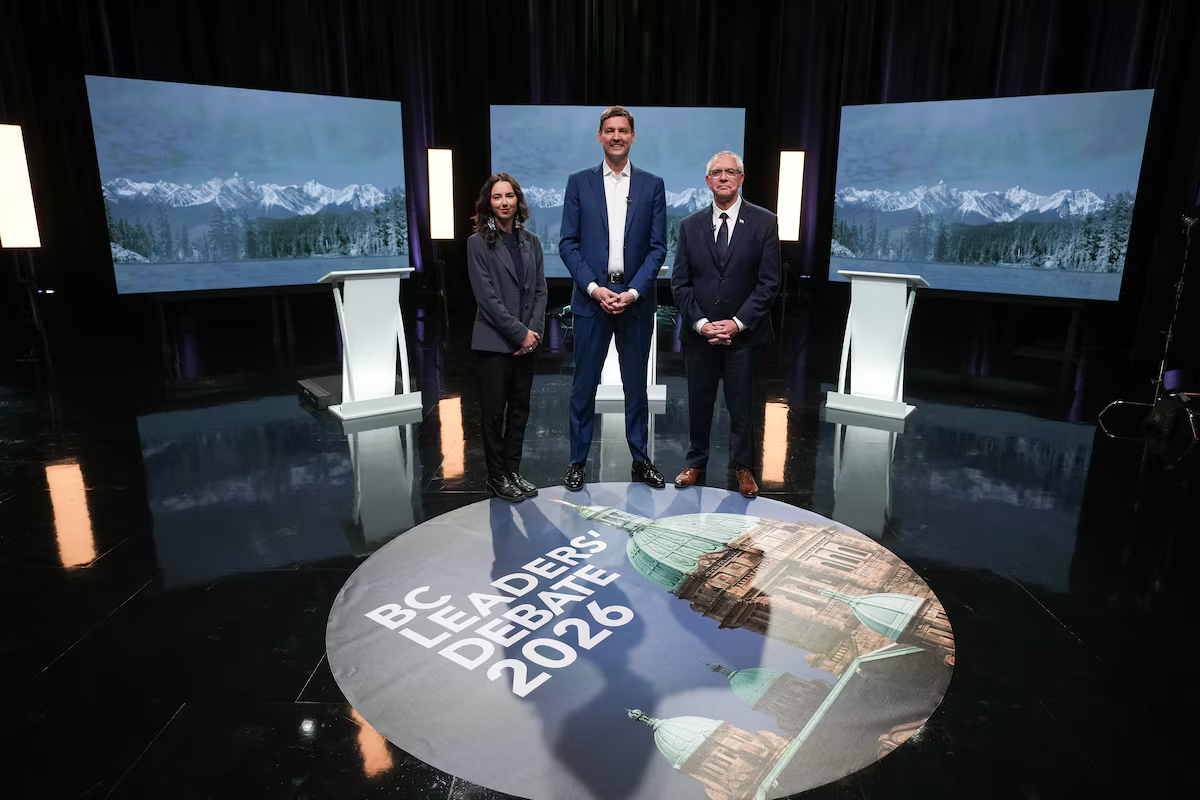
From left to right: BC Green Party Leader Emily Lowan, BC NDP Leader David Eby and BC Conservative interim leader Lorne Doerkson ahead of the televised B.C. Leaders’ Debate in Vancouver, on Oct. 14.DARRYL DYCK/The Canadian Press
When B.C.’s NDP Premier David Eby called a snap provincial election last month, two years early and with the Opposition BC Conservatives in disarray, he said he needed a strong mandate to deal with U.S. President Donald Trump’s trade war.
Some called the move opportunist, however now there’s a risk that it could backfire. Months of party chaos and infighting had the BC Conservatives looking like easy opponents, but in the weeks since the writ dropped, the Official Opposition appears to have pulled themselves together. In some surveys, interim leader Lorne Doerkson’s party is polling narrowly ahead of the NDP. The upheaval on the right didn’t reshape the province’s political landscape, and now it’s another tight two-way race, with the Greens and a couple new challengers trailing behind.
Upcoming Q&A: Ask us your questions about the B.C. election
Which parties are in the running, who are their leaders, and what do they stand for? Here’s what you need to know for Saturday’s general election.
When is the 2026 B.C. election?
The general election is on Saturday, Oct. 24.
Where to vote in the B.C. election
The last day to vote in advance is Wednesday. Several advanced polling stations are open from 8 a.m. to 8 p.m. PT.
On Saturday, polling stations are open from 8 a.m. to 8 p.m. PT. To find the closest polling station, enter your address on Elections BC’s website.
How many seats are needed for a majority in the B.C. Legislature?
There are 93 members of the Legislative Assembly of British Columbia, meaning a party must win 47 seats to form a majority government.
Your guide to the parties and platforms
BC New Democratic Party
Open this photo in gallery:
Jimmy Jeong/The Globe and Mail
Leader: David Eby
Seats at dissolution: 47 seats
Official party status: Yes
When David Eby called a snap election last month to try to increase his NDP’s narrow majority, it didn’t seem like much of a gamble. The BC Conservatives – who had come within a whisker of an upset election win two years ago – were practically leaderless and had seemingly destroyed themselves from the inside. But now, the NDP are polling a few critical points behind the Conservatives, as accusations of political opportunism and the baggage of nine years in power weigh down the ruling party’s campaign.
Five takeaways from the B.C. election leaders’ debate
Eby has presented himself as the only person strong enough to stand up to Donald Trump for B.C. in this “existential moment,” and leaned heavily on policies meant to invigorate the party’s centre-left base, such as raising taxes on those making more than $190,000 to pay for more health care services and capping some grocery prices. But running against Trump hasn’t worked as well for Eby as it did for Prime Minister Mark Carney during the last federal election. Criticism from the left and the right over the ballooning provincial debt, a recent billion-dollar-plus budget error, environmental policy and the state of B.C.’s stretched health care system have taken the wind out of the NDP’s sails. If the party manages to eke out a fourth mandate, polling indicates it’s unlikely to be stronger than what they started with.
Conservative Party of BC
Open this photo in gallery:
Jimmy Jeong/The Globe and Mail
Interim leader: Lorne Doerkson
Seats at dissolution: 28
Official party status: Yes
The BC Conservatives had all but imploded when the writ dropped on Sept. 22, but the party has pulled itself back together and is mounting a stiff challenge to the NDP. Two years ago, the party burst back onto the political scene, reshaped the political landscape and won 44 seats, coming within a handful of votes of forming government. But months of infighting and turmoil led to 16 MLAs leaving or being ousted, former leader Kerry-Lynne Findlay’s resignation and several former Conservatives joining challenger parties. However, in the weeks since Lorne Doerkson took over as interim leader, he has managed to reunite much of the big-tent right-wing party, which polls now suggest could win a majority on Saturday.
Lorne Doerkson didn’t plan on leading the BC Conservatives, but he’s trying to meet the moment
Doerkson, who was little-known a month ago, has wasted no time introducing himself to British Columbians. His jobs-focused campaign includes pledges to “supercharge the economy,” freeze income taxes, reduce red-tape and “fully-fund” frontline health care services. Doerkson has also promised to repeal the province’s legislation implementing the United Nations Declaration on the Rights of Indigenous Peoples, and to remove the sexual orientation and gender identity (SOGI) resource available for schools.
But the interim leader hasn’t clearly answered how he’ll reduce the budget deficit or where he might make cuts, and his opponents have cast doubt on his ability to govern both the province and his unruly caucus. Doerkson has already ousted two Conservative candidates – one accused of making Hitler remarks and another for racist social media posts – and the NDP and Greens have criticized others who remain on the campaign slate, including one who likened SOGI to grooming. It remains to be seen whether he can hold the party together – something his two predecessors failed to do.
Green Party of B.C.
Open this photo in gallery:
Chad Hipolito/The Canadian Press
Leader: Emily Lowan
Seats at dissolution: 2
Official party status: Yes
The BC Greens are hoping to pull themselves back from the brink of losing official party status and become kingmakers once again. Nine years ago, they helped John Horgan’s NDP end the 16-year reign of Christy Clark’s BC Liberals. But the party has struggled since Horgan’s snap pandemic election in 2020 betrayed their confidence-and-supply agreement and boosted the NDP to a historic majority. Now, the progressive party is trying to use a fresh leader, frustration with Eby’s snap election and the NDP’s track record on the environment and Indigenous rights to peel off left-wing votes and put itself back on the map.
Leader Emily Lowan, a 26-year-old renter, has campaigned on her youth and policies aimed at holding onto the party’s progressive base, which is largely concentrated in and around Victoria and on the Gulf Islands. The Greens are pledging a tax on the ultra-wealthy, oil and gas royalty reforms and vacancy control for renters. And while the Greens are polling a distant third, they have recruited star candidates – such as the province’s former chief coroner Lisa Lapointe – who could help give them a bit more sway in the legislature once again.
CentreBC
Open this photo in gallery:
ETHAN CAIRNS/The Canadian Press
Leader: Elenore Sturko
Seats at dissolution: 8
Official party status: No
CentreBC is trying to un-unite the right and return a centrist party to the province’s legislature, two years after BC United (formerly the BC Liberals) folded its campaign and endorsed the surging BC Conservatives. Leader Elenore Sturko, a former BC United MLA, sent a shock through provincial politics when she crossed the floor to the Conservatives in 2024, where she was a star candidate and later shadow minister for John Rustad’s Official Opposition. But she was removed from caucus in 2025 and Sturko, who is gay, later claimed she was prevented from voicing her “more socially Liberal beliefs.”
CentreBC formed in the same year, and merged with the British Columbia Party last month with eight former BC Conservative MLAs on board, including Sturko. When the snap election was called, all of them took Doerkson’s invitation to rejoin caucus, except Sturko, who now finds herself unexpectedly at the helm of the party. She has described it as “socially progressive, environmentally pragmatic and fiscally responsible,” saying it would ensure a strong centrist voice in Victoria. However, a recent poll put her far behind, and it’s unclear if CentreBC could win enough votes off the Conservatives to squeak out a seat.
OneBC
Open this photo in gallery:
ETHAN CAIRNS/The Canadian Press
Leader: Dallas Brodie
Seats at dissolution: 2
Official party status: Yes
OneBC is another recent product of the Conservatives’ internal divisions. Former BC Conservative MLAs Dallas Brodie and Tara Armstrong formed the party in 2025, after Brodie was removed from caucus over comments she made about residential schools. Now, Brodie is among two incumbent MLAs running under the OneBC banner, but polls suggest the party is unlikely to win a seat or keep its official party status.
In the legislature, OneBC has proposed a bill against gender-affirming care for transgender people and another to ban land acknowledgements by public institutions and employees in the province. Brodie has also vowed to “fight against these land-back giveaways that are being done by the current government” and “stop the greed and corruption of the reconciliation industry” during the course of the campaign.
With reports from Andrea Woo, Mike Hager and The Canadian Press