
Open this photo in gallery:
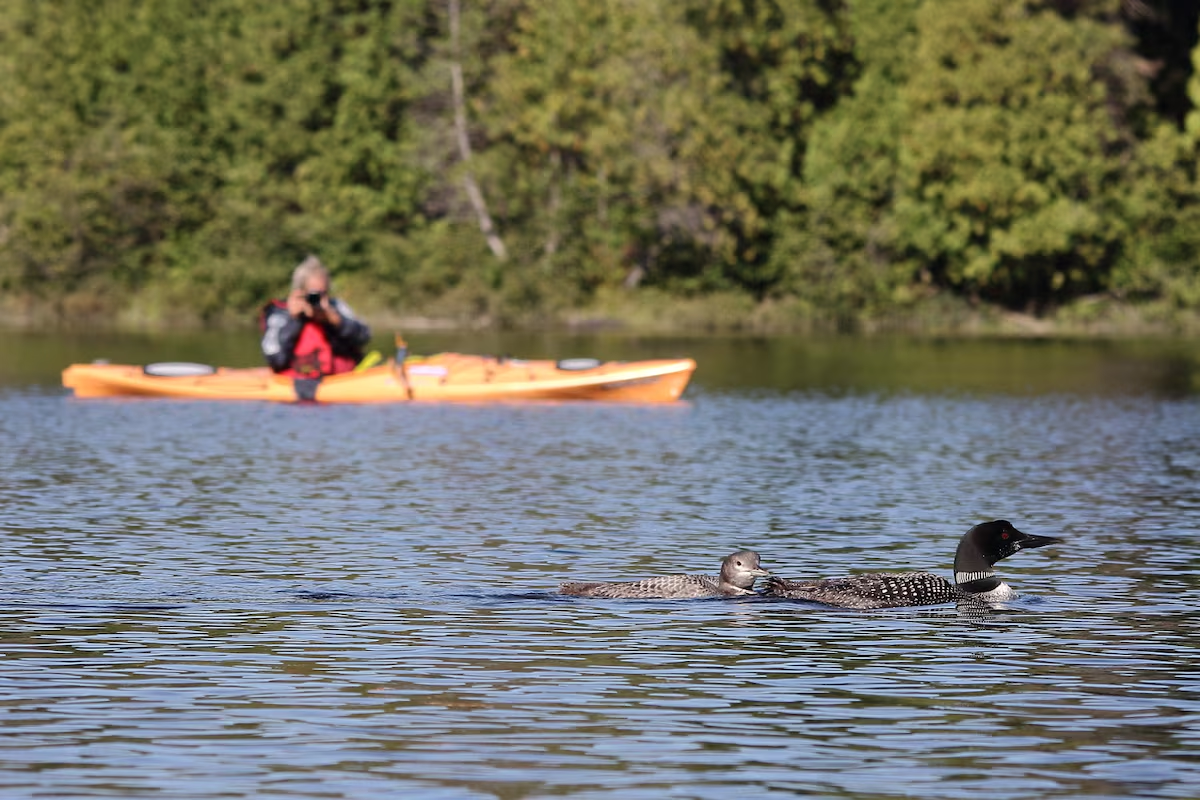
The study, published in the journal FACETS, found the steepest declines in loon populations occurred in Atlantic Canada and the Prairie provinces.Dave Gignac/Supplied
The haunting tremolo of a loon’s call echoing across a northern lake may be the signature sound of the Canadian wilderness, but a sweeping new study suggests the species could be seen and heard less frequently in the future.
“Loons are, unfortunately, not doing as well as we’d like,” said Matthew Fuirst, a research ecologist with the environmental organization Birds Canada, who led the work.
More than 20 researchers in Canada and the United States contributed to the study, published Thursday in the research journal FACETS. The landmark three-year effort pulled together decades worth of data on one of North America’s most beloved bird species.
In all but one of the 12 breeding regions that make up the study, loons are exhibiting “substantial long-term declines,” Dr. Fuirst said. “The steepest declines that we saw were in the Atlantic and Prairie provinces of Canada.”
Loons are not currently endangered, with an estimated 254,000 breeding pairs in Canada, accounting for about 94 per cent of the total species population. But regional studies have long hinted that they are under pressure.
The fact that the downward trends are widespread and vary in severity suggest multiple factors are at work, including various human-caused disturbances of loon habitat. But on a continental scale, Dr. Fuirst and his colleagues suggest that climate change may also be playing a role.
For many Canadians, loons are emblematic of both the country’s natural environment and its national identity, symbolized by its presence on the one dollar coin. Their distinctive calls, markings and association with picturesque lakes that also attract cottagers and campers have all helped to make them a quintessential feature in the landscape.
To help illuminate the loons’ status, researchers drew on more than 45,000 breeding records for loons sighted at 3,421 lakes across North America. About half the data in the study came from volunteers who participated in a long-running Birds Canada loon survey.
This, combined with other observations, in some cases reaching back to the 1980s, allowed researchers to compare loon breeding success across time and between regions.
The unifying measurement the researchers used to compare all the data is productivity, defined as the number of chicks per adult loon pair that survive beyond six weeks after hatching.
In the analysis, data were grouped into 12 regions to look at trends in productivity.
The results mostly showed declines, ranging from 0.5 to 2.5 per cent per year, over a time period of two to four decades depending on available data. The exception was northern Maine, where loon productivity has been relatively stable.
A blind area in the study is the northern half of the Common Loon’s breeding range, where there are far fewer people and where data have been difficult to obtain.
Walter Piper, a co-author on the study and a professor of biology at Chapman University in Orange, Calif., said it was not likely that data in the northern part of the loon’s range would show an increase to counterbalance what is being observed in the south or that loons were moving further north in response to environmental change.
He noted that, aside from productivity, the study also indicated there was a decline in chick quality that could signal poorer nourishment.
“We are probably detecting the leading edge of a broad decline in the loon population that is likely to continue in coming decades,” Dr. Piper said. “Loons are long-lived, so it will take a while for this decline to become obvious, but we had better look for causes now.”
One potential cause that has captured researchers’ attention is the possibility that increased precipitation due to climate change is affecting the loons ability to hunt for food and feed their young.
Unlike ducks, which occupy some of the same habitat, loons are built to catch fish in relatively clear water. Even their bones are denser than those of many other species to make it easier for them to stay submerged long.
But more flooding and churning of lake waters as a result of increased precipitation could be lowering visibility and impeding the loons’ hunting success.
James Paruk, a loon expert and biologist at St. Joseph’s College in Standish, Maine who was not involved in the study, said the stability of the loon population measured in that state may offer another clue.
He noted the part of the state that the study encompassed has relatively low human and shoreline development. This might account for some of the variations in the populations trends, he added.
Dr. Paruk also praised the study team for the significant amount of work and co-ordination that was done to conduct such a large scale analysis.
“The data covers such a long time span on such a broad scale that it’s really far reaching in its implications,” he said.
Dr. Fuirst said that he has already embarked on a follow-up study to get at the causes of the declines.
“If we can identify threats before they become detrimental, that’s the best case scenario,” he said.