
Open this photo in gallery:
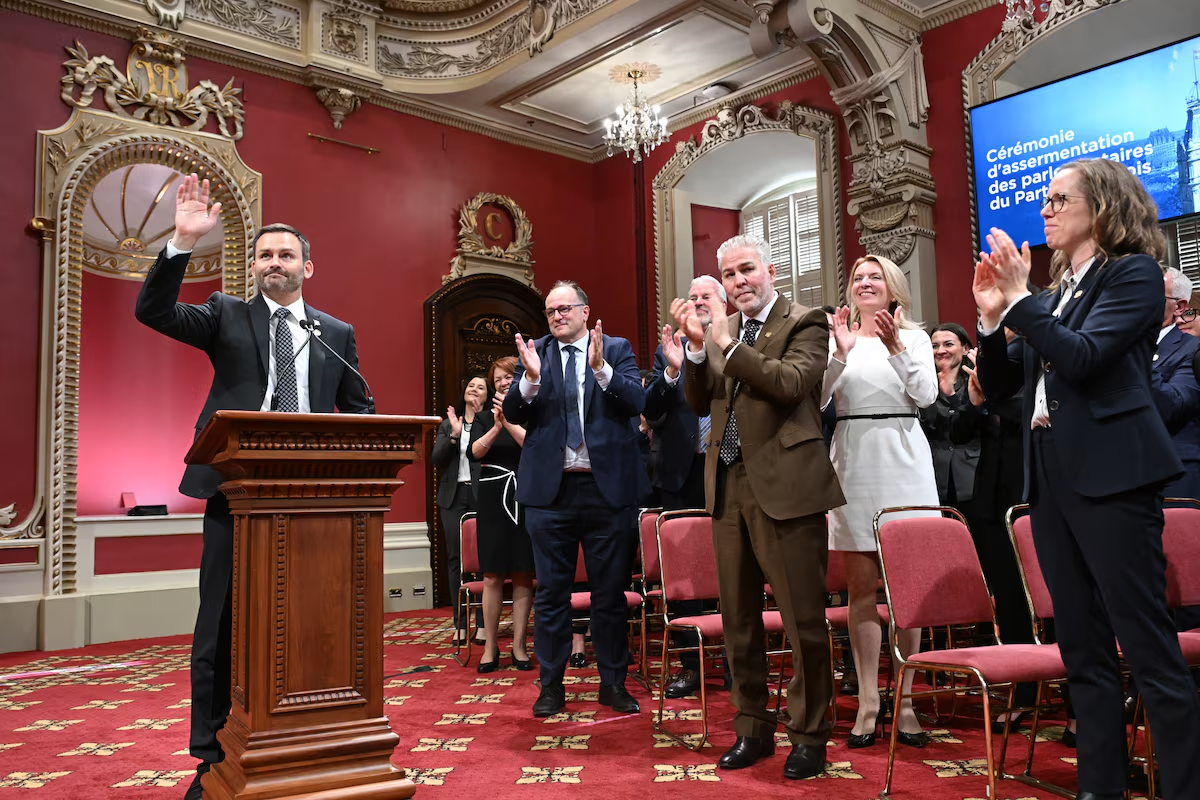
Quebec Premier Paul St-Pierre Plamondon waves as he is applauded by sworn in members at the legislature in Quebec City, Oct. 15.Jacques Boissinot/The Canadian Press
Quebec’s lieutenant-governor will not be present when Paul St-Pierre Plamondon is sworn in as premier on Wednesday – a symbolic change that presages a larger fight the Parti Québécois has promised to wage against the presence of the monarchy in the province.
The decision comes as Quebec’s latest batch of lawmakers has opted not to swear fealty to King Charles III after the province’s Oct. 5 election. They have instead taken an oath of allegiance only to the Quebec people, as permitted by a 2022 law whose constitutionality is now being challenged in court.
Mr. St-Pierre Plamondon has pledged to go further, promising that his newly elected minority government will pass another law eliminating the office of lieutenant-governor, which he says is an outdated symbol of British colonial history. Critics have accused him of angling for a constitutional battle that could help rally support for his planned independence referendum.
On Tuesday, the premier-designate confirmed he had sent a letter to Quebec Lieutenant-Governor Manon Jeannotte asking her not to attend the swearing-in ceremony for his new cabinet. In the letter, he said his party is “firmly committed to abolishing the monarchy in Quebec, both within our democratic institutions and in our civil society.”
Mr. St-Pierre Plamondon said Quebec’s secretary-general will attend the ceremony in place of the lieutenant-governor, who will watch on television from her office. Ms. Jeannotte will still sign the appointment letters for the new ministers.
Opinion: Quebec’s political mainstream has shifted to the right
In a social media statement, the premier-designate said the offices of the governor-general and provincial lieutenant-governors cost taxpayers $60-million annually.
“I pledge to redirect any funds we are able to recover in Quebec from this archaic symbol of British colonial rule toward addressing the needs of homelessness,” he said.
In a statement, a spokesperson for Ms. Jeannotte confirmed she will not be present at the ceremony.
“The Lieutenant-Governor is under no obligation to attend, and she does not wish to be the centre of attention,” said Ian Préfontaine. “What matters to her is the continuity of government in accordance with the Constitution.”
Earlier this month, Governor-General Louise Arbour raised doubts about the PQ government’s authority to scrap the role of lieutenant-governor.
“In Canada, we operate within a constitutional framework that, in my opinion, has served us very well so far and that imposes certain constraints on how public authorities function,” she said during a visit to Manitoba, according to a Radio-Canada report.
Constitutional experts say a move to unilaterally abolish the office of lieutenant-governor is patently unconstitutional and would end up in court. But Patrick Taillon, a professor of constitutional law at Laval University, said the decision not to have the lieutenant-governor present on Wednesday is little more than a symbolic move.
“The legality will be respected, because she will still do the work she has to do,” he said.
Incoming Parti Québécois eyes friends and foes across the aisle
Meanwhile, a Quebec Superior Court judge on Tuesday heard arguments related to a constitutional challenge of the 2022 Quebec law that abolished the requirement for lawmakers to swear allegiance to the British monarch. The law was passed unanimously after Mr. St-Pierre Plamondon and his caucus refused to take an oath to King Charles and were barred from entering the National Assembly.
This year, none of the 127 members of the legislature is expected to swear allegiance to the King.
Lawrence David, who teaches constitutional law at the University of Ottawa, argues Quebec had no authority to unilaterally amend the Constitution, and that bills adopted by lawmakers who have not sworn allegiance to the Crown will be legally invalid. He is seeking an emergency order to suspend the 2022 law and force MNAs to take the oath of allegiance pending the outcome of his legal challenge.
“This court challenge is not about monarchy versus republicanism,” he said in court Tuesday. “It’s about respect for the Constitution.”
Lawyers for the Quebec government argued that suspending the law would require MNAs who believed they would not have to swear allegiance to the King to set aside their political convictions in order to hold office. Justice Ian Demers will deliver his decision at a later date.
During a speech after his caucus was sworn in last week, Mr. St-Pierre Plamondon said he was proud of the law, and offered a quote widely attributed to Nelson Mandela. “It always seems impossible until it’s done,” he said.
In a previous interview with The Globe and Mail, Mr. David accused the premier-designate of spoiling for “a constitutional crisis that then bolsters the impetus for a referendum.” The PQ Leader has promised to hold a vote on independence, though not before U.S. President Donald Trump leaves the White House in 2029.
Support for sovereignty remains low in Quebec, hovering around 30 per cent, and the PQ will form a minority government with just 28 per cent of the vote – the lowest vote share of any government in the province’s history.