
Open this photo in gallery:
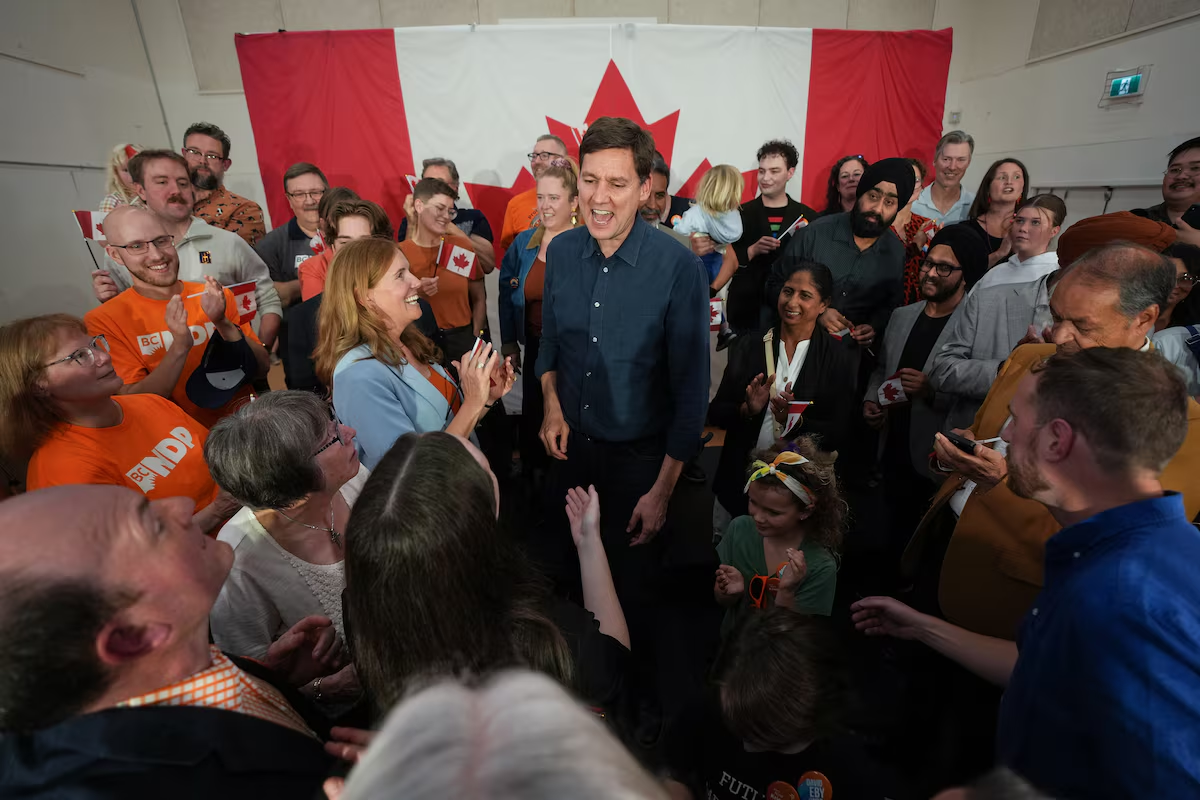
BC NDP Leader David Eby greets supporters at a campaign rally in Victoria, on Oct. 4. The $10-a-day commitment was not a talking point during the current election campaign until Mr. Eby said that one of his children was in a $10-a-day space.DARRYL DYCK/The Canadian Press
The promise of $10-per-day child care in British Columbia has been a signature pledge of the NDP for almost a decade, but as voters go to the polls in a snap election call next week, the data suggests the results have fallen far short of the commitment.
Spaces at $10 a day only account for approximately 10 per cent of licensed child-care spaces in the province, according to the $10aDay Child Care Campaign.
The BC NDP made $10-a-day child care the central focus of the 2017 election which first brought them to government.
The provincial government has increased the number of licensed child-care spaces by approximately 50 per cent since 2018, adding more than 60,000 new spots. It has also ensured that fees for publicly funded, licensed child-care providers have been reduced by 50 per cent.
But in July, 2021, when British Columbia was the first province to sign on to the Canada-Wide Early Learning and Child Care agreement, B.C. promised to create 30,000 new affordable spaces within five years, 40,000 spaces within seven years, and reduce child-care fees to an average of $10 a day by March 2026.
Eby set out to tackle B.C.’s biggest problems. Now, he must convince voters his efforts are working
Despite B.C.’s early enthusiasm for the plan, the province has struggled perhaps more than any other with its implementation.
It has created just over 17,000 spaces so far in the $10-a-day program, according to $10aDay.
Not only are spaces in the program scarce, but families with children in daycare centres outside of the program are paying some of the highest fees in the country. Earlier this year, the hopes of parents who had been waiting for a subsidized space were dashed when the province announced it was pausing the program to fix its flaws.
Sharon Gregson, a spokesperson for the Coalition of Childcare Advocates of B.C., said the provincial government’s many new child-care spaces, reduced fees and raised wages for many early childhood educators have been good news.
“It’s just that they have not delivered, and not only have they not delivered on their commitments, but they’ve stalled their progress in even making any incremental progress,” she said.
The $10-a-day commitment was not a talking point during the current election campaign until October 12, when, at a town hall event, NDP leader David Eby was asked about his family’s child-care arrangements.
B.C. heads to the polls on Saturday. Ask us your questions about the provincial election
His answer – that one of his children was in a $10-a-day space – led to critics charging that the premier was selfishly out of touch, having taken a spot that would otherwise have gone to a struggling family.
“Calling out Premier Eby for using affordable childcare is completely the wrong thing to do. The actual question is, why isn’t there more affordable, well-distributed quality childcare,” said Martha Friendly, executive director of the Childcare Resource and Research Unit, a Toronto-based think tank.
Child-care policy in the province, she added, is “a mess.”
According to a report co-authored by Ms. Friendly and released this August by the Canadian Centre for Policy Alternatives, the median fee for infant care in Richmond is $52 per day, and $40 per day in Vancouver.
By comparison, the median fee in Toronto is $22 a day, according to the report. In Calgary it is just $15 a day.
B.C. also has also had the second highest increase, after Alberta, in for-profit full-day spaces since 2021, with 72 per cent of new spaces being for-profit, Ms. Friendly said.
How B.C. got into a fiscal mess, explained in six charts
Operators of these spaces tend to charge higher fees than their non-profit counterparts, Ms. Friendly said.
In February, the provincial government said it would be pausing the program until at least early 2027.
“The way the program is structured right now, it is not sustainable for $10 a day. There just simply is not enough money in the system,” Lisa Beare, B.C. Minister of Education and Child Care, told the Globe and Mail earlier this year.
On Saturday, the campaigning NDP announced that if re-elected, it would invest $80-million in new funding to create 7,200 new before- and after-school spaces on school grounds, plus an additional $250-million to expand universal child care, in partnership with the federal government.
Although the BC Conservative Party has yet to release its child-care platform, it says expansion is a priority.
“A Conservative Party of BC government is 100 per cent committed to opening more child care spaces. Child care is critically important, and we believe care should be available when and where people need it,” Alex Shiff, a spokesperson for the party, said in a statement e-mailed to The Globe and Mail.
Prosperity’s Path: Fixing the broken dream of $10-a-day child care
“Nobody begrudges David Eby and his wife for their success,” Margareta Dovgal, Conservative Party of BC candidate for Vancouver-Yaletown, said in the statement.
“The Conservative Party of BC wants more British Columbians to succeed. What families will not accept is a premier who promised them $10-a-day child care, failed to deliver it, and then took one of the scarce spots for himself while a single mom working two jobs sits on a waitlist.”
The Green Party has an even more ambitious child-care plan.
“Child care shouldn’t be a lottery, it should be a guarantee. That’s why the BC Greens will restart the $10-a-day program and make it universal and free by 2031,” Prym Goodacre, a spokesperson for the party, said in a statement.
The party is also promising to create a wage grid for early childhood educators that will reach $35 to $45 an hour by 2028.
Since October 12, the B.C. NDP has clarified that Mr. Eby’s family has donated $3,200 to the child-care facility since mid-2024, and plans to donate another $4,800 at the end of this year.
“We felt that we did not need that discount and we wanted to make sure that the child-care centre could provide other supports for families in the community,” Mr. Eby said in a post on X.