About this series
The Globe is reporting from cities and towns in Ontario, Manitoba and British Columbia to hear from residents about the issues affecting their communities and their votes in the municipal elections. Explore the entire series here.
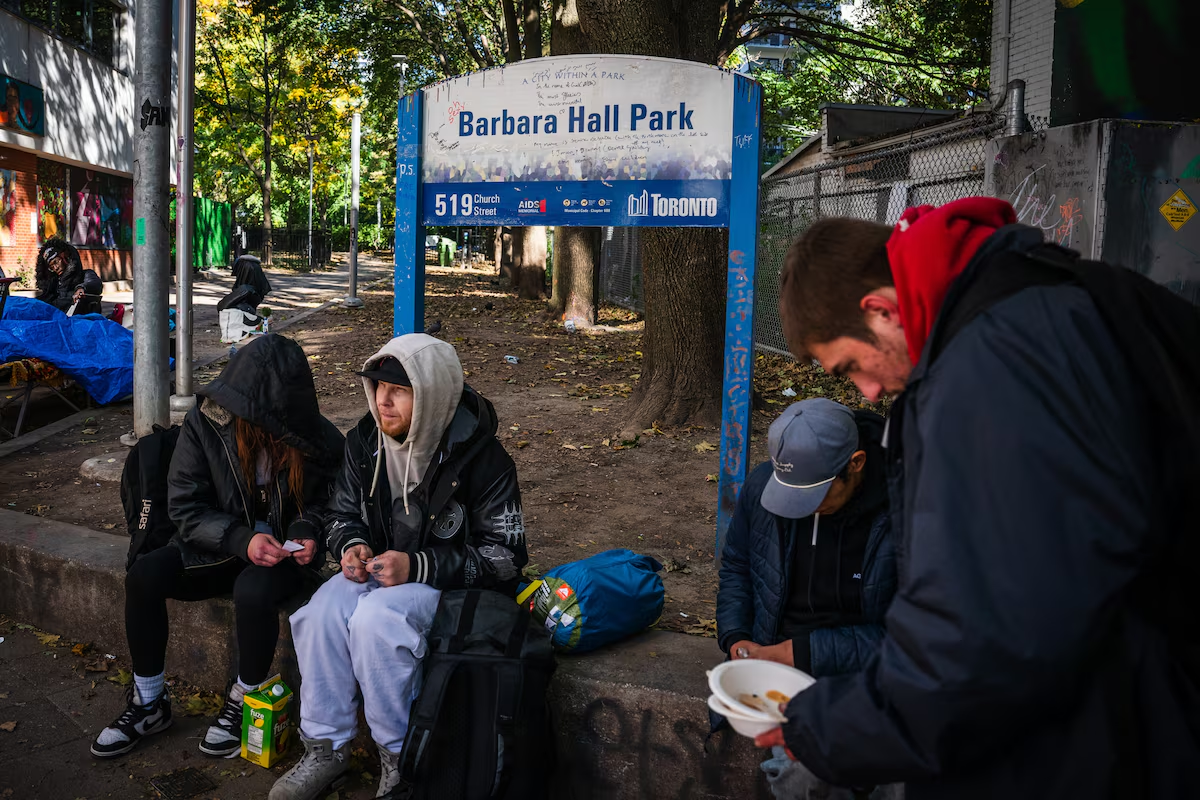
Barbara Hall Park in Toronto’s Gay Village is an unusual kind of park. It has a splash pad and a dog run, but more paving stones than grass. The benches are painted in rainbow colours. It surrounds a community centre called the 519, renowned for advocating for gay rights and social justice.
At the heart of the park is a memorial for the victims of AIDS. Opened in 1993, it features a row of concrete pillars with the names of those who died of the disease engraved on stainless steel plaques.
Barbara Hall, named after a former mayor, was meant to be an inclusive, urban space that honoured gay history and life, but welcomed everyone.
Yet, in recent years, many local residents say it has become something else: A round-the-clock hangout for people dealing with addiction, mental illness and homelessness.
As of Oct. 14, Toronto police had made 227 arrests in the park this year, up from 177 for the same period last year. The charges included assault, theft and possession of drugs for the purpose of trafficking. A hardware store just down the street has had its window smashed.
Unhoused people and security guards keep an eye out for each other in Barbara Hall Park. Shouting matches are common here, and police arrests have been higher in 2026 compared with last year.
Go by the park on any given day, and you are almost sure to see someone drawing on a drug pipe or slumped over in a state of deep intoxication. On one recent afternoon, a skinny young woman wearing only one shoe did a jerky dance, singing an incoherent song. On another, a shirtless man walked out of the park and into the street, stopping traffic.
That upsets neighbours such as Vera Tarman, whose home backs onto the park. As an addiction doctor, she sympathizes with people who find themselves in the thrall of today’s potent street drugs.
But as a proud lesbian who saw AIDS tear through the LGBTQ community in the 1980s and 1990s, she is appalled to see people dealing drugs, strewing garbage and even relieving themselves in a place that is home to a memorial where many people come to remember those they have lost.
Fires, fights and shouting matches break out all the time, she says. Ambulances and police cars pull up, sirens blaring. Ms. Tarman, who is 69, no longer feels comfortable walking through the park with her little dog, Maddie.
She is so exasperated that she finds herself wishing the city would send in more police to clean the place up, a position she is a bit surprised to find herself taking. “That’s not who Vera was 20 years ago.”

Vera Tarman, 69, is upset by what she sees near her home in Toronto’s Barbara Hall Park.
The park, named for a former Toronto mayor, was called Cawthra Square Park when the AIDS Memorial opened there. The nearby Trans Memorial made its debut in 2014.
Her feelings are far from unusual these days. Confronted with scenes of conflict and despair on sidewalks, parks and public transit, even liberal-minded city dwellers are getting fed up, making urban disorder a potent issue in this fall’s cycle of municipal elections.
Some candidates say the answer is to crack down on street disorder, with more policing and even mandatory treatment for those with addictions or severe mental illnesses. Others say the emphasis should be on providing better housing and health care for vulnerable people.
The debate is playing out across the country. In Winnipeg, which will hold its vote on Oct. 28, all the main candidates for mayor are pledging to improve public safety. A recent survey from Abacus Data found that, despite a drop in the crime-severity index, more than two-thirds of Winnipegers felt less safe now than they did four years ago.
In Oshawa, which votes on Monday, drug use and disorder in the heart of the historic automaking community east of Toronto have become a major campaign issue. A months-long police crackdown that just wrapped up led to almost 500 arrests, many for drug-related crimes, according to the Durham Regional Police Service.
In Toronto, city councillor Brad Bradford has made public safety one of the main thrusts of his campaign to unseat Olivia Chow, a former NDP stalwart who is seeking a second term as mayor.
Under the slogan “a city that is not safe is not free,” he is pledging to hire 1,000 police officers, though police stats show a drop in several types of offences.
Open this photo in gallery:
In their campaigns for mayor and councillor, respectively, candidates Brad Bradford and Daniel Tate are courting Toronto Centre with promises of action on public disorder.
The question is what to do about it. The debate is especially sharp in Toronto Centre, a dense downtown ward that, along with the Village, includes soaring condo towers and big public housing estates.
On one side is Daniel Tate, a candidate for area councillor who complains on his website that the city’s “parks and public spaces have been overtaken by crime, disorder and open drug use.” He is the founder of a provocative watchdog group, IntegrityTO, that routinely posts stark videos of urban disorder. He was scheduled to hold a press conference at Barbara Hall on Tuesday, with Ms. Tarman at his side to speak about her concerns.
On the other is Curran Stikuts, a former head of advocacy for the 519 who is also running for council. He says the park has suffered from the province’s decision to cut funding for supervised drug-use sites and the city’s decision to wind up homeless encampments – moves that he says pushed many people to Barbara Hall. “I don’t think that anybody across the political spectrum thinks that it’s acceptable for a parent to have to step over a needle to go use a park,” Mr. Stikuts says. But he thinks the stress should be on help, not enforcement.
Open this photo in gallery:
Curran Stikuts hopes to be elected as councillor in Toronto Centre.
Those who aren’t running for office are divided, too.
Ginette Hahn was passing through Barbara Hall on her daily walk on a recent morning, pushing a shopping cart. She said that, years ago, she was part of a group of mothers who came to the park with their children. Back then, “it was a joy to come here, but now it’s an embarrassment. It’s a drug park, that’s all it is.”
But Rowan Jetté Knox, who has a popular new cafe just down the block, says it would be a mistake just to lower the boom, because “what we are seeing in the park is folks who are not having their needs met at a systemic level.”

Rowan Jetté Knox, who runs the Understory Café on Church Street, acknowledges that problems at the nearby park begin at a ‘systemic level.’
Ms. Tarman has suggested putting a fence around the park and closing it at night, like a cemetery. After all, she said, with the AIDS memorial and a trans memorial just next to it, “We have two sacred grounds there.”
But Joel Moffatt, 43, a long-time crystal methamphetamine user who was visiting the park one day last week, said fencing the park would only force people onto the street, where they would be more visible and disruptive. He said most users don’t take their drugs when families or children are around anyway, so “there’s enough respect here for people and the property” as it is.
At a city hall committee meeting in June, many residents and advocates spoke against the fence idea, but the sitting councillor, Chris Moise, says he is open to putting it forward again if he is re-elected on Monday.
In the meantime, says Mr. Moise, a former police officer and health care worker, the city has put in “layers and layers of supports” to make the park more livable: posting security guards there day and night, sending in squads of health and housing workers, and dispatching cleaners three times a day to sweep up debris. The city, he says, is “using every tool that’s legally available to it.”
That does not wash with Ms. Tarman, who says anyone who passes by the park can see that something is terribly wrong. She is frustrated not just with the condition of Barbara Hall, but with being scolded on Facebook for speaking up about it. “Whenever we complain about something like this, the response is: ‘You’re a bad person,’” she says. “It’s very demoralizing.”

Local Matters: More from The Globe and Mail
The Decibel podcast
In pockets of Vancouver and Toronto, the population has shrunk by up to 40 per cent over 50 years, even as the cities grow overall. Has the solution to the housing crisis been there all along? Architecture critic Alex Bozikovic spoke with The Decibel about the demographics and politics at play. Subscribe for more episodes.
Communities in focus
Toronto: Tackling congestion may be a key issue for mayoral candidates, but it’s not all bad
Sault Ste. Marie, Ont.: Trade war sparks conversations about change
North Bay, Ont.: Plans to demolish birthplace of ringette take spotlight in municipal elections