
Listen to this article
Estimated 4 minutes
The audio version of this article is generated by AI-based technology. Mispronunciations can occur. We are working with our partners to continually review and improve the results.
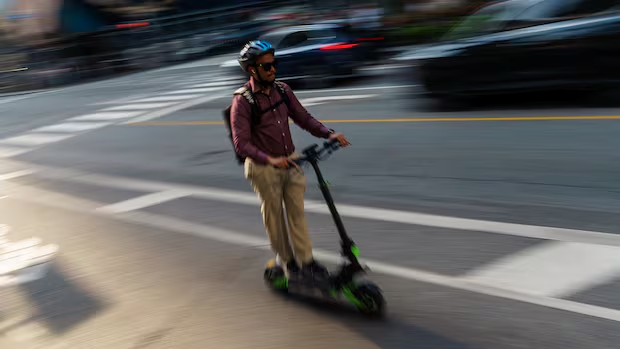
The Montreal borough of Saint-Laurent has adopted a new bylaw banning electric scooters and other motorized personal mobility devices in public areas that fall within its jurisdiction.
That includes city parks, trails and sidewalks.
Vana Nazarian, a city councillor for the borough, says the bylaw was adopted after a series of incidents and near misses over the summer, as the popularity of the devices continues to grow.
“We’re not banning them, but we want to make sure that with the speeds that these scooters have, they stay more on places where vulnerable populations won’t be at risk,” she told CBC’s Let’s Go.
Nazarian added the borough is home to many young families and seniors, and they should be able to use parks and trails without being afraid or at risk of a collision.
She’s hopeful the bylaw will force those who ride e-scooters or e-unicycles and other motorized transportation devices to use them more responsibly.
The move comes just a little over two months after Quebec decided to extend its e-scooter pilot project, even as doctors warned the rules leave children at risk.
The original pilot, introduced in 2023, allowed for anyone 14 and older to use the devices on roads where the maximum speed limit is less than 50 km/h, as well as on bike paths. Helmets are required at all times.
Those rules will still apply along with new restrictions that came into effect on July 18, including a 25 km/h speed limit for e-scooters. Exceeding that limit can result in a $200 fine by police.
14 times more injuries than in 2023
Deborah Friedman, the trauma director at the Montreal Children’s Hospital, says that since the pilot came into effect, the number of e-scooter injuries have skyrocketed.
“We have seen 14 times the number of traumatic injuries related to e-scooters than we did in 2023 when it was first implemented,” Friedman said.
In 2025, there were about 80 cases in total. So far this year, that number is 112.
Friedman, who is also the director of the Canadian Hospitals Injury Reporting and Prevention Program (CHIRPP), said the severity of injuries is also increasing, with close to 20 per cent of the cases requiring hospitalization.
“We’re not talking about little cuts and bruises,” she said.
The injuries include traumatic brain injuries, multiple fractures to the face, lots of facial dental trauma, complicated fractures of limbs and abdominal trauma.
Of particular concern is the age of the victims. Friedman says close to 60 per cent of the children that present at the trauma centre are under 14 years old.
“That’s a problem,” she said.
WATCH | E-scooters spotted on Quebec highway:
E-scooters spotted on Quebec highway reignite calls for stricter regulations
A video of two people riding e-scooters on Highway 125 South in Laval, Que., is prompting safety concerns and calls for stricter rules.
Stronger regulations, better enforcement needed
Friedman commended the borough of Saint-Laurent for its new bylaw and encourages other municipalities to follow suit, but she says more needs to be done at the provincial and federal levels.
Doctors across Canada have been advocating for stronger regulations and better enforcement of the rules.
Friedman said that in Quebec, they’d like to see the minimum age to use an e-scooter increased to 16, as well as a Class 6D licence made mandatory — the same licence needed to operate a vehicle like a moped.
Friedman says younger children don’t have the judgment, skill level, height or control to navigate e-scooters on the road, all while following the rules.
The type of helmets used could also make a difference.
“You need to have something that’s going to protect the face as well,” Friedman said, saying many injuries they see are a result of children “faceplanting and ending up with profound trauma.”
Friedman says e-scooter manufacturers also bear some responsibility with the labelling of their products and how they are sometimes marketed as though they are toys.
With the holidays around the corner, this type of issue is of particular concern, Friedman says.
“So we’re trying to work at different levels to try to sensitize the public and encourage policymakers to hear our concerns and to base decisions on real data,” she said.
“Each number that I mentioned is attached to a child, which is attached to a family, which is attached to a community.”