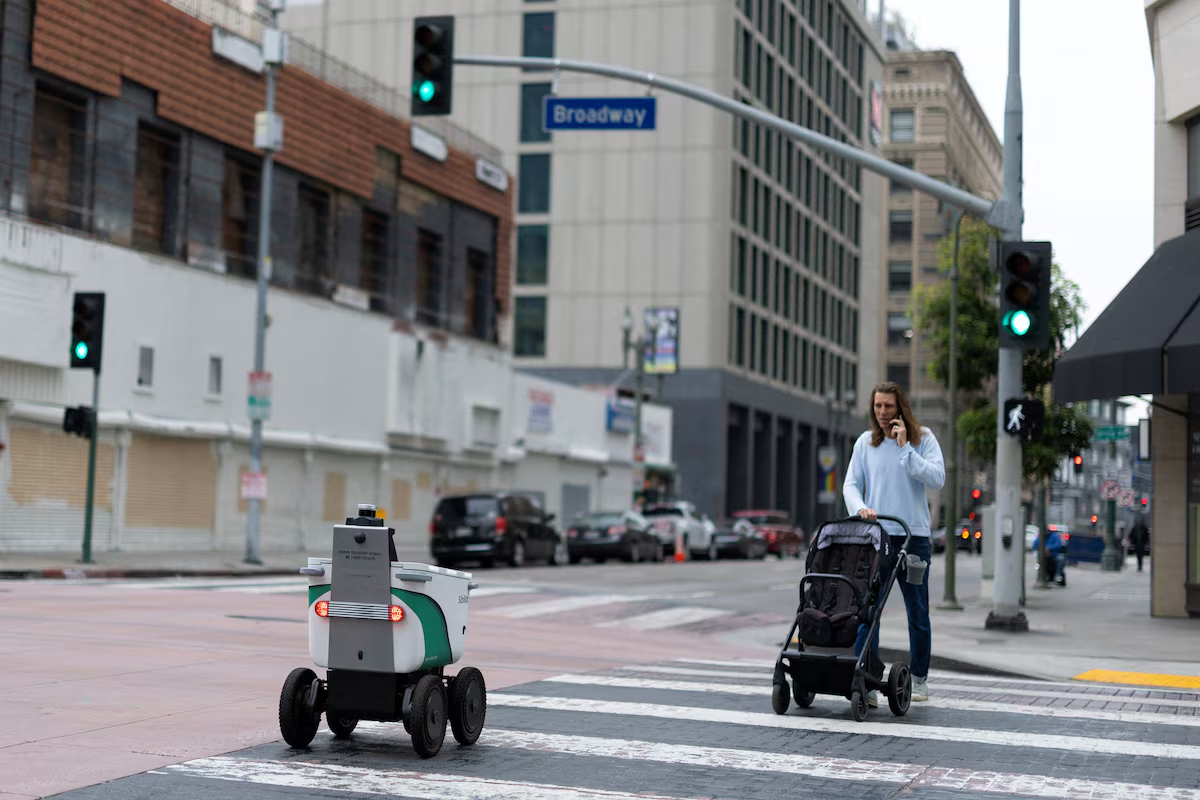

Open this photo in gallery:
A food delivery robot in Los Angeles. AI is becoming more common in the workplace, and billionaire Bill Gates thinks taxing robots would help deter companies from replacing human workers.Mike Blake/Reuters
In a widely publicized recent interview with American political commentator and journalist Ezra Klein, tech billionaire Bill Gates revisited an idea he has long heralded as a solution to the threat of automation on jobs: a robot tax.
Specifically, Mr. Gates posited that as artificial intelligence becomes more embedded in white-collar workplaces, robot workers should be required to contribute to payroll taxes to deter businesses from replacing human employees entirely.
“You define a unit of labour and say, independent of whether that’s delivered by a human or robot, you are paying the same FICA tax that a human worker would pay,” Mr. Gates said, referring to the U.S. payroll tax. He added that taxing AI or robots would ultimately ensure continued revenue for the government when human jobs are replaced en masse.
Startups are hiring low-paid gig workers to train robots on manual labour
The idea of a tax solution to the threat of mass job upheaval by AI has previously surfaced in certain academic and tech circles; Mr. Gates first called for it in 2017. Yet as global AI chief executives call for slowing the pace of development and tech leaders including Mr. Gates amplify their warnings that many jobs are at risk of disappearing forever, the debate has returned to the spotlight.
Any such tax policy, proponents argue, would help disincentivize companies from laying off workers and would serve to boost government revenue, which would then effectively get redistributed among workers.
But some economists and tax experts are skeptical that it would address wealth inequality potentially resulting from AI shaking up the work force.
“If you want to collect taxes because you are worried about inequality arising from technology, then you obviously tax the people who own the technology,” Jim Stanford, an economist and director of the Vancouver-based Centre for Future Work, said in an interview.
Mr. Stanford argued that the emerging robot-tax discourse distracts from the public dialogue about more immediate and concrete policy solutions to AI-driven inequality – for instance, imposing a wealth tax on billionaires who have already benefited from the deployment of AI in the work force.
Business Brief Newsletter
A daily look at the most important business stories that are making news and moving markets, written by Chris Wilson-Smith
Unsubscribe any time. By signing up, you will be subject to our Terms and Conditions. See our Privacy Policy. Learn more
Already have account? Log In
Increasing income inequality in Canada is already a big policy problem and AI could certainly exacerbate it, said Jennifer Robson, a tax-policy expert and associate professor of political management at Carleton University. “If AI displaces labour and further concentrates returns to capital, then yes, taxation is one tool for redistribution to offset that shift,” she said in an interview.
But if governments treat AI agents and robots as taxable entities themselves – as proposed by Mr. Gates – then they would have to neatly and accurately figure out what unit of human labour has been replaced, Prof. Robson said. “What is the income stream that we would be taxing? How do you assign a dollar value?”
Fitting a robot tax into Canada’s present tax regime would also be challenging, she added. As one example, taxing corporations that purchase and use AI or robots would run counter to Prime Minister Mark Carney’s recent Productivity Mega Deduction, which incentivizes capital investment by companies to boost productivity. “For tax policy coherence, you can’t both deduct capital investment and then impose something like a robot surtax on that same capital investment,” she said.
In a recent paper published in the Chicago Booth Review, Raghuram Rajan, a former governor of India’s central bank, wrote that one way to “tax AI” would be to base it on the AI tokens a company uses. Tokens are used to measure how much data an AI agent uses to perform a task.
Mr. Rajan argued that such a tax is crucial because governments need to minimize potential job losses and thus “maintain social solidarity.” The precise tax rate would need to be carefully calculated to “avoid impeding AI deployment,” but could be set low initially and gradually increased, he said.
In discussing a robot tax, some have questioned the very need for a tax solution to possible AI-led job displacement. In Canada, despite signs of weak hiring in coding and customer-service positions, there’s still no clear, data-driven evidence that AI has resulted in widespread job losses.
Prof. Robson acknowledged the confusion of “disparate estimates floating around” about the projected change in demand for human labour resulting from AI. She said that ultimately, policy solutions should focus on regulation rather than taxation.
“I’m just not clear if we have strong evidence to set tax rates and enforce new rules,” she said.
Mr. Stanford said he believes there is a low risk of white-collar jobs shrinking to the extent that it affects the income tax base.
In the near term, he said, the greater threat of job losses comes from the growing AI bubble, and the trillions of dollars in capital that hyperscalers such as Amazon, Microsoft, Google and Meta are investing in computing and data centres with borrowed money.
“This is competition run amok, and when that bubble bursts, there will be a financial crisis and unemployment,” Mr. Stanford said. “That’s what we should be more worried about.”